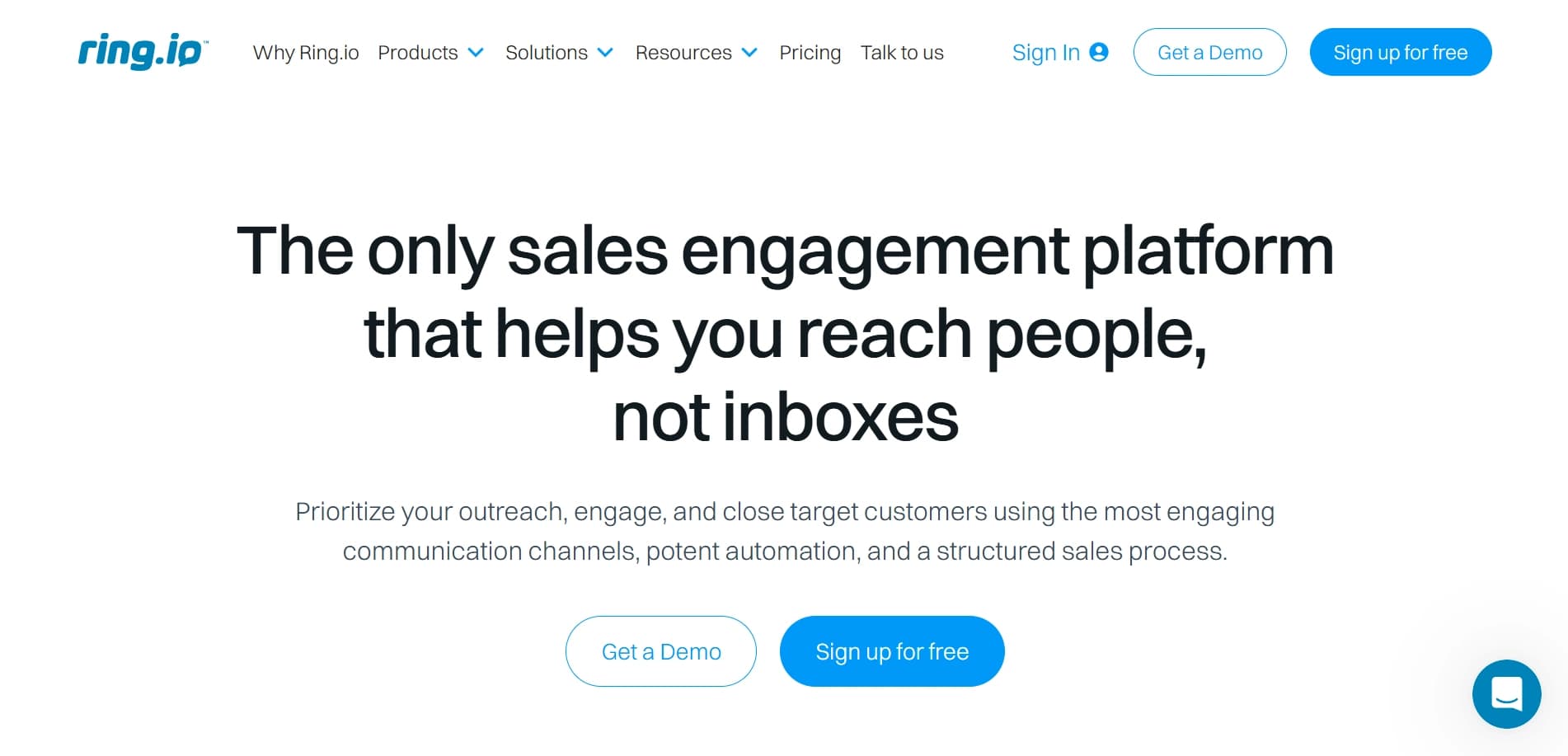
Ring.io positions itself as a purpose-built sales engagement platform designed to “accelerate sales productivity” through high-velocity dialing technology and deep CRM embedding.
According to Ring.io, the platform empowers sales organizations to bridge the gap between representatives and their data by fusing power dialing, workflow automation, and telephony into a single, CRM-centric interface.
In this review, we take a closer look at Ring.io by analyzing what the company claims to offer, how users describe their experiences across platforms like G2, Capterra, and Trustpilot, and what potential buyers may want to consider before committing in 2026.
Ring.io Overview
Ring.io presents itself as a solution primarily for inside sales teams, SDRs, and high-volume recruitment squads that need to execute intense outreach campaigns without the friction of disjointed phone systems.
It is commonly marketed as a tool that prioritizes seamless workflow, using “CRM-embedded dialing” to ensure reps never have to switch tabs or manually log data, a frequent efficiency killer in the industry.
According to the platform, key capabilities include:
- Multi-channel support (Voice, SMS, Email)
- Local Presence (Connection Rate Optimization)
- Intelligent Power Dialer
- Deep CRM integration (Salesforce, Zoho, HubSpot, Pipedrive)
- Smart Call Routing & IVR
- Real-time leaderboards and analytics
- Mobile App for remote sales
- Automated Voicemail Drop
Does Ring.io actually deliver these results for real users?
To answer that, we analyzed reviews across multiple reputable platforms to see what real sales teams are experiencing. Let’s break it all down.
User reviews and ratings
On G2
Rating: 4.5/5 (50+ reviews), with a significant majority of reviewers awarding 4 or 5 stars. From the “Pros & Cons” summary generated from user reviews, the most frequently mentioned positives are:
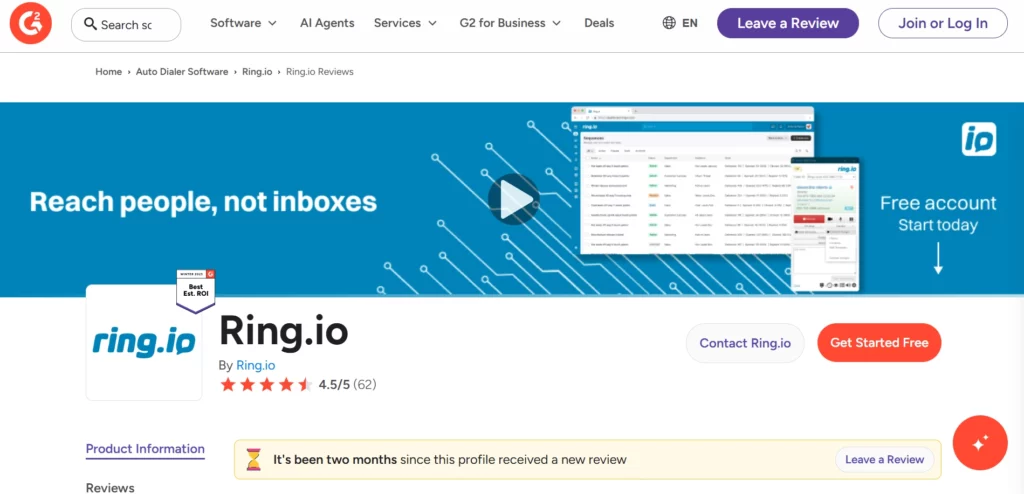
- Customer Support Quality (Frequent mentions)
- Salesforce/Zoho Integration Depth (Frequent mentions)
- Ease of Implementation (Multiple mentions)
- Call Quality & Stability (Multiple mentions)
- Workflow Automation (Multiple mentions)
On the negative side, a smaller number of reviewers mention:
- UI feels slightly dated (Several mentions)
- Occasional connection jitter (Some mentions)
- Learning curve for advanced routing (A few mentions)
- Desire for more modern reporting visuals (A few mentions)
(Credit: G2)
On Capterra
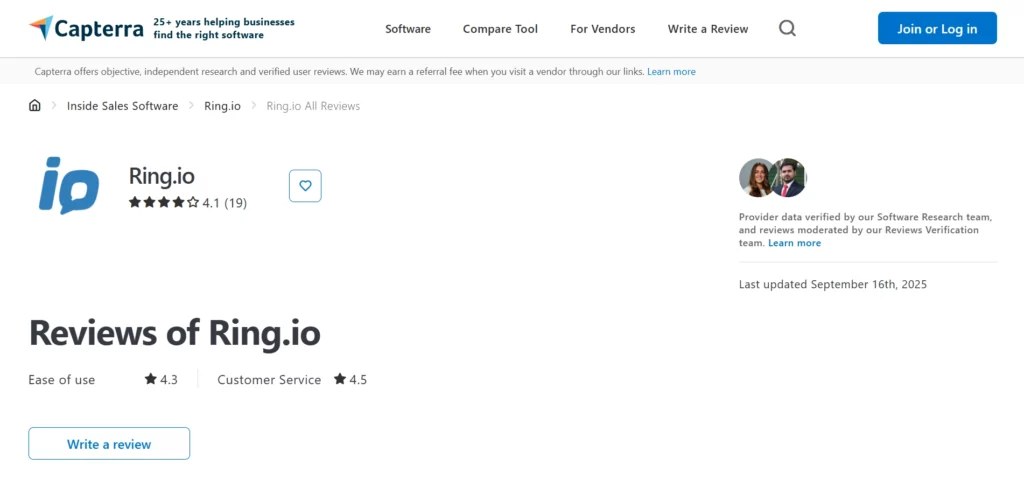
Rating: 4.1/5 (15+ reviews), based on verified user feedback from Capterra and its affiliate network (GetApp). Users frequently highlight the platform’s straightforward utility for small to mid-sized teams.
Pros mentioned by users:
- Ease of Use: Reviewers often praise the “Web Phone” for its intuitive design, allowing new hires to start dialing immediately without complex training.
- Zoho & HubSpot Sync: Users specifically commend its tight integration with Zoho and HubSpot, often finding it performs better than native dialers.
- Customer Support: Similar to G2, Capterra users frequently mention the support team’s helpfulness during onboarding.
Cons mentioned by users:
- Interface Design: Several reviews describe the UI as “ugly” or functional but lacking the polish of modern SaaS tools.
- Connectivity Sensitivity: Some users report that the browser-based phone is highly sensitive to internet fluctuations, requiring a stable connection to avoid “choppy” audio.
(Credit: Capterra)
On Trustpilot
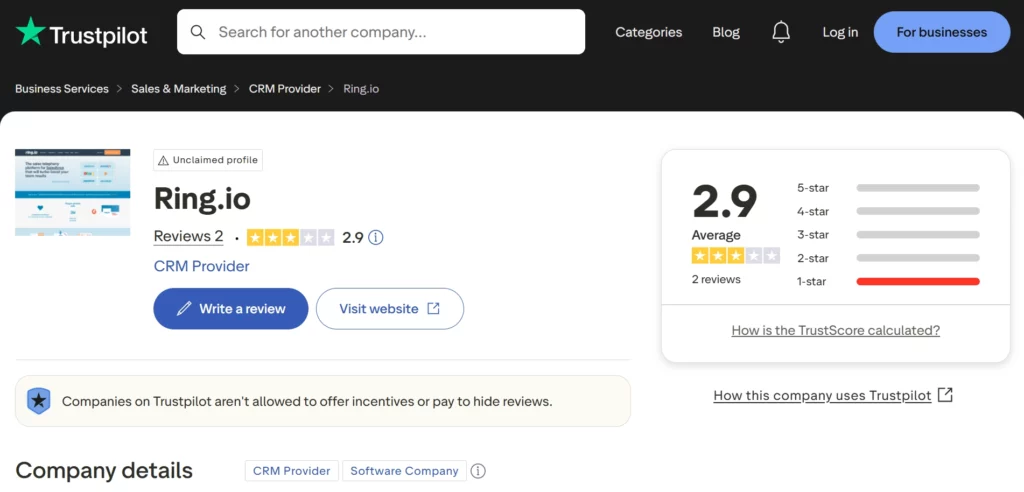
Rating: 2.9/5 (1+ reviews), based on a limited number of reviews. Unlike general consumer apps, Ring.io’s B2B user base is less active here, focusing more on specialized platforms like Salesforce AppExchange.
Pros mentioned by users:
- Core Functionality: Early reviewers acknowledge that the dialer reliably connects calls and logs data for small teams.
- Niche Focus: Users appreciate that it is a dedicated CRM solution rather than a generic VoIP system that clutters their workflow.
Cons mentioned by users:
- Limited Public Feedback: The primary drawback of this platform is the lack of recent, detailed, verified reviews compared to G2 or Capterra.
- Setup Hurdles: Some users have noted that initial configuration without support guidance can be tricky for non-technical admins.
(Credit: Trustpilot)
Review Authenticity
Each platform applies its own moderation and verification processes.
- G2 requires account verification and uses internal checks to reduce inauthentic reviews, often soliciting feedback after verified usage via LinkedIn.
- Capterra: Capterra employs a rigorous manual verification process where a team of experts checks each submission for authenticity, often encouraging users to sign in via LinkedIn to validate their professional identity.
- Trustpilot: Trustpilot uses 24/7 automated fraud-detection software to identify suspicious patterns and allows businesses to generate ‘Verified’ reviews through official invitations, ensuring feedback is tied to genuine transactions.
On G2, Capterra, Trustpilot, and many Ring.io reviews are labeled as Verified Current User, indicating they authenticated via a business email or professional network.
Another useful signal is timing. Reviews for Ring.io appear steadily over time rather than being clustered into a short marketing push window.
This consistent feedback loop suggests that user sentiment is organic and reflects ongoing usage rather than a coordinated campaign.
Overall, the publicly available metadata shows a strong product with a solid reputation in the SaaS sector, despite some critiques of the interface aesthetics.
Pros & Cons
Ring.io’s pros
- CRM-First Architecture: Users consistently cite Native Integration as a critical benefit, eliminating manual data entry by automatically logging every call, recording, and note in Salesforce or Zoho.
- Local Presence: Many reviewers mention that the dynamic local area code feature is a game-changer, allowing reps to connect with prospects who would otherwise ignore out-of-area numbers.
- Productivity Gains: The ability to utilize features like “Click-to-Call” and “Power Dialing” to speed through lead lists is frequently mentioned as a major efficiency win.
- Support Responsiveness: Users appreciate the US-based support team, often noting that issues are resolved quickly compared to larger telecom giants.
- Flexibility: An adaptable IVR and routing system allows managers to configure call flows exactly how their specific sales floor operates.
Ring.io’s cons
- User Interface: A notable number of reviewers find the visual interface less modern than newer competitors, citing a “utilitarian” look rather than a sleek SaaS aesthetic.
- Reporting Visualization: Unlike some dedicated BI tools, Ring.io’s reporting is functional but may feel too tabular for managers who prefer instant graphical dashboards.
- Carrier Costs: Some users note that high-volume SMS compliance (10DLC) costs, while industry-standard, add complexity to billing.
- Mobile Experience: A few users mention that while the desktop app is powerful, the mobile experience can feel like a “lite” version with fewer advanced admin controls.
Don’t invest in any tool before…
Considering the following tips:
- Check multiple review platforms to ensure consistent user feedback regarding integration stability with your specific CRM version.
- Look at the “hidden costs” of usage; ask specifically about per-minute overage rates and international dialing fees. To get a complete picture of their Startup, Growth, and Enterprise tiers, we can check out this detailed Ring.io pricing breakdown.
- Research what people are saying on sales communities about specific browser compatibility (e.g., does it work best on Chrome or Firefox?).
- Ask fellow sales leaders about their experiences with the onboarding process and how long it takes to train new reps.
Ultimately, the best provider is one that will give your sales team a massive efficiency boost and make the prospect experience seamless.
However, if it doesn’t quite match our needs or budget, we can explore the best Ring.io alternatives on the market.
Ring.io is a powerhouse option for CRM-heavy sales teams, but if your main focus is simple, high-volume automated outreach…
Consider VoiceDrop as an Alternative
If you’re looking for a streamlined, AI-powered ringless voicemail solution without the complexity of a full CRM-integrated phone system, VoiceDrop is an ideal choice for sales teams, outreach specialists, lead generation agencies, recruiters, and business owners.
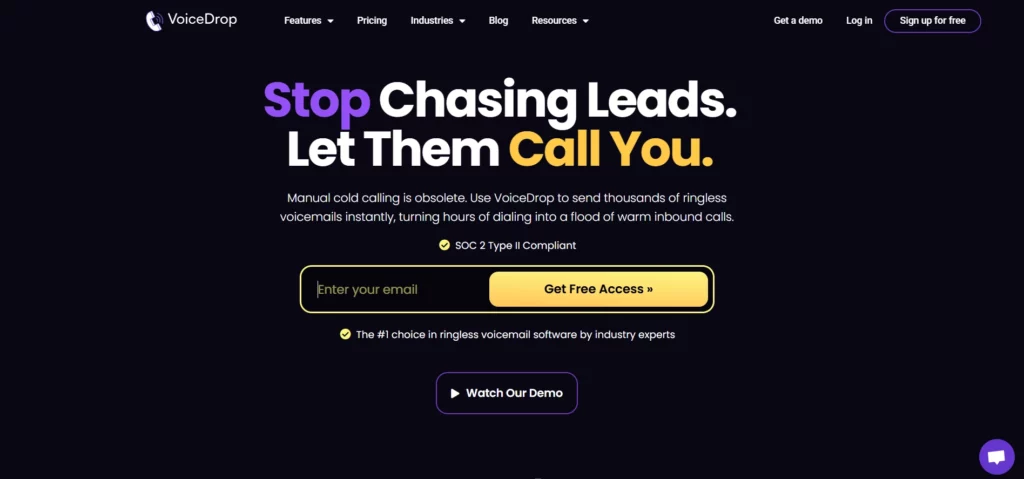
Unlike Ring.io, which is built for complex live sales conversations and deep database management, VoiceDrop offers scalable automation that works in the background to deliver messages directly to voicemails.
Starting at $95 per month, VoiceDrop lets you send up to 1,000 ringless voicemails. The ENTERPRISE plan guarantees the best market pricing for high-volume needs.
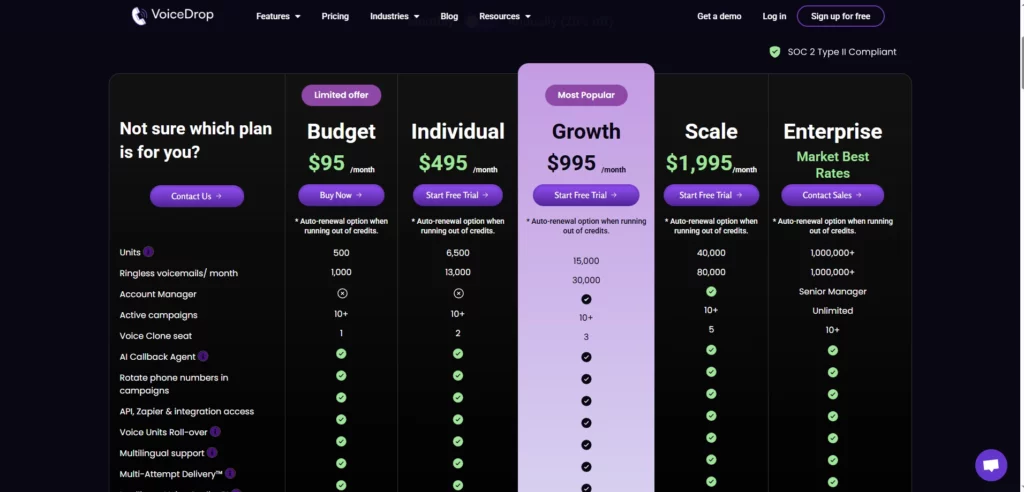
Some of its features include:
- Use a phone number you already own
- 10+ active campaigns
- Voice Clone seat(s)
- Rotate phone numbers in your campaign
- API, Zapier, Make & CRM integration access
- Voice Units Roll-over
- Multilingual support
- Multi-Attempt Delivery™
- Intelligent Voice Scaling™
VoiceDrop also offers a 7-day free trial so you can experience its capabilities firsthand.
Grab your free trial and get started today!