
Free SMS Spam Checker
Paste a text to see which words US carriers filter, how to fix each one, and a cleaner version to copy.
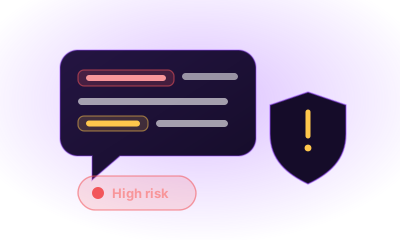
Problem words get marked in your text as you type.
Carriers filter texts silently, and no dashboard shows it.
When a carrier filters your text, you usually don't get an error. The dashboard says “sent,” the recipient gets nothing, and your reply rates quietly crater. Carriers do this by scoring every message against patterns learned from billions of scam texts, which means legitimate businesses get caught for sounding like scams, not for being one. Inside VoiceDrop, the same checker also learns from each account's own delivery history.
Some offers are restricted whatever the wording.
Carriers judge these by what the text offers, so no rewrite fixes them.
- Debt relief or credit repair. Carriers ban debt relief offers. Rewording won't get them through.
- Loan or credit offer. Only the lender itself can text loan offers, on a registered direct-lending campaign.
- Cannabis or CBD. Banned on every US number, even in states where it's legal.
- Gambling or sweepstakes. Most carriers refuse betting offers. Sweepstakes need an approved short code.
- Income or investment pitch. Carriers ban income and investment promises. Take the claim out.
- Prescription drugs. Drug offers are banned. Take the drug name and the offer out.
- Tobacco, vaping or firearms. Age-restricted, and many providers refuse it. Ask yours before sending.
- Alcohol. Allowed only to people who gave a birth date when they signed up.
Source: CTIA Messaging Principles.
SMS deliverability stands on three legs.
- Registration. US business texting runs on A2P 10DLC: your brand and campaign get vetted and registered with The Campaign Registry. Unregistered traffic is throttled or blocked outright, regardless of copy.
- Copy. This is the leg the tool checks: the wording patterns spam models score. Write like a person texting a person: name yourself, say why you're texting, one clear ask, full URLs, and an opt-out.
- Behavior and list quality. Sudden volume spikes, high invalid-number rates, and missing opt-out honoring all burn sender reputation. Clean your list first; the phone number formatter catches dead and duplicate numbers before they hurt you.
Here are answers to 7 questions about why texts don't get delivered.
Want deliverability handled for you?
VoiceDrop registers your traffic, screens copy against live rejection data from your own sends, rotates message variations automatically, and pairs SMS with ringless voicemail in your own voice.
Keep your outreach sharp
Every tool runs free in your browser, with no signup and no limits.
Phone Number Formatter
Clean, dedupe, and validate a whole phone list in your browser. E.164 or (xxx) xxx-xxxx, with state tagging.
Voicemail Greeting Generator
Professional voicemail greeting scripts for any situation. Pick a use case and tone, then copy or listen.
SMS Character Counter
Live segment calculator with GSM-7 vs Unicode detection. See exactly which character doubles your SMS cost.
TCPA Calling Hours Calculator
Enter a number or pick a state. See if you can legally call right now, with federal and state windows.
Best Time to Send
Paste a list and get one send time per time zone: 5 pm their time, from VoiceDrop call data, checked against state calling hours.
Ringless Voicemail Cost Calculator
The Callback Math for your list: delivered voicemails, callbacks, and cost per callback on VoiceDrop's real per-unit pricing.
Ringless Voicemail Script Generator
Sales voicemail-drop scripts by industry, with a pacing meter that keeps you in the 15-30 second sweet spot.