
What Is Ringless Voicemail?
Deliver a prerecorded message straight into a voicemail inbox without the phone ringing. Your contacts listen when it suits them, then call you back.
Ringless voicemail, also called a voicemail drop or direct-to-voicemail, is a way to deliver a prerecorded message straight to someone's voicemail inbox without their phone ringing. The recipient still gets a normal voicemail notification, so they listen when it suits them instead of being interrupted mid-day.
Sales, collections, and marketing teams use it to reach thousands of contacts in one send and then work the callbacks, instead of dialing one number at a time. The walkthroughs below use VoiceDrop's ringless voicemail service for the concrete numbers and screenshots, but the mechanics are the same on any provider. Below: how the delivery actually works, what it costs, where the legal line sits, and how to choose a platform.
Median callback rate quoted in named customer reviews (4.7% to 11.7%)
Per delivered static drop on VoiceDrop; a failed drop costs nothing
In free credits to start, no long-term contract
How Does Ringless Voicemail Work?
A ringless voicemail platform never places a normal call. It connects to the carrier's voicemail platform and deposits the audio file directly, which is why the handset stays silent.
- 1Step 1
Upload and validate your list
Import contacts from a CSV or straight from your CRM. Phone validation checks each number's line type and drops anything that cannot receive a voicemail, so you are not paying to fail.
- 2Step 2
Record or clone the message
Record a message once, or clone your own voice and let the platform generate a personalized version per contact. See voice cloning voicemail for how the cloning step works.
- 3Step 3
Deliver server to server
The platform opens a connection to the recipient's carrier voicemail server and deposits the audio there. No call is placed to the handset, so there is no ring and no missed-call entry. How ringless voicemails work covers the routing in more detail.
- 4Step 4
Take the callbacks
Contacts see a voicemail notification, listen, and call back on their own time. Delivery and callback events report per contact, so you can tell which list and which script actually worked.
$20 in free credits, about 200 voicemails, cancel anytime.
Start My Free Trial
What a campaign looks like in practice
The campaign builder runs the compliance checks for you
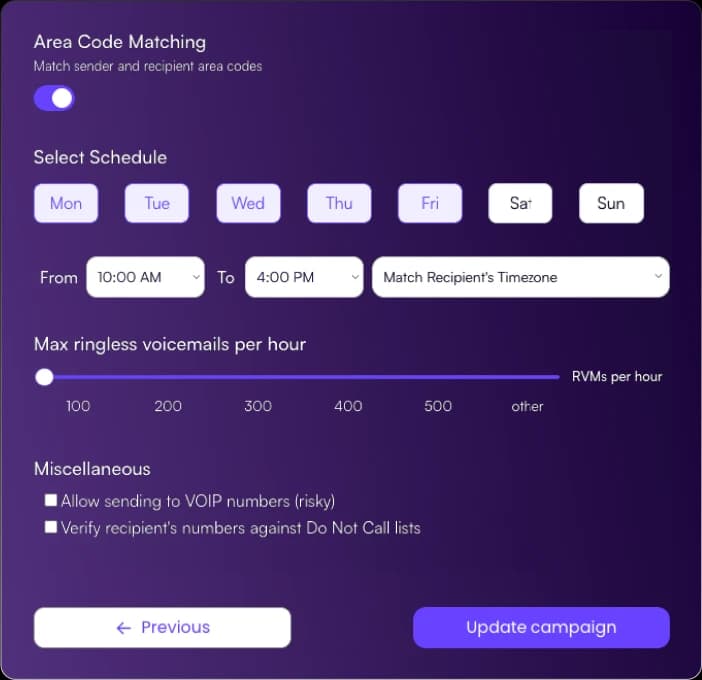
Every send starts in one screen: name the campaign, pick your sender numbers, and launch. The guardrails the legal section below describes are switches here, not policy documents.
- DNC suppression scrubs the list before a single message goes out
- Line-type validation drops landlines that cannot take a voicemail
- Calling windows keep delivery inside each recipient's local hours
Callbacks come back like returned calls
The message sits in voicemail in your own voice, so the callback dials the number you sent from and lands on your team like any other returned call. Route callbacks to your reps, or let the AI Inbound Agent (closed beta) qualify and book while your lines are busy.
Throttle delivery to the pace your team can answer
A list of 20,000 contacts does not have to mean 20,000 callbacks by lunch. Set sends per hour so the phones ring at a rate your closers can actually work, and spread a campaign across days without babysitting it.
Ringless voicemail versus the alternatives
What each channel does mechanically. No response-rate estimates here: those vary too much by list and offer to be worth quoting.
| Ringless voicemail | Cold call | SMS | ||
|---|---|---|---|---|
| The phone rings | - | - | - | |
| Recipient must answer to get the message | - | - | - | |
| Delivered in your own voice | - | - | ||
| Recipient can replay it later | - | |||
| Sends at campaign scale with no rep dialing | - |
A cold call only leaves a replayable message if the recipient misses it and you leave one manually.
What to expect from a ringless voicemail platform
Carrier-grade delivery
Server-to-server delivery built for inbox rate. VoiceDrop adds Multi-Attempt Delivery™ on numbers that do not take the drop first time.
Pay per successful delivery
You should be billed on delivery, not on the attempt. On VoiceDrop, failed drops cost nothing and every delivery carries a verifiable recording.
Consent and DNC tooling
Built-in phone validation, do-not-call suppression, and calling-window controls. VoiceDrop runs these on a SOC 2 Type II certified platform.
The callback rates behind the numbers above
Named customers, Trustpilot reviews: three of the reviews behind the callback figure above, in their own words.
“Instead of dealing with the hassle of cold calling, we now leave personalized, AI-driven voicemails that get noticed - and the results speak for themselves. Our callback rate skyrocketed from 1% to 9% in just a month.”

Nick
1% to 9% callbacks in a month · Trustpilot review
“Cain went above and beyond to ensure our campaigns were optimized for our target market. His insights helped us achieve a 9.2% callback rate.”

Ido Shacham
9.2% callback rate · Trustpilot review
“The AI voice cloning sounds natural and keeps my messages personal, without the intrusion of a phone call. I've seen a 7.3% callback rate, and the platform has essentially paid for itself.”

Benjamin Levenbach
7.3% callback rate · Trustpilot review
What Sending Ringless Voicemail at Scale Taught Us
Most of what follows is in no provider's brochure. It is what operating the delivery side of ringless voicemail teaches you, and each lesson is built into how VoiceDrop sends.
Callbacks are the metric. A campaign can show a healthy delivery percentage and still fail if nobody rings back. Routing that delivers more and produces fewer callbacks is a downgrade, so VoiceDrop tunes routing, sender numbers and send timing for callbacks, and reports delivered and callbacks per contact so you can see exactly what each list and script produced.
We send on the highest quality carrier routes on the market. Carrier quality is the biggest lever on how many people call back: two campaigns with identical delivery numbers can return very different numbers of callbacks depending on the route they travelled. VoiceDrop delivers through premium carrier routes, ranks every one of them on the callbacks it produces, measures that continuously, and puts a new route in front of customer traffic only after weeks of testing.
Every delivery is verified and failed drops are free. Full voicemail boxes, disconnected numbers and carrier filtering are facts of the channel on any platform. VoiceDrop retries them automatically with Multi-Attempt Delivery™, bills only for delivered voicemails, and attaches a verifiable recording to every one, which is also why a clean list matters more than a clever script.
Sender numbers stay fresh and local. Carrier spam filters tag any outbound number over time, and a tagged number stops getting called back. VoiceDrop tests sender numbers continuously and rotates flagged ones out before callbacks are affected, and every campaign sends from the recipient's own area code by default because it measurably lifts callbacks: in our call records, a caller ID from the recipient's own state got 65% more callbacks than an out-of-state number.
Compliance is built into the send. Every list is validated for line type and scrubbed against do-not-call lists before a single voicemail goes out, and every send is held to the recipient's local calling window. A disconnected number or a do-not-call registrant is removed before it can cost you a complaint, so the rules are enforced by the platform rather than remembered by your team.
Taken together, those lessons are why the three numbers worth tracking are delivered voicemails, callbacks, and cost per callback (we call it the Callback Math), and why the free ringless voicemail cost calculator is built around cost per callback rather than cost per send.
Who Uses Ringless Voicemail?
Any team that runs outbound at volume, but the returns concentrate in a few industries. Real estate and wholesaling teams use it to win the race on speed-to-lead. Debt collection agencies treat it as a compliant, lower-friction touch than a call. Car dealerships mine databases of past customers for service and trade-in offers.
Solar and home-services installers book appointments off aged leads. Mortgage brokers reach rate-sensitive borrowers the moment terms move. Nonprofits and political campaigns mobilize large lists quickly on small budgets.
Ringless Voicemail Best Practices
Keep the message 15 to 30 seconds: long enough to say who you are and why you called, short enough that it gets played to the end. Make one clear ask (call back, or reply by text), say the callback number slowly, and sound like a person leaving a real voicemail rather than an ad being read out. Crafting voicemail messages covers scripts that convert, and a script generator can draft one from your offer.
Operationally: validate the list first so you are not paying to reach dead numbers, send inside each recipient's local calling window (5 p.m. in their time zone drew the most callbacks in our own call data, and half of all callbacks came within 8 minutes), and throttle delivery to the callback volume your team can answer. Then judge the campaign on the Callback Math, the three numbers that decide whether it paid for itself: delivered voicemails, callbacks, and cost per callback, never raw sends. The ringless voicemail cost calculator runs those three on your own list size and our published prices, and measuring voice campaigns shows where each number lives in the reporting.
How Much Does Ringless Voicemail Cost?
Across the market, pricing splits into pay-per-delivery and bundled monthly plans. The number that matters is not the headline rate: it is whether you pay for attempts or only for messages that actually land, and whether unused credits expire.
Static drops generally run $0.01 to $0.10 per successful delivery across the market. VoiceDrop plans start at $95 per month for 500 voice units, which covers 1,000 static ringless voicemails since a static drop costs half a unit, and scale to $1,995 per month for 80,000 static drops; unused units roll over for 90 days. Full tiers are on pricing, and the ringless voicemail cost guide works through monthly examples at 1,000, 10,000, and 30,000 drops. To price your own list, the cost calculator turns a list size and expected delivery and callback rates into voice units, the plan that fits, and cost per callback.
What the major providers charge
Published pricing as of 2026, simplified. Verify current rates on each provider's site before you commit.
| Provider | Typical cost per drop | Billed on | Free trial |
|---|---|---|---|
| VoiceDrop | ~$0.10 at entry, ~$0.025 at scale (plans $95-$1,995/mo) | Successful delivery only | $20 in credits, about 200 messages |
| Slybroadcast | ~$0.10 at 100 drops, ~$0.04 at 10,000; monthly credits expire | Delivery | None; ~$10 starter pack with refund |
| Drop Cowboy | Monthly plans plus a per-message compliance fee | Per message, plus add-on fees | 24-hour, $125-capped guarantee |
| LeadsRain | ~$0.02 entry, toward $0.015 at volume, plus ~$0.002 DNC scrub | Delivery; credits expire ~90 days | None advertised |
| Call Loop | 2 credits per drop, about $0.066-$0.12 effective | Credits, per delivered drop | 14 days, 25 credits (~12 drops) |
Rates from each provider's published pricing, compiled 2026. The cost guide linked above carries the sources, the hidden fees, and worked monthly examples. Prices change: verify on the provider's site.
Plugs into the tools you already run
Trigger a campaign from your CRM, forms, or automation stack, and write delivery and callback events back the other way.












Is Ringless Voicemail Legal?
Yes, when you have consent. The important detail is that not ringing the phone does not exempt you: in a 2022 declaratory ruling (FCC 22-85, adopted November 21, 2022) the FCC held that a ringless voicemail sent to a wireless number is a call using an artificial or prerecorded voice under the TCPA, rejecting the industry petition that asked it to rule the other way. Under the FCC's telemarketing rules that means prior express consent for wireless numbers, and prior express written consent where the message is marketing.
In practice: collect and log consent, honor do-not-call and opt-out requests, respect calling-window rules, and check state law, which is stricter than federal law in several states. VoiceDrop ships DNC suppression, phone validation, and calling-window controls to support that, and the platform is SOC 2 Type II certified. Read are ringless voicemails legal for the full picture and TCPA compliance for the tooling. None of this is legal advice: check your campaigns with your own counsel.
How to Choose a Ringless Voicemail Platform
With several providers on the market, selecting the right voicemail drop software decides whether a campaign clears its cost. Five things separate them: delivery model (per attempt or per successful delivery), whether credits expire, whether there is a real free trial, whether voice cloning is included or an upsell, and whether there is a documented API rather than a Zapier-only integration.
Worth checking before you commit: Slybroadcast and Drop Cowboy both run monthly plans, and Drop Cowboy layers a per-message compliance fee on top. SlyDial caps a group send at 10 recipients, so it is a consumer tool rather than a campaign platform. Call Loop charges two credits per drop, which changes the effective rate. The best ringless voicemail services roundup compares them side by side, and VoiceDrop vs Drop Cowboy and VoiceDrop vs Slybroadcast go deeper on the two largest.
If you are wiring this into your own product, the ringless voicemail API covers REST endpoints, webhooks, and voice cloning, and integrations lists the CRMs and automation tools already connected.
Ringless Voicemail FAQ
Send your first ringless voicemail today
Start with $20 in free credits, about 200 messages, and no long-term contract. Or book a live demo and see a campaign run end to end.