
SMS Character Counter & Segment Calculator
Live character count, GSM-7 vs Unicode detection, and per-segment cost math, using the same segment engine VoiceDrop runs in production. Find the one character that's doubling your bill.
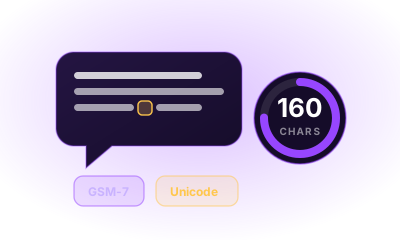
0
Characters
N/A
Encoding
0
Segments
160
Left in segment
of 160/segment
What does this cost at scale?
N/A
$0 / send
Most US providers bill per segment, per recipient. Trimming one segment off a 1,000-contact blast saves $10.00 every send.
How SMS length actually works
Every text message travels in one of two encodings. GSM-7, the original 1980s SMS alphabet, packs 160 characters into one segment. Unicode (UCS-2) handles everything else (emoji, non-Latin scripts, smart punctuation) but fits only 70 characters per segment. There is no in-between: a single non-GSM character flips the entire message to Unicode.
| Encoding | Single message | Per segment when split |
|---|---|---|
| GSM-7 | 160 characters | 153 characters |
| Unicode (UCS-2) | 70 characters | 67 characters |
The usual culprits aren't emoji you added on purpose. They're characters pasted in from Word, Google Docs, or ChatGPT: curly quotes (“ ” ’), em dashes, ellipses (…), and invisible non-breaking spaces. They look identical to their plain cousins and cost you 90 characters of capacity.
Why segments decide your campaign budget
Providers bill per segment, per recipient. At a typical $0.01 per segment, the same announcement to 25,000 contacts costs $250 as one tight GSM-7 segment, or $750 if smart quotes pushed it to three Unicode segments. Multi-segment messages also see more carrier filtering, so the long version can cost triple and deliver worse. Before you send, run the copy through the SMS spam checker too. Length is one of the risk signals it scores.
Here are answers to 6 questions about SMS length and segments.
Counting characters is the easy part.
VoiceDrop sends two-way SMS at wholesale rates alongside ringless voicemails in your own AI voice, with segment-aware previews built into the composer, so campaigns never surprise you on cost.
Keep your outreach sharp
Every tool runs free in your browser, with no signup and no limits.
Phone Number Formatter
Clean, dedupe, and validate a whole phone list in your browser. E.164 or (xxx) xxx-xxxx, with state tagging.
Voicemail Greeting Generator
Professional voicemail greeting scripts for any situation. Pick a use case and tone, then copy or listen.
TCPA Calling Hours Calculator
Enter a number or pick a state. See if you can legally call right now, with federal and state windows.
Best Time to Send
Paste a list and get one send time per time zone: 5 pm their time, from VoiceDrop call data, checked against state calling hours.
SMS Spam Checker
Paste your text message and get a carrier-filtering risk report with flagged phrases and fixes.
Ringless Voicemail Cost Calculator
The Callback Math for your list: delivered voicemails, callbacks, and cost per callback on VoiceDrop's real per-unit pricing.
Ringless Voicemail Script Generator
Sales voicemail-drop scripts by industry, with a pacing meter that keeps you in the 15-30 second sweet spot.