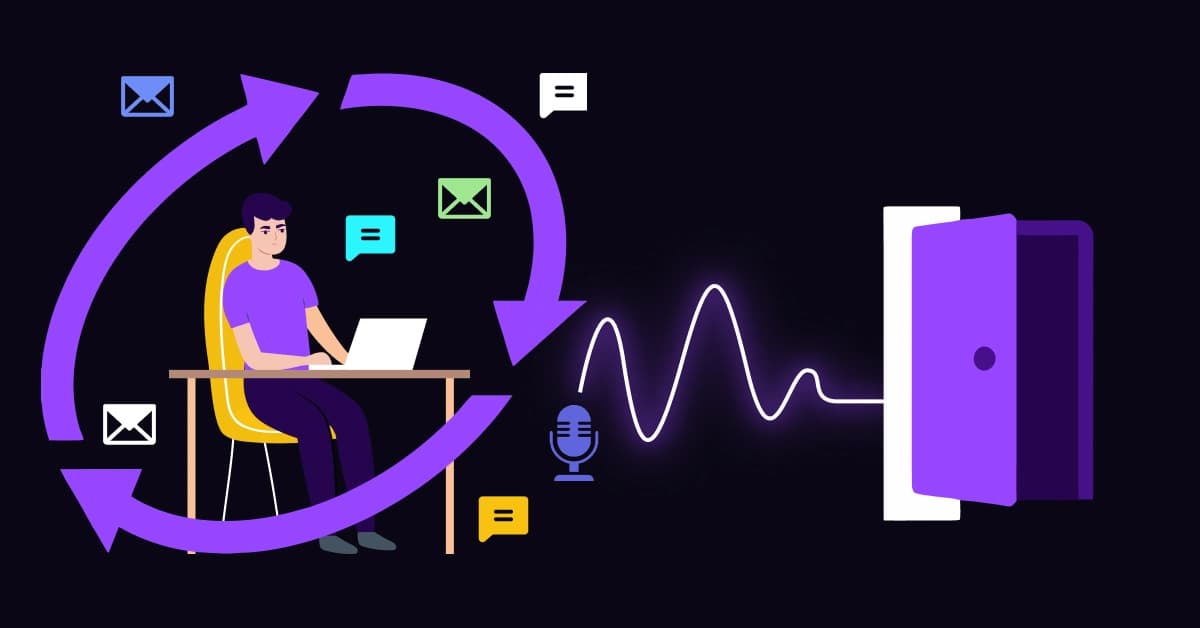
It is the scenario every sales professional dreads. You delivered a flawless demo; the prospect nodded enthusiastically and even said, “This looks exactly like what we need.” Then, silence. You send an email, call a few days later, and send a LinkedIn connection request, but you get nothing in return.
You have entered the “Zone of Ghosting.“
This silence creates a dangerous byproduct in your pipeline known as “Hopium.” This false hope clogs your forecasting and wastes mental energy on deals that are likely already dead.
However, you must realize that a clear “No” is infinitely better than a “Maybe.” A “No” allows you to move on, whereas a “Maybe” keeps you stuck in limbo.
To navigate this, you must understand why they ghost. Usually, it is not malicious. Often, it is simply a priority issue; other fires have started in their business that require immediate attention.
Furthermore, many prospects are afraid to say “No” because they do not want to hurt your feelings or face a confrontation. Therefore, your job is not to chase them, but to make it psychologically safe for them to reject you.
Why “Just Checking In” Is The Kiss of Death
For decades, lazy sales advice taught us to “be persistent.” Consequently, most inboxes are flooded with weak, low-value messages like:
- “Just checking in…”
- “Bubbling this to the top of your inbox…”
- “Wanted to see if you had thoughts…”
While these seem polite, they are status killers.
When you “check in,” you signal that you have nothing of value to add and are sitting by the phone waiting for them. It reeks of desperation. In high-stakes B2B sales, desperation is a repellent.
The Power Dynamic Shift Sales is a negotiation of status. The rule is simple: Whoever needs the deal less holds the power.
Standard follow-ups give your power away. Breakup scripts take it back by showing you are willing to walk away. According to HubSpot, persistence is key, but the quality of that persistence dictates the outcome.
The Power Dynamic Shift
Sales is fundamentally a negotiation of status. The rule of thumb is simple: whoever needs the deal less holds the power. Standard follow-ups give your power away by chasing the prospect for validation. Conversely, breakup scripts take the power back by showing you are willing to walk away.
According to recent Sales Follow-Up Statistics, persistence is key, but the type of persistence matters. Continuing to push without changing your angle yields diminishing returns.
The Psychology of “Pattern Interrupts”
Prospects are conditioned like Pavlov’s dogs. They are trained to ignore salespeople who chase, beg, and “check in.” To get a response, you need to deploy a “Pattern Interrupt.”
Breaking the “Chasing” Cycle
You must do the opposite of what they expect. When you stop chasing and start pulling away, the prospect becomes confused. They expect you to pursue them, so when you don’t, it disrupts their mental model.
As a result, this confusion forces them to pay attention to your message to understand why the dynamic has changed.
The Science of “Going Negative” (Strip-Lining)
This technique is deeply rooted in behavioral psychology and the Sandler Training method, often referred to as “Strip-Lining.” The concept is counterintuitive: to pull a prospect toward you, you must first push them away.
Triggering Loss Aversion
This technique is rooted in the Sandler Training method, often called “Strip-Lining.” The concept is counterintuitive: To pull a prospect toward you, you must first push them away.
Triggering Loss Aversion: Humans are wired to fear loss significantly more than they desire gain. This isn’t just a theory; it is biological.
When you say, “I am closing your file,” you flip a switch in the prospect’s brain. Suddenly, you aren’t chasing them; you are removing the opportunity.
The pain of losing a potential solution is often a stronger motivator than the pleasure of gaining it. By threatening to take the solution away, you force them to decide: Do I really want to let this go?
In fact, understanding The Psychology of Loss Aversion reveals that the pain of losing a potential solution is often a stronger motivator than the pleasure of gaining it. By removing the offer, you force them to decide if they really want to let it go.
Why Ringless Voicemail (RVM) Beats the “Breakup Email”
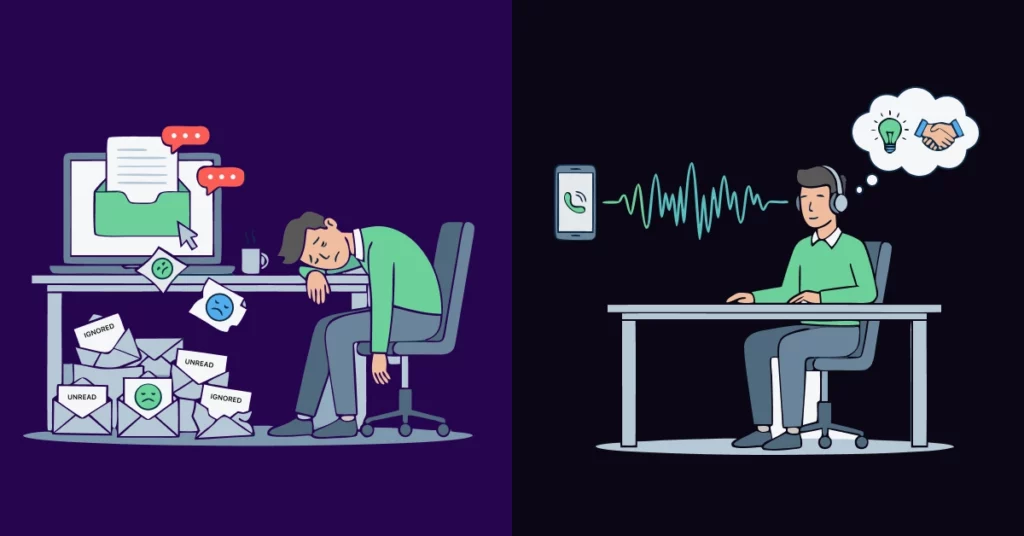
While you can send a breakup email, voice is far superior for this tactic.
Tone and Sincerity
You can send a breakup email, but voice is superior for “going negative.” Here is why:
- Tone Control: Text is ambiguous. A breakup email can easily be misread as passive-aggressive or snarky. A voice message allows you to sound genuine, calm, and professional, conveying that you truly “don’t want to be a bother.”
- The “Pattern Interrupt”: Executives are masters at deleting sales emails. They engage differently with voicemail.
- Listen Rates: Emails have open rates; voicemails have listen rates. RVM lands directly in the mobile inbox, boasting a 96% listen rate compared to the abysmal open rates of cold email.
(See how other sales teams are leveraging this high listen rate in our Use Cases).
The 4 Rules of a Perfect Breakup Script
Before you record your message, you must adhere to four rules to ensure you maintain professionalism.
Rule 1: No Guilt Trips
You must sound completely at peace, never passive-aggressive (“I guess you’re too busy…”). If you sound angry, you confirm their decision to ghost. If you sound relieved, they wonder what they are missing.
Rule 2: Absolute Clarity
Ambiguity fails here. Do not say, “I’ll try one last time.” You must make it undeniably clear that this is the end. You are closing the file. This finality is the psychological trigger.
Rule 3: The “Totally Fine” Validation
Explicitly states that walking away is okay (“If this isn’t a priority, that is totally fine”). Validating their decision removes the social pressure that caused the ghosting in the first place.
Rule 4: The “Zero-Ask” Close
Stop begging for a callback. Do not end with a question like “Please call me.” Instead, state your action (“I am closing the file”). This signals you do not need the deal, which immediately raises your status.
Script 1: The “Permission to Close File” (The Classic)
This is the gold standard for general ghosting. It is clean, polite, and final.
- “Hi [Name], I haven’t heard back since our demo. I’m assuming this isn’t a priority right now, which is totally fine. I’m going to close your file so I don’t keep bothering you. Best of luck.”
Script 2: The “Did I Mess Up?” (The Humility Play)
Use this variation when you feel a really strong connection during the meeting, and the subsequent silence is baffling. It disarms the prospect by taking the blame.
- “Hi [Name], usually when I don’t hear back, it means I didn’t answer a key question or the timing is off. If you’ve decided to go in a different direction, just let me know so I can stop checking in.”
Script 3: The “Priority Shift” (The Soft Breakup)
This approach is best suited for long sales cycles where timing is often the main objection.
- “Hi [Name], I’m guessing this project got pushed down the priority list. I’ll take you off my outreach list for now. If this becomes a priority again in Q4, feel free to reach out.”
Script 4: The “Final Hail Mary” (The Offer Removal)
If you have a time-sensitive deal or discount, use urgency and scarcity to force a decision.
- “Hi [Name], since I haven’t heard back, I can’t hold that pricing we discussed past Friday. I’ll assume we are pausing for now. Take care.”
For sales teams that need to send these at scale, using Voice Cloning Features lets you maintain the personal “founder” voice without recording individual messages for every stalled lead.
Automating the Breakup: The “Final Nudge” Sequence
You should not be manually calling 50 ghosting leads every Friday. That is a poor use of your time. Instead, you must operationalize this process.
The 30-Day Stalled Trigger
Automating the Breakup: The “Final Nudge” Sequence. You should not be manually calling 50 ghosting leads every Friday. That is a poor use of your $100/hour time. Instead, operationalize this process.
The 30-Day “Stalled Deal” Trigger Set up a workflow in your CRM (Salesforce, HubSpot, Pipedrive). The logic is simple:
- Trigger: Lead Stage = “Negotiation” AND Status Unchanged for 30 Days.
- Action: Zapier triggers VoiceDrop Integration.
- Output: The “Permission to Close File” script is dropped into their mobile voicemail.
This ensures no lead is ever left behind, and your pipeline remains clean without you lifting a finger.
Technical Implementation: Connecting CRM to VoiceDrop
Implementing this automation is straightforward and requires no coding knowledge.
Integration with Salesforce, HubSpot, or Pipedrive
You can easily connect your existing stack via Zapier. The logic is simple: Trigger: Lead Status changes to “Stalled.” Action: Send VoiceDrop Breakup Script.
Once this is active, your “cleaning” process runs on autopilot. You can explore Automated Sales Integrations to see how easily this fits into your current workflow.
Data Hygiene: Don’t Break Up with a Landline
There is one crucial technical step. If you send ringless voicemails to office landlines, they might never reach the decision-maker, or they will ring the front desk, ruining the “personal” effect.
You must ensure you are targeting mobile numbers.
Stop Wasting Budget on Landlines. Before launching your campaign, use 1Lookup’s line type lookup to filter your list. 1Lookup is built by the same team as VoiceDrop. This ensures 100% mobile deliverability, protecting your budget and your sender reputation.
Handling the “Zombie” Resurrection (When They Reply)
When this strategy works, and it will, dead leads will suddenly come back to life. You need a plan for when they reply.
The “Welcome Back” Protocol
Do not act surprised or overly excited. Simply reply with, “Great to hear from you. Let’s get that call scheduled,” and send your calendar link. Essentially, you want to welcome them back without acknowledging the ghosting, allowing everyone to save face.
Compliance and Best Practices (TCPA)
While “going negative” is a psychological tactic, you must still adhere to legal and ethical standards.
Honouring the “No”
If the breakup script works and they reply with, “Yes, please stop calling,” you must immediately remove them from your list. Ultimately, this builds long-term brand respect and ensures you remain compliant with communication regulations.
Measuring Success: Reply Rates vs. Unsubscribes
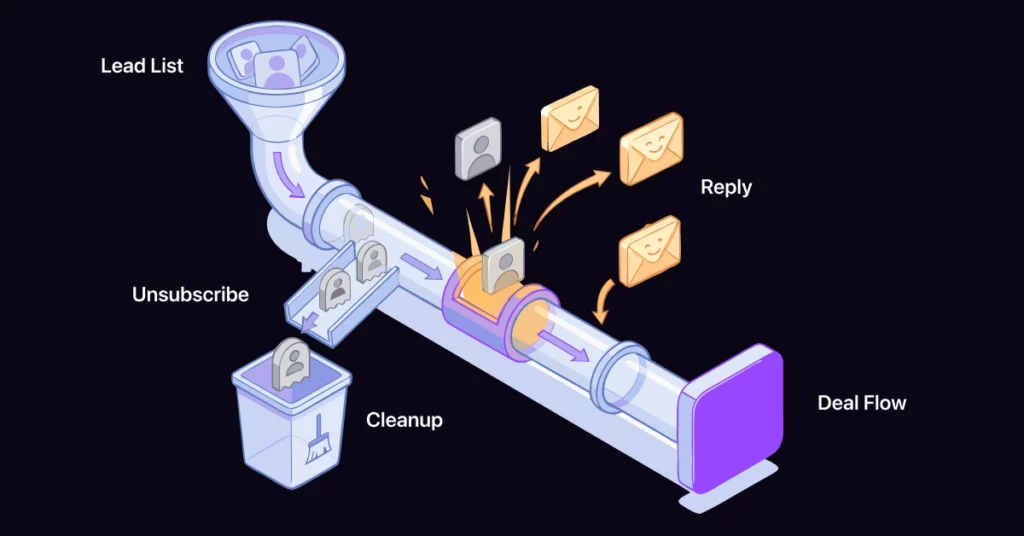
Finally, you need to track your ROI differently for this campaign. A high unsubscribe rate on a breakup campaign is actually a positive metric.
It means you are cleaning your list of people who were never going to buy. Simultaneously, you should track the “Resurrection Rate, the percentage of dead leads who reply to save the deal.
Conclusion
Embrace the “No” Sales is about truth, not hope. “Hopium” is an addiction that kills productivity and bloats your pipeline with deals that will never close.
The “Going Negative” strategy forces the truth to the surface. It allows you to focus your valuable time on prospects who are actually interested, rather than chasing ghosts.
Stop sitting by the phone. Send the breakup. Get the truth.
Ready to clean up your pipeline? Start Your Free Trial today and automate your re-engagement flow.
FAQ’s
Is “going negative” rude?
No, provided your tone is calm and professional. It is actually polite because you are permitting them to say “no” and ending the cycle of unwanted interruptions.
What if they reply saying “No”?
That is a win. You can stop wasting time on them, remove them from your forecasting, and focus your energy on active buyers who are ready to close.
Can I automate this for all my old leads?
Yes, you can upload a CSV of all leads older than 60 days and send a “cleaning the files” blast to revive old interest instantly.