
You hit ‘Send’ on a campaign of 50,000 leads. With the subject line nailed and the offer perfected, you wait for the replies… but you hear silence.
The problem isn’t your copy. It’s the Delivery Gap.
In 2026, the void between “Sent” and “Delivered” has widened. Major ISPs like Google and Yahoo have weaponized their spam filters.
If you are sending to invalid addresses, you aren’t just missing a lead; you are flagging your entire domain as spam. A robust Bulk Email Validation Tool is the only way to ensure your messages survive the filter.
The Mechanics: How Email Validation Actually Works
To trust the software, you need to understand what is happening under the hood. It isn’t magic; it is a rigorous technical interrogation of every single email address on your list.
Syntax and Formatting Checks
The first line of defense is the simplest but most necessary. The tool scans your list for obvious human errors.
It instantly removes addresses with typos (like “john@gmai.com”), missing “@” symbols, or invalid characters. This step clears out the “junk” before deeper technical checks begin.
DNS and MX Record Verification
Once syntax is cleared, the tool queries the Domain Name System (DNS). It checks if the domain (e.g., “@company.com”) actually exists and is active.
More importantly, it verifies the Mail Exchange (MX) records, which confirm that the domain has a mail server configured to accept emails. If the domain is dead, the email is dead.
The SMTP Handshake (Ping Test)
This is the “secret sauce” of high-accuracy tools. Instead of sending an actual email, the tool initiates a technical conversation with the recipient’s mail server, known as an SMTP handshake.
It asks the server, “Does this specific user exist?” The server responds with a code (Yes/No), and the tool disconnects instantly. The result? You verify the email exists with 99% accuracy, but the prospect never receives a message, and you never trigger a spam filter.
Why “Dirty” Data is a Revenue Killer
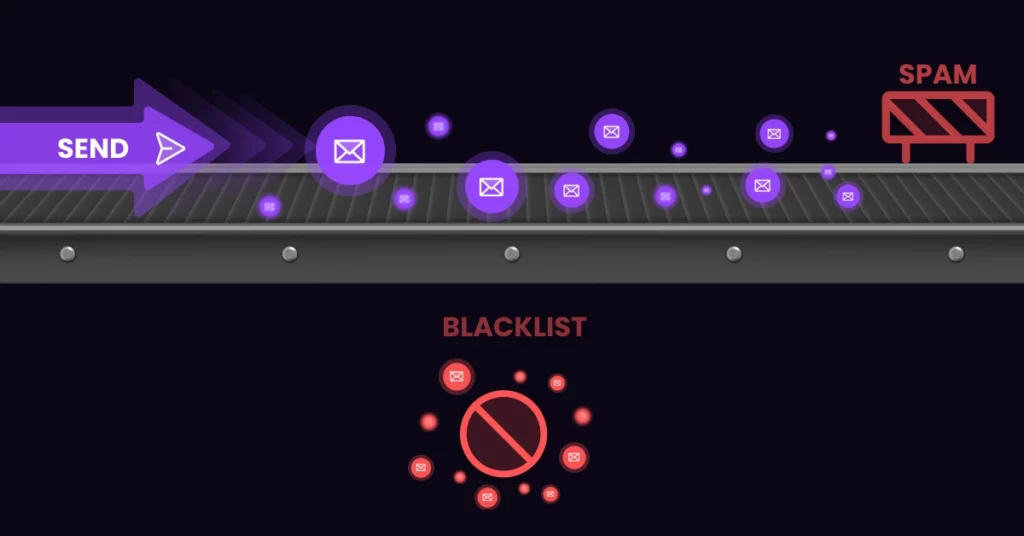
Bad data doesn’t just annoy your marketing team; it burns your budget. If you are ignoring list hygiene, you are actively sabotaging your company’s revenue engine.
The Impact on Sender Reputation and Deliverability
Your Sender Score is like a credit score for email. Every time you hit a “Hard Bounce” (a permanent failure), that score takes a hit. If your score drops too low, ISPs will start diverting your future emails, even the ones to valid, interested leads, straight to the Spam folder.
Maintaining a low bounce rate is critical. According to industry-standard email marketing benchmarks, a bounce rate higher than 2% puts your account in the “danger zone.” Platforms like Mailchimp or SendGrid may even suspend your account if you consistently exceed this threshold.
The Danger of Spam Traps and Honeypots
The biggest threat to your list isn’t a fake email; it’s a Spam Trap. These are valid-looking email addresses secretly created and monitored by ISPs solely to catch spammers.
If you hit a spam trap, it tells the ISP that you are scraping data or buying low-quality lists. Hitting just one can get your domain blacklisted immediately.
High-quality validation tools update their databases daily to recognize and flag these traps before you fall into them.
Essential Features to Look for in 2026
Not all validators are created equal. When shopping for software to protect your business, ensure it includes these non-negotiable features.
Catch-All Server Detection
Some mail servers are configured to accept all emails sent to their domain, regardless of whether the specific user exists. These are known as “Catch-All” servers.
While some of these emails are valid, many will silently discard your message or bounce it later. A good tool must identify these as “Risky” or “Catch-All” so you can segment them out and treat them with caution rather than assuming they are safe.
Pro Tip: Verify the Human, Not Just the Inbox “Catch-All” servers are tricky; the email might be valid, but is it the right person? Don’t gamble on risky addresses. Run a quick reverse lookup on 1Lookup to verify the prospect’s identity and job title before you waste a credit adding them to your campaign.
Real-Time API Integration
The best way to clean your list is to never let it get dirty in the first place. Your validation tool should offer a real-time API that connects directly to your signup forms or CRM.
By using VoiceDrop API Integrations, you can verify email addresses the moment a user types them in.
If they enter a typo or a fake address, the system can prompt them to correct it immediately, ensuring bad data never enters your database.
Data Security and GDPR Compliance
You are uploading sensitive customer data, names, emails, and potentially IP addresses.
Security is paramount. Ensure the tool you choose uses enterprise-grade encryption (like 256-bit SSL) and is fully GDPR compliant to avoid regulatory fines.
Top Strategies for List Hygiene and Management

Validation is just the first step. Once you have your results, you need a strategy to manage that data effectively.
Segmenting by Validation Status (Valid vs. Risky)
Never just “delete” the emails flagged as “Risky” or “Catch-All”, there might be gold in there. Instead, segment them.
- Valid List: Safe to send your main marketing campaigns.
- Risky List: Send a careful, plain-text “test” campaign to this segment. Monitor it closely. If they open or click, move them to the Valid list. If they bounce, remove them immediately.
Maximize Value from Your “Valid” List. A clean email is good; a complete profile is better. Once you have validated your list, don’t stop there. Use 1Lookup’s email append to enrich those valid emails with phone numbers and social data. 1Lookup is built by the same team as VoiceDrop. This turns a simple email list into a multi-channel asset, allowing you to call the leads who don’t reply to your emails.
The “Sunset Policy” for Unengaged Leads
Even a valid email is dangerous if the user never opens it. Consistently sending to unengaged users hurts your engagement rates and signals to ISPs that your content is irrelevant.
Implement a “Sunset Policy”: If a contact hasn’t opened or clicked an email in 6 months, remove them from your active mailing list.
It hurts to cut the numbers, but a smaller, engaged list is far more profitable than a massive, silent one.
Top Bulk Email Validation Tools Reviewed
Here is how the top players in the market compare for different business needs.
VoiceDrop (Best for Multichannel Follow-Up)
Our Top Pick for Automated Outreach: VoiceDrop excels where others don’t. While most tools on this list focus only on cleaning data, this platform is different because it prioritizes your revenue.
It is an all-in-one execution platform. You don’t just get a clean list; you get the ability to immediately trigger multichannel outreach sequences, like Ringless Voicemail and SMS, to those verified contacts.
The Verdict: If you want to clean a list and start selling to it in the same workflow, VoiceDrop is the superior choice.
ZeroBounce (Best for Detailed Reporting)
ZeroBounce is a heavy hitter in the validation space, known for its granular reporting. It provides detailed error codes explaining exactly why an email failed (e.g., mailbox full, domain invalid). Their “AI Scoring” system also helps rate the quality of “catch-all” emails.
NeverBounce (Best for Enterprise Volume)
For large enterprises that need to clean millions of emails overnight, NeverBounce is a strong contender. It is designed for speed and high volume.
Its interface is simple: it categorizes lists into “Valid,” “Invalid,” “Accept All,” and “Disposable,” making it easy for large teams to make quick decisions.
Measuring the ROI of Email Validation
Is the cost of the tool worth it? The math is simple, and the ROI is often immediate.
Calculating Cost Savings on ESP Bills
Most Email Service Providers (ESPs) like HubSpot, Mailchimp, or Klaviyo charge you based on the size of your database. If you are paying for 50,000 contacts, but 10,000 are invalid, you are literally throwing money away every month.
Calculating Cost Savings on ESP Bills: Let’s look at the math. Most ESPs (like HubSpot or Mailchimp) charge by database size.
- Scenario: You have 50,000 contacts. 10,000 (20%) are invalid or inactive.
- The Cost: You are paying tier pricing for 50k contacts, likely wasting $200–$500/month on housing dead data.
By scrubbing those 10,000 bad emails, you drop a pricing tier. You instantly lower your monthly overhead, often paying for the validation tool with the savings alone. It is essentially free money.
Improving Open and Click-Through Rates
Marketing metrics are a game of denominators. When you remove dead leads (the denominator), your Open Rate and Click-Through Rate (CTR) naturally shoot up.
Higher engagement rates signal to ISPs that you are a top-tier sender, which improves your inbox placement for everyone else.
Navigating Legal and Compliance Issues
Handling data comes with legal responsibilities. Ignorance is not a defense.
GDPR and Data Processing Agreements
If you have customers in Europe, you must comply with the General Data Protection Regulation (GDPR). Under these rules, you are responsible for the vendors you choose to process your data.
Using a cheap, non-compliant validation tool that stores data on insecure servers can lead to massive fines. Always ensure your provider adheres to GDPR email marketing rules and offers a Data Processing Agreement (DPA).
CAN-SPAM Act Compliance
In the US, the CAN-SPAM Act requires you to honor opt-out requests promptly. A clean list helps here, too.
By removing invalid addresses and managing your list hygiene, you ensure that you are only emailing people who have validly opted in and that your opt-out systems are working correctly for active users.
Conclusion: Clean Lists Drive Revenue
The days of quantity over quality are over. Email validation is the foundation of a healthy, profitable sales funnel. It protects your reputation, lowers your costs, and ensures your message is heard.
Don’t let bad data paralyze your outreach. Audit your lists, implement a validation protocol, and then take action. Start your VoiceDrop Demo today to validate your leads and convert them with superior automated outreach tools.
FAQ’s
How accurate are bulk email validation tools?
Top-tier tools offer 98-99% accuracy by using real-time SMTP handshakes rather than just database checks. This “ping” method verifies the user exists without sending an email.
What is the difference between a hard bounce and a soft bounce?
A hard bounce is a permanent failure (e.g., the email address does not exist). A soft bounce is temporary (e.g., the recipient’s inbox is full or the server is down). Validation tools primarily focus on preventing hard bounces.
Can I validate emails for free?
Many tools offer a small free tier (e.g., 100 credits), which is great for testing. However, for bulk lists (1,000+), paid plans are necessary to ensure high accuracy, security, and access to advanced features like catch-all detection.