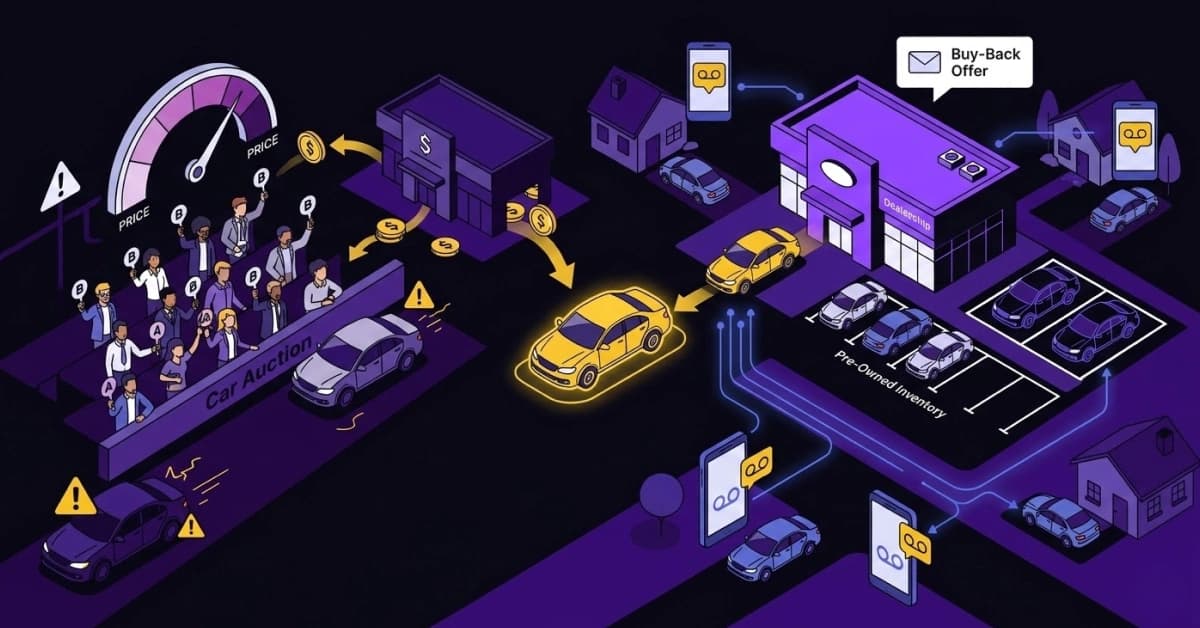
The auction lanes are bleeding your gross profit dry. In the current automotive climate, relying on trade-ins to stumble onto your lot is no longer a business strategy.
To protect your margins and maintain a “front-line ready” inventory, dealerships must shift from passive reception to proactive acquisition. You cannot wait for the market to bring you cars; you have to get them.
The most profitable dealerships today are using a targeted “Buy-Back” strategy: identifying past customers with desirable VINs and telling them, “We need your car, and we need it today.”
The Inventory Crisis: Why Waiting for Trade-Ins is a Dying Strategy
The automotive market has experienced unprecedented volatility over the last few years. Consequently, the old playbook of waiting for customers to visit the showroom to trade in their vehicles is failing.
If you rely solely on floor traffic for used inventory, you leave your dealership vulnerable to market dips and new car supply chain shortages.
To survive and thrive, General Managers and Used Car Directors must define a strategy of “Proactive Acquisition.” This means actively going out and finding the specific cars you need rather than hoping they drive onto the lot.
By identifying the vehicles in your database that match your inventory needs and reaching out first, you take control of your supply chain. Ultimately, relying solely on passive trade-ins is a strategy that leaves too much to chance.
The Economics of “Street Buys” vs. The Auction Lane
Why is a “Street Buy” (acquiring directly from the consumer) mathematically superior to the auction lane? It comes down to one word: Pack.
When you raise your hand at Manheim or Adesa, you are actively bidding against your own margin. Before that car even hits your service bay, you are underwater due to:
- Buy Fees: Often ranging from $300 to $800+ per unit.
- Transportation: $200-$500 to get the unit to the lot.
- Reconditioning Risks: Auction cars often have hidden issues that you can’t verify until it’s too late.
- Arbitration Fees: The cost of disputing a bad buy.
By sourcing directly from a customer, you eliminate these fees. You acquire the vehicle at fair market value, often with better maintenance records, instantly increasing your front-end gross potential. (See the latest inventory trends at Cox Automotive Market Insights.
The Psychology of the Buy-Back Offer
Why would a customer accept a dealer’s offer when they could technically get more by selling privately? The answer lies in the battle of Convenience and Safety vs. Price.
For the average consumer, selling a car privately is a nightmare. It involves meeting strangers in parking lots, dodging scams, and navigating complex DMV title transfers.
Your script must position the dealership as the “Safe & Easy Button.” You aren’t trying to sell them a car; you are offering to liquidate their asset instantly.
By framing the conversation around “helping” them avoid the dangers of private selling, you lower their defenses. Consequently, the customer views the dealership not as a salesperson, but as a solution to a logistical problem.
3 Proven Buy-Back Scripts for Different Lead Sources
A generic script will not work for every customer. Instead, you need specific messaging tailored to the customer’s lifecycle stage. Here are three variations to maximize your conversion rates.
1. The Service Drive Script (Service-to-Sales)
Target: Customers currently in your service database with desirable vehicles.
- Hi [Name], this is [Manager Name] at [Dealership]. I saw your [Year/Model] is here for service. I have a client looking for this exact configuration, and we are short on inventory. I’d love to verify the miles and make you an aggressive buy offer while you wait. No pressure to trade, I just need the car. Let me know if you’re open to a 5-minute appraisal.”
2. The Equity Mining Script (Past Customers)
- Concept: “Hi [Name], it’s [Name] from [Dealership]. I was reviewing our sales records, and your [Year/Model] hit a value trigger today. Based on current demand, you might be able to upgrade to a 2024 model and keep your payment roughly the same. I have two open slots tomorrow to show you the numbers. Give me a call back at…”
3. The Private Seller Script (Facebook/Craigslist)
- Concept: “Hi, I’m calling about the [Car Model] you listed for sale. I’m a buyer for [Dealership]. I can cut you a check today and handle the DMV transfer so you don’t have to meet strangers. If you want to sell it today without the hassle, call me back.”
Pro Tip: Don’t get scammed by fake sellers. Identify the Real Vehicle Owner Before You Make an Offer. 1Lookup is built by the same team as VoiceDrop.
Automating the Outreach: The Ringless Voicemail Advantage
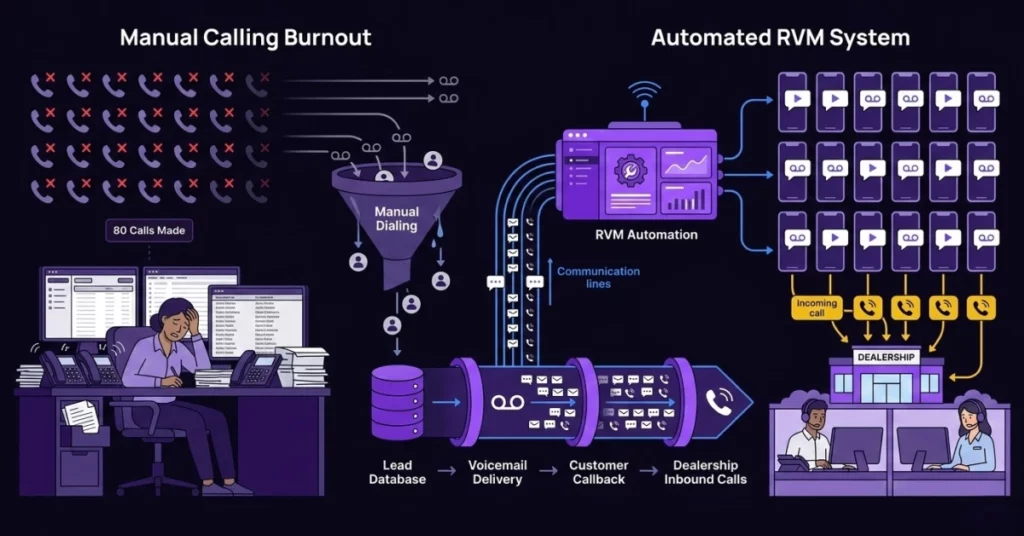
The biggest hurdle in executing these scripts is volume. A Business Development Center (BDC) agent can only make 80 to 100 manual calls a day.
Moreover, answer rates for unknown numbers are historically low, often hovering below 10%. This leads to “Sales Fatigue” and burnout among your staff.
However, automation solves this bottleneck. VoiceDrop Automotive Solutions allows you to use Ringless Voicemail (RVM) to deliver these scripts directly to the customer’s mobile inbox without the phone ever ringing. You can drop 1,000 voicemails in minutes.
Consequently, your BDC team stops wasting time dialing and starts handling inbound calls from interested sellers who have already heard your message.
Data Hygiene: Verifying the Seller Before You Dial
Automation is only as good as the data feeding it. Sending voicemails to landlines or disconnected numbers is a fast way to burn your marketing budget.
Before uploading any list from your CRM, performing a Reverse Phone Lookup is non-negotiable.
This step verifies that the number is a valid mobile line and confirms the identity matches the vehicle owner. Clean data ensures high deliverability and protects your dealership’s reputation.
The “Acquisition Appointment” Protocol
When the phone starts ringing, your team must have iron discipline, the Golden Rule: Never negotiate the price over the phone.
If you give a number, the customer will use it to shop you against a competitor. The goal of the call is solely to set an “Appraisal Appointment.”
The Rebuttal: “I understand you want a ballpark figure, but I need to see the condition to give you the highest possible value. Computer estimates are often too low. If you can bring it in, I can have a certified check ready in 30 minutes.
The Appraisal Strategy: Building Trust Transparency
When the customer arrives, the process must remain transparent. Specifically, you should conduct an “Active Appraisal.” This means walking around the car with the customer rather than taking the keys and disappearing.
Point out the positive aspects, such as a clean interior, but also gently note the deductions, such as worn tires or scratches.
This approach validates your offer so they don’t feel low-balled when you present the number. To support your valuation, you can reference the NADA Valuation Guidelines, which serve as the industry standard for vehicle valuation. This third-party validation helps build trust and close the deal.
Compliance: TCPA Rules for Acquisition Teams
Even though you are offering to buy a car, you are still engaging in marketing activity. Therefore, strict adherence to compliance is non-negotiable. It is vital to differentiate between “Transactional” messages (such as service updates) and “Solicitation” messages (such as Buy Back offers).
Dealerships must always scrub their lists against the National Do Not Call (DNC) registry. Additionally, you must obtain the necessary consent. Ignorance of the law is not a defense. For a complete understanding of the legal landscape, always refer to the official FCC Consumer Protections documentation regarding telemarketing and automated calls.
Integration: Automating the Trigger
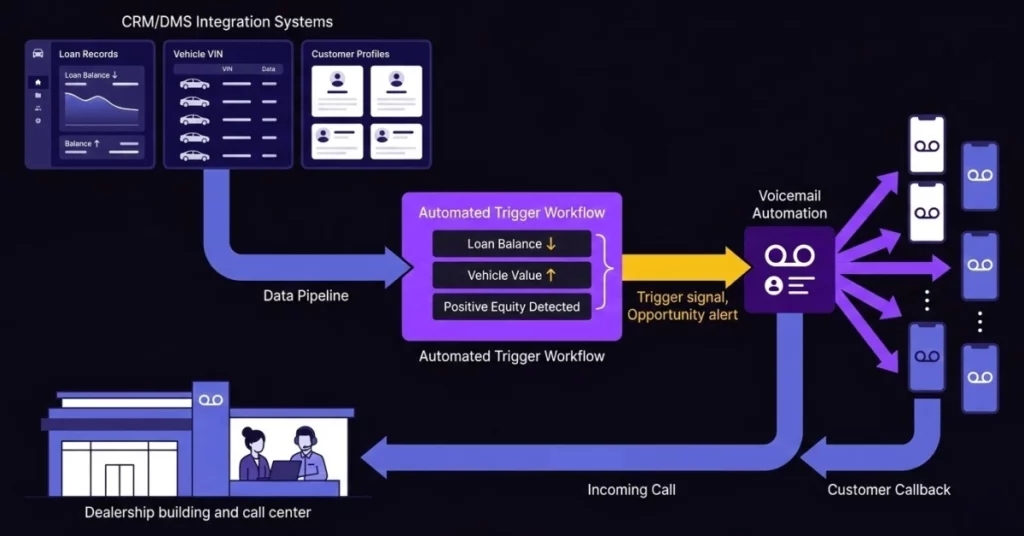
Ideally, this process shouldn’t require manual list uploads every day. In fact, the best acquisition strategies are “Set and Forget.” By integrating your voicemail software with your DMS or CRM (like Reynolds & Reynolds, VinSolutions, or DealerSocket), you can create automated triggers.
For example, you can set up a workflow where, if a customer’s loan balance drops below a certain threshold signaling positive equity, the system automatically triggers a “Buy Back” voicemail. To see how to connect these workflows, explore VoiceDrop Integrations. This seamless connectivity ensures no opportunity slips through the cracks.
Conclusion
Stop letting the auction control your margins. Inventory is the lifeblood of your dealership, and the most profitable inventory is already sitting in your customer database or driving past your lot.
Shift your strategy from reactive to proactive. Automate your outreach, protect your gross profit, and fill your lot with high-margin vehicles today.
Ready to automate your acquisition? Get a VoiceDrop Demo and start sourcing inventory on autopilot.
FAQs
Is it legal to call private sellers from Craigslist?
Yes, but with caveats. You are inquiring about a specific item that they have placed for sale publicly. However, using automated dialers to contact them requires strict adherence to TCPA consent rules, so manual calling or obtaining prior consent is often safer for cold outreach.
What is the best time to send a Buy Back voicemail?
The “Goldilocks Zone” for acquisition campaigns is typically Mid-week (Tuesday or Wednesday) between 10 AM and 2 PM. This timing avoids the frantic “Monday Morning Rush” and ensures your message lands when the customer is likely to check their phone.
How do I handle customers who demand a price over the phone?
You should use the “Range Strategy.” Give them a broad range based on KBB values to satisfy their curiosity, but emphasize that the final check amount depends entirely on a physical inspection to verify the condition.