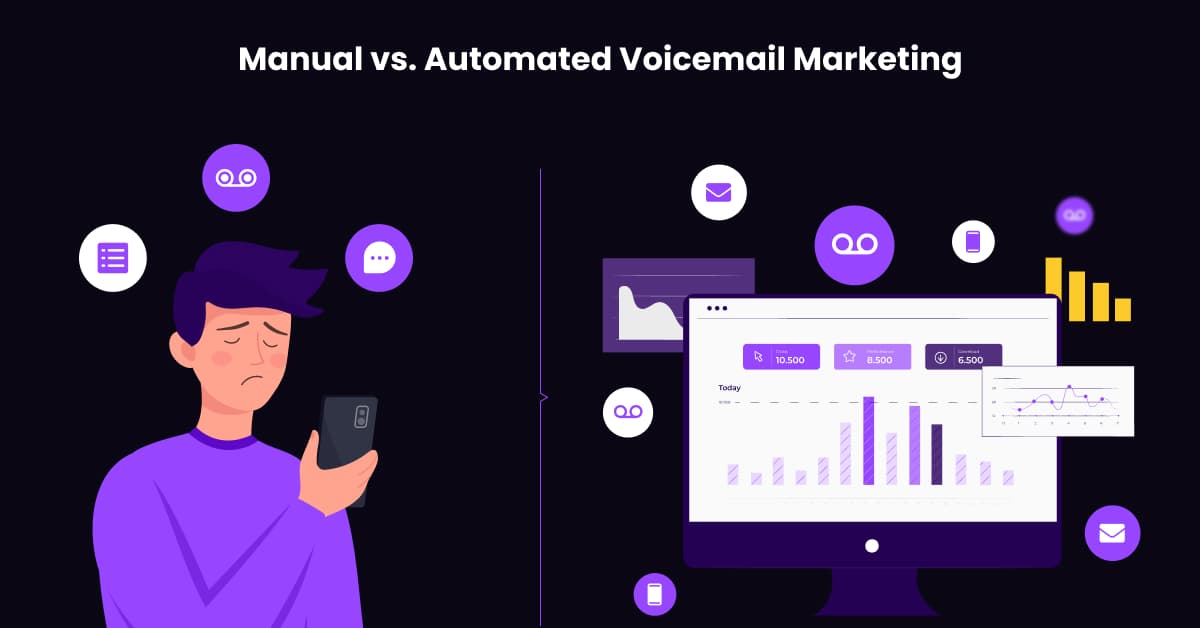
Are you still manually dialing dozens of prospects every day, hoping to catch someone live? Is your sales team wasting hours leaving the same message over and over again? What if you could send thousands of personalized voicemails and get up to 10% in callbacks while your team focuses on closing deals?
Cold calling is frustrating, inefficient, and often leads to burnout. The real problem is the time investment required versus the low return. The traditional outreach process is outdated harassment. Today, sales and marketing professionals need a way to reach decision-makers without gatekeepers and without interrupting their day. They need Automated Voicemail Marketing, a solution that transforms cold outreach into warm callbacks. This article will explore the differences, advantages, and disadvantages of manual versus automated voicemail marketing. You will get actionable insights on choosing the right approach, best practices, and tools like VoiceDrop.ai to maximize your engagement and conversions. Ready to turn cold lists into inbound callbacks? Keep reading.
What Is Automated Voicemail Marketing?
Automated Voicemail Marketing is a modern system that uses software platforms to deliver pre-recorded or dynamically generated voicemails directly to voicemail inboxes. This process is also known as ringless voicemail (RVM). The best part? It works without making the phone ring, although a microsecond ring may occur. You can reach thousands of prospects simultaneously and instantly. This approach is the complete opposite of manual dialing, offering massive benefits in speed and efficiency.
VoiceDrop is a next-generation AI-powered ringless voicemail platform that leads this market. The core purpose of this technology is to save time, scale your outreach, and drive data-driven optimization. Instead of wasting time manually dialing, your voice works for you 24/7. The platform combines advanced AI voice cloning technology with scalable voice broadcasting capabilities. This means you can maintain a personal touch while scaling. You are only charged for successful deliveries, making it a cost-effective alternative to traditional cold calling. Automated voicemail marketing replaces manual effort with automation, allowing you to reach more leads and book more meetings faster than ever before.
How Automated Voicemails Work
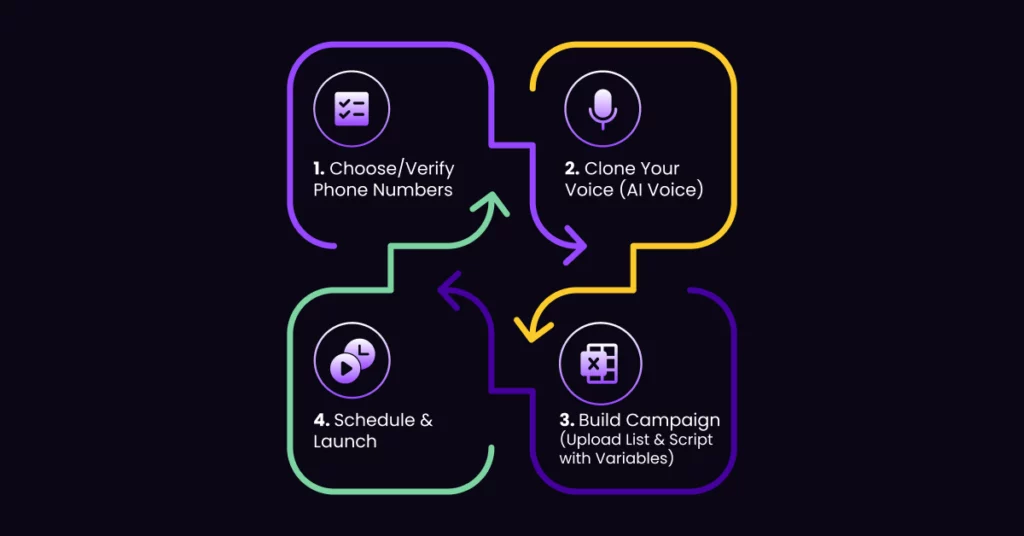
Sending automated voicemails is a simple, four-step process. First, you choose or verify your phone numbers, often selecting local area codes for better presence. Second, you create your voice. You can clone any voice with just a 30-60 second recording, creating a digital replica that sounds about 90% like the original. Third, you build your campaign. This involves uploading your contact list, which can be a CSV or Excel file with unlimited variables. You write your script using variables like {FirstName} for full personalization. Finally, you set the schedule, including advanced time zone optimization, and launch.
Platforms like VoiceDrop.ai offer features such as Multiple Sending Options, including the powerful AI Voice option for full script personalization (1 unit per message). The platform also includes analytics dashboards for real-time monitoring. Key compliance tools, like built-in DNC checking and time restrictions, are included. For callbacks, the AI Inbound Agent can handle them automatically 24/7, qualifying leads based on your custom criteria. This entire process is about achieving the human touch through advanced personalization at scale. Learn how to implement this effectively with automated follow-up systems.
Pros and Cons of Automated Voicemail Marketing
The advantages of Automated Voicemail Marketing are clear and focus on efficiency and scale. Scalability is the greatest strength; you can send messages to thousands of contacts in minutes, with throttling controls scalable to 100K+ per hour for enterprise clients. You achieve incredible time efficiency; what takes 10 hours of manual calling takes only 30 minutes with VoiceDrop. The messaging offers great consistency because every prospect receives the same high-quality, pre-approved message. Detailed analytics and reporting provide real-time data on delivery rates, callback rates, and ROI, which is crucial for optimization. Finally, easy Integration with CRMs like HubSpot and platforms like Zapier or Make.com allows for automated workflows.
However, there are a few challenges. There is a potential lack of personal touch if you use generic static messages. This is why advanced platforms like VoiceDrop.ai prioritize the AI Voice option, which uses variables to maintain personalization. There may be some initial setup complexity when building custom workflows via API. Lastly, you must always maintain compliance with legal regulations like TCPA, which is why VoiceDrop includes built-in DNC checking and state-specific compliance features.
What Is Manual Voicemail Marketing?
Manual voicemail marketing involves leaving individual voicemails by hand, either by dialing each contact personally or using basic phone systems. This approach is defined by the process of a sales representative manually dialing and recording a message after the call goes to voicemail.
This method places a high value on the personal touch and highly tailored messaging. It is often used in situations where the list of contacts is very small or the message is so unique to the recipient that automation is not feasible. The goal is relationship building through a unique connection. While it is a tried-and-true method, it is fundamentally a low-volume, high-effort approach. The core pain point is the time and labor cost. For a comparison of manual dialing versus AI in B2B sales, read more here: AI vs Manual Dialing.
How Manual Voicemails Work
The manual process is straightforward but extremely time-consuming. A sales rep receives a list of prospects and begins dialing. When a call goes to voicemail, the representative must wait for the beep, record a message, and then hang up. The message should be highly personalized, often referencing recent activities or specific company details to strengthen the connection.
The primary benefit of this approach is the ability to convey genuine sincerity and flexibility. A human representative can react to the moment, adjust their tone, and deliver a more personal message than a static recording. However, the constraints are severe. The biggest drawback is the lack of scalability. The number of voicemails a rep can leave in an hour is severely limited by manual dialing time. Furthermore, tracking performance is challenging. The rep typically must log the result of each call manually in a spreadsheet or CRM system, leading to inconsistent tracking and difficulty measuring overall campaign performance.
Pros and Cons of Manual Voicemail Marketing
Manual Voicemail Marketing has a few clear advantages. It offers the highest personalization possible, as the message can be tailored to the individual right down to the tone of voice. This level of customization can lead to a more personal connection with the recipient. There is also flexibility in the delivery, allowing the rep to react immediately to unexpected situations. This approach is ideal for small, highly-targeted lists where relationship building is the ultimate goal.
The challenges, however, often outweigh the benefits for scaling businesses. The process is time-consuming, making it impractical for large lists. It is difficult to scale because it requires more staff and more time to reach a larger audience. Tracking is inconsistent and relies heavily on the rep’s diligence in logging data. Additionally, the message quality is inconsistent. One rep’s tone or message may differ greatly from another’s, affecting the overall brand message and results. For high-volume operations, the high resource investment makes this approach obsolete.
Key Differences Between Manual and Automated Voicemail Marketing
The difference between manual and automated voicemail marketing boils down to two factors: scalability and personalization. Manual campaigns are inherently slow and require massive time and human resources. Automated campaigns are fast, efficient, and allow a single individual to reach 10,000 prospects simultaneously. Automated platforms excel at efficiency, cost-effectiveness, and data-driven insights. Manual campaigns, while personal, are a high-cost, low-volume approach that simply cannot compete in a modern sales environment.
The choice depends on your campaign goals, audience size, and available resources. If you are targeting a small handful of high-value, existing clients, manual may work. However, if your goal is outbound lead generation, B2B sales, or any form of high-volume prospecting, automated voicemail marketing is the only viable option. It’s the professional tool versus the basic feature. Modern sales teams need to automate to survive.
Personalization vs. Scalability
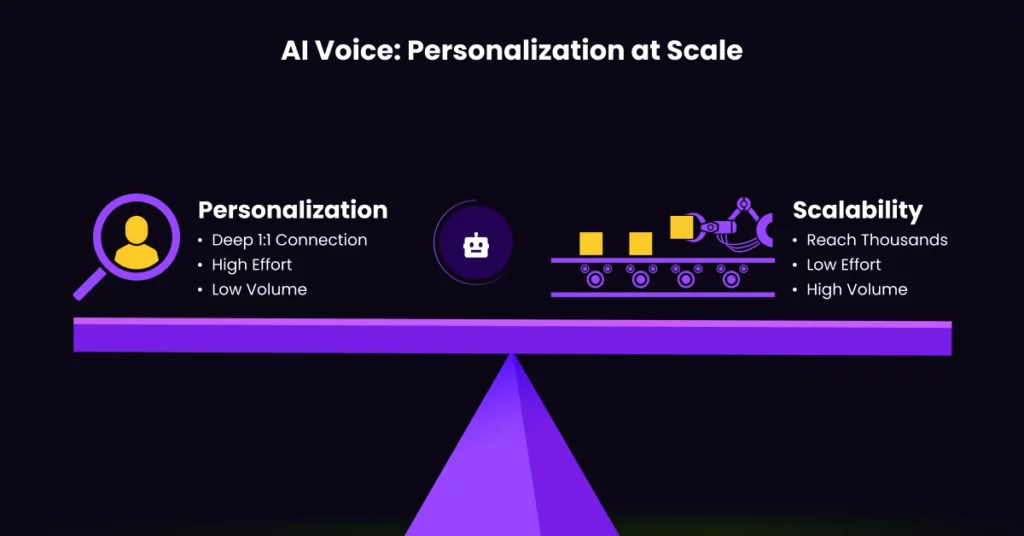
This is the central conflict in outreach strategy. Manual voicemails excel in personalization because a human can craft a unique message for every single recipient. However, this comes at the ultimate cost: zero scalability. You sacrifice volume for hyper-focus.
Automated systems, especially those powered by AI Voice cloning like VoiceDrop, solve this trade-off. You can still clone your voice, ensuring the message sounds 90% like you. By using custom fields and variables from your contact list, the AI can deliver a fully personalized script to thousands of people. This is called personalization at scale. The Hybrid or AI Voice approach delivers cost-effective personalization that a single static recording cannot, and it scales far past what manual dialing can cover.
Time and Resource Investment
The contrast in time and resource investment is stark. Manual dialing is an extreme drain on your most valuable resource: your sales team’s time. 10 hours of traditional calling can be completed in just 30 minutes with VoiceDrop. Manual calling costs anywhere from $15 to $25 per qualified lead. You are essentially paying an agent to spend 80% of their day dialing and leaving messages instead of closing deals.
Automated campaigns require a quick initial setup time of about 10-15 minutes to launch your first campaign. After that, the system works autonomously. The cost per callback with VoiceDrop is often under $3. You only pay a flat monthly rate and only for successful deliveries. This resource optimization results in an 80-90% reduction in outreach costs and an instant, massive improvement in team productivity.
Tracking and Analytics
Detailed analytics and tracking are nonexistent in manual campaigns. Manual voicemail marketing relies on a sales representative logging the results of each call into a CRM system. This is subject to human error, inconsistency, and is simply not a robust metric. It is virtually impossible to measure overall campaign ROI accurately.
Automated platforms provide sophisticated, real-time analytics and reporting tools. You can track key metrics such as Delivery Rate (target: 70%+), Callback Rate (target: 3%+ minimum), and Cost per Callback. This Data Accuracy is essential for refining your strategies, optimizing scripts, and improving results. VoiceDrop.ai provides detailed reports and undeliverable reason codes.
Consistency and Delivery
In a manual campaign, every message delivered is slightly different. The rep’s tone, energy level, message quality, and timing will fluctuate based on the time of day, list fatigue, or their mood. This is known as Traditional voicemail.
Automated voicemails ensure perfect consistency. Once the voice clone and script are finalized, every single contact receives the same, high-quality, professional message. The delivery itself is consistent due to features like Multi-Attempt Delivery™ and Intelligent Voice Scaling™. You can set advanced scheduling for specific business hours and use time zone optimization to ensure messages are delivered appropriately. Deliverability is robust, with an industry-standard rate of 60-80%.
Compliance and Legal Considerations
Compliance is critical, and both approaches must adhere to the rules. Ringless voicemail (RVM) technology is subject to evolving TCPA regulations (Telephone Consumer Protection Act). Manual campaigns require the sales rep to manage compliance individually, which can easily lead to costly errors. This requires diligence regarding Legal considerations.
Automated platforms simplify this complex issue by building compliance safeguards directly into the system. VoiceDrop offers built-in DNC (Do Not Call) list integration and automatic DNC checking before every send. The platform handles time zone restrictions and state-specific compliance for places like Florida and California. You should always consult your legal counsel, but dedicated platforms offer better protection and tools to mitigate risk than a manual process.
Common Mistakes to Avoid
Mistakes can tank your campaign, regardless of whether you are manual or automated. Leaving overly long messages is a frequent error. Keep your script under 30 seconds. Recipients often tune out after the first few seconds. Another mistake is using generic scripts. Always lead with personalization, even if it’s just the recipient’s name, to show the message isn’t spam.
Poor timing is another pitfall. Use advanced scheduling and time zone optimization to hit your prospects during business hours. Failing to personalize beyond a name variable is a mistake; use contextual details to show you did your homework. Lastly, ignoring compliance rules puts your company at massive legal risk. The fix for all of these is to use the best practices outlined in this guide: keep it conversational, use a clear, single call-to-action, and utilize the compliance features of an automated platform.
Future Trends in Voicemail Automation
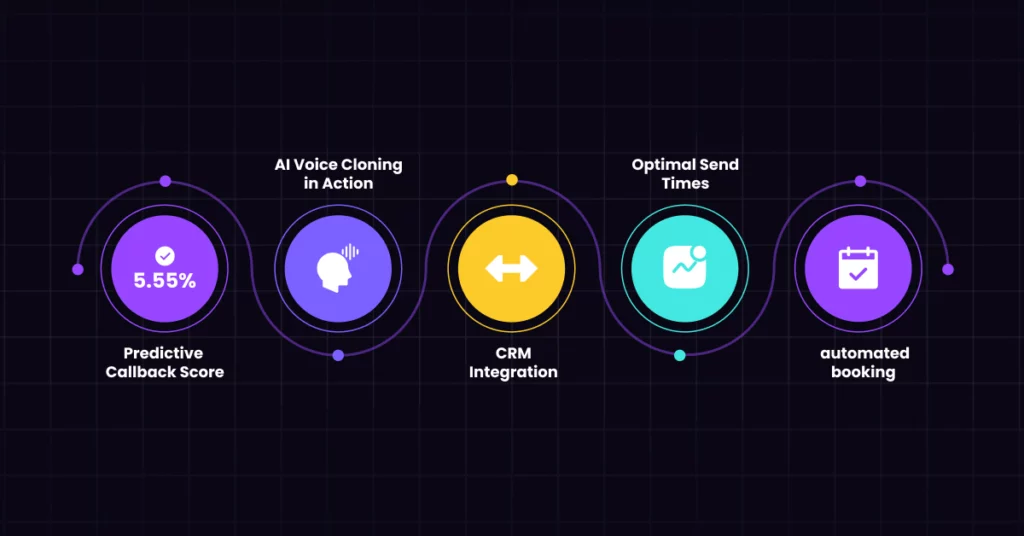
The future of outreach is centered on advanced automation and intelligence. Emerging trends are moving far beyond simple ringless voicemail. AI-driven personalization will become the standard, where the AI can adjust message tone and content based on prospect data. VoiceDrop is already leading this with AI voice cloning and its AI Inbound Agent, powered by its proprietary AI voice engine.
The next step is predictive analytics and integration. Platforms will offer predictive callback scoring to route the hottest leads instantly. Integration with CRM systems will become tighter, allowing two-way syncs and campaign triggers based on form submissions or CRM events. Another major upcoming feature is the ability for the AI agent to handle direct calendar booking after qualifying a lead (on the roadmap). These trends will fundamentally transform sales outreach, making it more efficient and vastly more engaging. Explore advances in AI voice technology here: AI Voice Advancements.
Data & Metrics to Watch
You cannot improve what you do not measure. Marketers must track several key metrics to measure the performance and ROI of any voicemail campaign.
- Delivery Rate: The percentage of messages successfully dropped into a voicemail box. The industry average is 60-80%.
- Callback Rate: The percentage of successful deliveries that result in a callback. On VoiceDrop, top accounts hold 6% to 7% and the best campaigns reach 8% to 10%.
- Conversion Rate: The percentage of callbacks that convert into a booked meeting or a closed deal.
- Cost Per Callback: A calculation of the total campaign cost divided by the number of callbacks received. This should be under $3.00 for an efficient campaign.
These metrics guide your strategy. If your delivery rate is low, you need better list validation. If your callback rate is low, you need to A/B test your script and voice speed. Use the data to refine your lists, optimize your script, and adjust your sending times. Learn how to boost your callback rates here: Increase Callback Rates.
Integration Tips
Integration is key to maximizing efficiency and personalization in your campaigns. The goal is to move beyond simple bulk uploads and create seamless, automated workflows.
Integrating with CRM Systems
Syncing your voicemail platform with your CRM system allows you to track contacts and manage follow-ups effectively. This means you can automatically trigger a voicemail campaign when a lead hits a certain stage in the pipeline. Two-way sync capabilities ensure that a callback received through VoiceDrop instantly updates the record in your CRM. This is essential for improved lead management and preventing sales reps from making redundant calls.
Connecting with Marketing Automation Tools
By integrating with platforms like Zapier or Make.com, you can create cohesive, multi-channel outreach. An interested prospect who calls back might trigger an SMS follow-up or a personalized email sequence. This automation reduces manual work and ensures consistent messaging across all channels, such as email, SMS, and voice. For more information on sales outreach tools, click here: Sales Outreach Tools. This is a core function of Marketing automation tools.
Leveraging Analytics and Reporting Tools
Integrating voicemail platforms with analytics dashboards allows tracking delivery rates, callbacks, and conversions. This central view lets you correlate voicemail performance with other activities like email opens or site visits. Using this data is what allows you to optimize campaigns, refine scripts, and improve your ROI over time. This is powered by effective Reporting tools.
Maintaining Data Accuracy and Compliance
Discuss best practices for keeping contact lists updated and ensuring all integrations comply with TCPA and opt-in regulations. Use phone validation and HLR lookup tools built into the platform to keep contact lists clean. You must also ensure that every step of your integrated workflow respects DNC and TCPA regulations. Tools or processes should be in place to prevent duplicate contacts or incorrect data from causing legal risks. This focus on quality ensures high Data Accuracy.
Final Recommendations
The debate between manual voicemail marketing and Automated Voicemail Marketing is settled for any business seeking growth: Automated Voicemail Marketing is the superior solution. While manual dialing offers pure personalization, it is entirely unscalable, resource-intensive, and impossible to track with precision. Modern businesses need to work smarter, not harder.
To succeed, you must embrace the power of personalization at scale. Your final strategy should focus on creating, optimizing, and measuring voicemail campaigns that drive higher callbacks. Clone your voice for the human touch, use variables for personalization, and rely on the platform’s analytics for continuous improvement. The right tool, such as VoiceDrop.ai, will ensure scalability, maintain compliance, and deliver results that traditional methods cannot touch.
Call to Action
Ready to transform your outreach? Stop manually dialing and start closing deals. Every day without VoiceDrop is a callback lost. You can start a campaign in 15 minutes with a free 7-day trial. If just one callback becomes a client, the platform pays for itself for months.
Click here to schedule a demo and see the AI-powered difference.
FAQ’s
1. What is the difference between manual and automated voicemail marketing?
Manual voicemail marketing involves leaving individual voicemails by hand. Automated Voicemail Marketing uses software, like a ringless voicemail platform, to send pre-recorded or dynamically generated voicemails to multiple contacts efficiently.
2. Can automated voicemail campaigns be personalized?
Yes. Modern platforms like VoiceDrop.ai allow dynamic personalization. This includes using AI to insert recipient names and contextual details for higher engagement.
3. Are automated voicemail campaigns legal?
Yes, if they comply with TCPA regulations and opt-in rules. It is essential to follow legal guidelines for automated messaging to avoid penalties.
4. Can voicemail campaigns work for cold leads?
Yes. Both manual and automated approaches can engage cold leads effectively if the messages are concise, personalized, and well-timed.
5. How often should I send voicemails in a campaign?
Frequency depends on the audience and campaign goals. Typically, 1-2 voicemails per week per contact is effective without being intrusive.