Every campaign manager has a blind spot in their database: the “Silent Voter.” You have their name, precinct, and party affiliation, yet they are still impossible to reach. Calling isn’t an option because there’s no landline, and texting won’t work either since no mobile data is available. Essentially, they are invisible to your campaign.
In the razor-thin margins of the 2026 election cycle, you cannot afford to have 30-40% of your district in the dark. Data is the new ground game. Appending mobile numbers is the strategic bridge that transforms a static, dusty list of names into a dynamic, interactive force that drives turnout.
Without this critical step, your digital strategy is simply shouting into the void.
What Does It Mean to “Append” Voter Data?
First, let’s clear up a misconception: Appending is not buying a cold list of strangers. It is the process of enhancing the assets you already own.
From “Flat File” to “Rich Data”
A standard voter registration list from the county is a “flat file.” It tells you where a voter lives, but not how to talk to them. It is functionally useless for modern digital outreach.
An Enriched File changes the game. By appending data, you fill in the critical blanks:
- Mobile Numbers (for SMS)
- Personal Emails (for fundraising)
- Demographics (for targeting)
Suddenly, your spreadsheet isn’t just a record; it’s a weapon.
How the Matching Process Works
The process is instantaneous. The system takes your raw data, e.g., “Jane Doe at 123 Maple Ave, and scans it against massive commercial telecom databases containing billions of records.
It identifies a high-confidence match and returns the missing key: “Jane Doe: 555-0199 (Mobile).” This turns a dead lead into a contactable voter in seconds.
Why You Can’t Rely on the Board of Elections
Rookie candidates often think, “Why pay for data when the Board of Elections gives it to me for free?” Here is the harsh reality: Free data is often dead data.
The Landline Problem (Cord-Cutting)
Government lists are notoriously heavy on landlines. But today, over 70% of American households are wireless-only. If you rely strictly on the Board of Elections’ data, you are actively ignoring 7 out of 10 voters in your district. You simply cannot win a modern race by talking to only 30% of the electorate.
🚫 Stop texting landlines. Not sure if that number on your list is a mobile or a home phone? Don’t waste your budget on failed messages. Run a specific Carrier Lookup now on 1Lookup to instantly separate mobile users from landlines. 1Lookup is built by the same team as VoiceDrop.
Data Decay in Public Records
Furthermore, public records suffer from significant “data decay.” Government databases are updated slowly, often only when a citizen actively votes or renews their driver’s license. Conversely, commercial databases are dynamic.
They are updated in real-time, capturing moves, new service activations, and number changes much faster than any bureaucratic entity can manage.
The Strategic Value of Mobile Appending
Budgeting for data appending often raises questions, but the return on investment is undeniable. Why should a campaign manager spend precious resources on this service?
Unlocking High-Engagement Channels (SMS & RVM)
You cannot text a landline. But once you append mobile numbers, you unlock the holy grail of engagement: SMS.
While email open rates struggle at 20%, text message open rates sit at 98%. Furthermore, mobile data enables you to deploy Ringless Voicemail (RVM), delivering your candidate’s message directly to a voter’s inbox without the phone ever ringing.
To execute advanced political text messaging strategies, you first need the raw fuel: verified mobile numbers.
Reaching the “Unreachable” Demographics
Gen Z, Millennials, and renters are notoriously hard to reach via door-knocking. They are rarely home, and they never answer unknown calls. Mobile appending is the only bridge to these voters. Without it, you are ceding the youth vote to your opponent.
Step-by-Step: How to Append Mobile Numbers
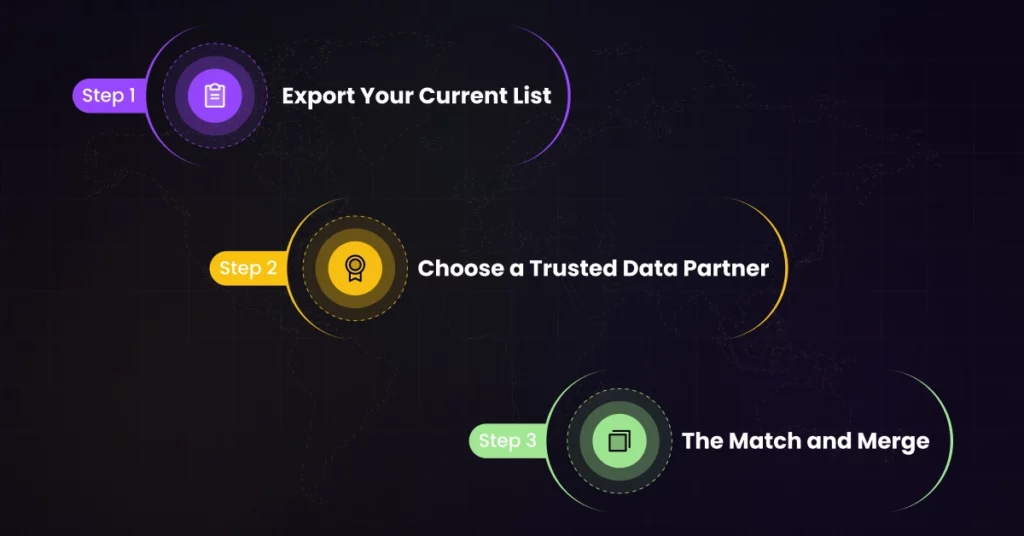
Ready to modernize your list? Follow this workflow to ensure clean data integration.
Step 1: Export Your Current List
Export your current voter file (CSV or Excel). Crucial: Ensure your column headers are distinct (First Name, Last Name, Address, Zip). The cleaner your input data, the higher your “Match Rate” will be.
Step 2: Choose a Trusted Data Partner
Upload your file to a trusted partner. The system will scan your list against the telecom database.
Note: Expect a 40-60% match rate. You will not find a number for every single person, and that is okay. Finding mobile numbers for half of your “unreachable” list is a massive victory.
Step 3: The “Match and Merge”
Once you submit your file, the matching begins. It is essential to have realistic expectations regarding the “Match Rate.” You will rarely get a 100% match. Typically, you can expect 40-60% of your list to find a solid mobile game. This is a typical and highly valuable result that instantly doubles or triples your reach.
✅ Verify before you dial. Even appended lists can have errors. Before you load thousands of numbers into your SMS platform, run a quick validity check. Test your data with the 1Lookup Validation Tool to ensure every number is active and reachable.
Navigating Compliance: TCPA & Appended Data
Great power comes with great legal responsibility. Appending data is legal, but how you use it is strictly regulated.
Consent vs. Public Record
Just because you found a voter’s number does not mean they opted in.
- Auto-Dialing (Robocalls): Generally requires express written consent. Do not robocall appended numbers.
- Peer-to-Peer (P2P): In most cases, political P2P texts (where a human manually hits send) are compliant with outreach guidelines.
Always consult your legal counsel, but understand that the delivery method matters as much as the data source.
Scrubbing Against the DNC
Additionally, even if you append a number legally, you must respect your internal lists. Always scrub new numbers against your internal “Do Not Call” list. Ignoring a voter’s previous request to be removed is the fastest way to invite harassment complaints and potential fines.
For a deeper understanding of these rules, review the official FCC robocall regulations.
Quality Control: Ensuring Accuracy
A common fear among campaign managers is “paying for bad numbers.” Fortunately, there are ways to mitigate this risk.
Confidence Scores explained
Reputable vendors don’t just give you a number; they provide a “confidence score.” This metric indicates how specific the system is that the number belongs to the target individual (e.g., “We are 90% sure this is John’s number”). You should teach your team to filter your lists, prioritizing high-confidence matches for your most important campaigns.
Verification After Appending
Before loading data into your dialer, run an HLR (Home Location Register) Lookup. This technical check pings the network to see if the number is currently active.
Once your list is scrubbed and verified, you can safely deploy high-impact tools like Ringless Voicemail for Political Campaigns to engage donors withoutfear of bounce rates or spam flags.
Maximizing ROI from Your New List
Now that you have a clean, enriched database, how do you use it to win?
Targeted SMS Fundraising
One immediate application is fundraising. You can now send donation links directly to a supporter’s pocket. Mobile donors tend to convert significantly faster than direct mail recipients because the friction is so low that they can often donate with a single click.
Polling and Surveying
Furthermore, mobile numbers enable rapid responses. Use your new list to send out quick text polls to gauge voter sentiment on breaking news. This real-time feedback loop allows your campaign to pivot strategies instantly based on accurate data.
Common Pitfalls to Avoid
As you embark on this process, be mindful of these common mistakes.
Over-Appending (Quantity vs Quality)
Do not fall into the trap of quantity over quality. Don’t force a match on every record if the data isn’t there. It is far better to have 50% accurate, reachable numbers than 90% guesses that lead to wrong numbers and angry voters.
Ignoring Data Hygiene
Finally, remember that data is never static. People move, get married, and change careers constantly. An appended list is a snapshot in time; therefore, it needs to be cleaned and re-verified at least every 6 months to maintain its value.
Keeping up with mobile technology facts highlights how quickly the landscape changes, reinforcing the need for regular hygiene.
Conclusion
A voter list without mobile numbers is like a car without gas; it looks nice, but it won’t get you to the finish line. In the 2026 cycle, the ability to reach a voter’s pocket directly is the deciding factor between a win and a concession speech.
Don’t let your voter list gather dust while your opponent captures the digital ground game. Enrich your data, verify your numbers, and start the conversation.
🚀 Ready to upgrade your outreach? Get a free data consultation today and start connecting with the voters who actually decide elections.
FAQs
What is the average match rate for voter lists?
Typically, match rates range from 40% to 70%. This variance depends mainly on the quality of your initial addresses and the specific region you are targeting.
Can I append email addresses as well?
Yes, absolutely. Most professional services allow you to append emails, landlines, and detailed demographic info simultaneously, giving you a complete 360-degree profile of the voter.
Is it expensive to append mobile numbers?
It is usually very cost-effective. Most vendors price per “hit” (per successful match), meaning you only pay for the data you actually receive, not for the entire file you upload.