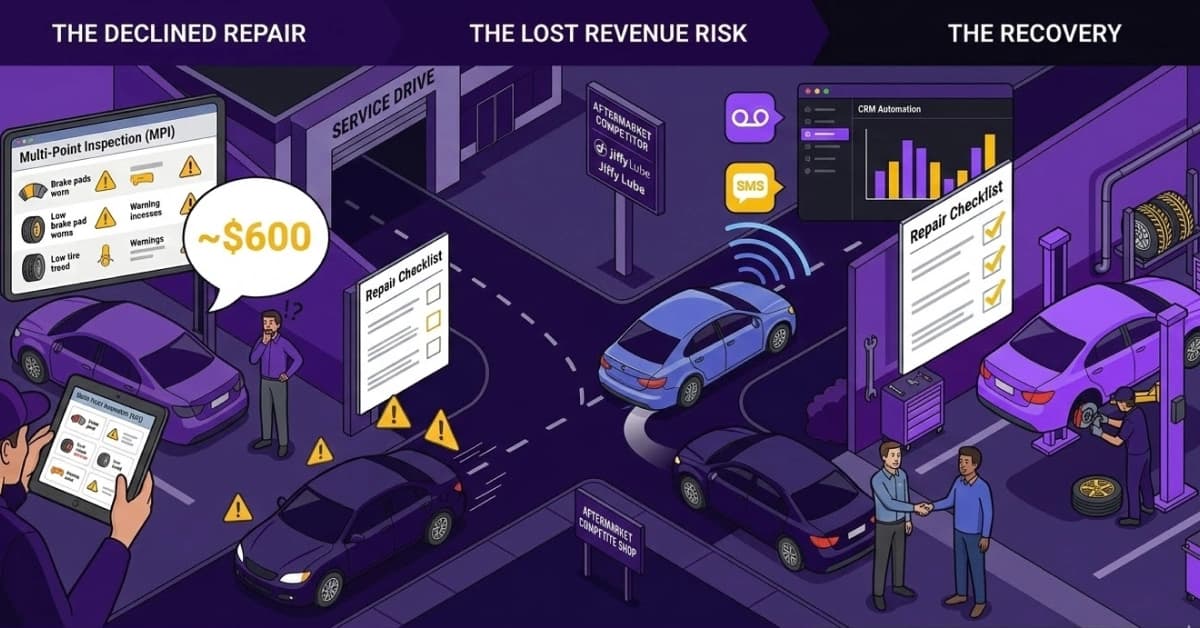
Service Lane Leakage is the silent killer of dealership profitability. It is a scenario that plays out in service drives daily: A customer arrives for a routine oil change, and your Multi-Point Inspection (MPI) reveals a critical need for new brakes or tires totaling $600.
However, due to immediate sticker shock or a tight schedule, the customer declines the recommendation and drives away.
This interaction represents more than just a missed sale for the day; it is a massive retention risk. If that customer eventually visits an aftermarket competitor, such as Jiffy Lube, to get that repair done cheaper, you haven’t just lost a repair; you have likely lost a service customer forever.
Closing the loop on these declined repairs is not optional; it is essential for long-term dealership health.
The Economics of “Unsold Labor”
To understand the gravity of the situation, we must analyze the financial impact of “Unsold Labor.” In many dealerships, the dollar value of declined work sitting dormant in the DMS often exceeds the value of work actually sold on any given day.
This is revenue that has already walked through your door, occupied a technician’s lift, and consumed an Advisor’s time, yet failed to convert.
Furthermore, reclaiming this revenue is the fastest way to boost your Fixed Absorption Rate. This metric measures the percentage of the dealership’s operating overhead covered by the service and parts departments.
Capturing just 20% of previously declined work can drastically improve this percentage, effectively insulating the dealership from fluctuations in variable sales. For a deeper dive into industry benchmarks, review the latest NADA Fixed Ops Data.
The Psychology of the “No”: Why Customers Decline
You might wonder why a second attempt would work if they already said no. To explain this, we must look at the psychology behind the decline. Customers typically refuse service for two primary reasons: Sticker Shock (price sensitivity) or Lack of Trust (skepticism regarding urgency).
In the heat of the moment, standing at the service counter, the pressure is high. However, a follow-up 24 hours later changes the dynamic entirely.
By then, the customer has had time to cool down, review their bank account, and, most importantly, recognize the safety risk of ignoring the repair. Consequently, a well-timed reminder acts as a helpful service rather than a sales pitch.
The Bottleneck: Why Service Advisors Fail to Follow Up
If the revenue potential is so high, why don’t Service Advisors make these calls? The answer lies in the “Whirlwind” of the Service Drive. Advisors are constantly greeting customers, writing Repair Orders (ROs), managing technician workflows, and handling cashiers.
Realistically, Advisors physically do not have two hours a day to make 40 outbound calls to yesterday’s declined list. Moreover, they often suffer from “Phone Fatigue,” viewing outbound dialing as nagging, which conflicts with their role as customer service professionals. As a result, these high-value leads are abandoned.
Efficiency is the only cure. Nothing kills a Service Advisor’s remaining motivation faster than dialing a wrong number during their precious free time.
Ensure your team is reaching the actual vehicle owner every time. Perform a quick Reverse Phone Lookup on 1Lookup to confirm the identity behind the number before you invest time in the call.
The Automated Solution: Ringless Voicemail (RVM) for Service
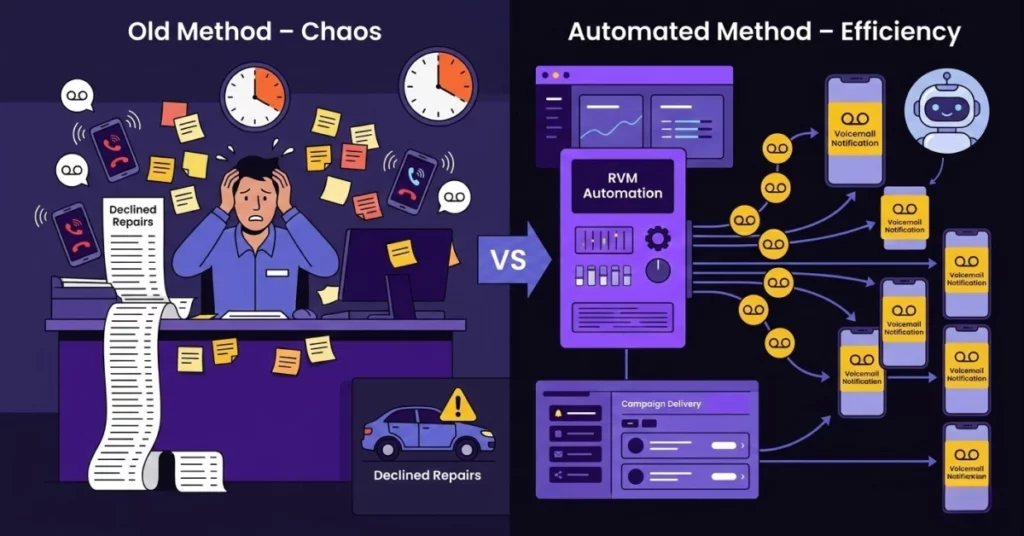
To solve the volume problem without burning out your staff, smart dealerships are turning to automation. Ringless Voicemail (RVM) positions itself as a “Virtual Assistant” for your advisors. Instead of manual dialing, RVM delivers a perfect, non-intrusive message to 100% of yesterday’s declined customers in minutes.
Automation solves the volume problem. Smart dealerships are turning to Ringless Voicemail (RVM), which acts as a “Virtual Assistant” for your advisors. Instead of manual dialing, RVM delivers a consistent, non-intrusive message to 100% of yesterday’s declined customers in minutes.
Crucially, this technology allows you to control the tone perfectly. The message isn’t a high-pressure request for money; rather, it is a courtesy notification about vehicle safety.
This approach preserves the advisor-customer relationship while subtly nudging the customer back into the service bay. To see how this aids service departments, explore VoiceDrop Automotive Solutions.
Step-by-Step: Executing the Declined Service Campaign
Automation requires a strategy to be effective. You cannot simply blast a generic message to everyone. Here is a technical, process-driven approach to setting up your campaign.
Step 1: Segmentation and Data Hygiene
Success begins with clean data. You must filter your DMS (whether CDK, Reynolds, or Dealertrack) to identify the highest value opportunities. Specifically, filter for “Red” (Safety) and “Yellow” (Maintenance) items valued over $150.
Step 1: Segmentation and Data Hygiene. Success begins with clean data. You must filter your DMS (CDK, Reynolds, etc.) to identify high-value opportunities, specifically “Red” (Safety) and “Yellow” (Maintenance) items valued over $150.
Pro Tip: Your automation is only as good as your data. Sending text messages or voicemails to landlines or disconnected numbers is a waste of budget. Before you upload your list, use a Reverse Phone Lookup tool to instantly verify line types and ensure every message lands on a valid mobile device. 1Lookup is built by the same team as VoiceDrop.
Step 2: The “Concerned Advisor” Script
The content of your voicemail is critical. It must sound like a personal update, not a robocall.
- Script Template: “Hi, this is [Manager Name] at [Dealership]. I was reviewing the technician’s notes on your [Car Model] from yesterday and noticed we flagged the [Part Name] as a safety concern. I wanted to see if you had questions on the pricing or if we could prioritize this for you to ensure the vehicle is safe. Give me a call back at…”
Step 3: The “Visual Proof” Add-On
If your dealership utilizes video MPI tools like TruVideo or Xtime, leverage them. In your voicemail, mention the video evidence. For example, say, “I can re-send the video the technician took so you can see the wear for yourself.” This reinforces trust and validates the recommendation.
Compliance: TCPA Rules in the Service Drive
Even though these are existing customers who have recently visited your shop, strict adherence to regulations is non-negotiable. You must navigate the Telephone Consumer Protection Act (TCPA) carefully.
Transactional vs. Marketing Messages
It is important to distinguish between message types. A call regarding a safety recall or a critical safety repair is often viewed as “informational” or “transactional.” These generally have more leeway than a pure “Marketing” message, such as a “Buy 3 Tires Get 1 Free” offer.
Nevertheless, you should always scrub your list against the National Do Not Call (DNC) registry and offer an opt-out mechanism to be safe. For a comprehensive understanding of the legal landscape, always refer to the official FCC Consumer Protections documents.
Handling the Callback: Converting the Lead
Once the campaign launches, it will generate inbound calls. Consequently, your Advisors must know how to handle them. The goal is not just to quote the same price that was declined yesterday.
Once the campaign launches, it will generate inbound calls, so your Advisors must be prepped. The goal is not just to quote the same price that was declined yesterday.
Instead, the Advisor should offer a “soft landing.” Often, the decline was due to logistics, not just price. Offer a loaner vehicle, a shuttle ride, or a small incentive to secure the appointment immediately.
For instance: “If you can bring it in on Thursday, I can knock 10% off the labor cost since the parts are already here.” This bridges the gap between the customer’s budget and the repair cost.
Integration: Connecting RVM to Your Tech Stack
While manual uploads work, this process shouldn’t remain manual forever. Efficiency comes from integration. You want to connect your voicemail drop software directly to your CRM or DMS.
By utilizing tools like Zapier or an open API, you can trigger these voicemails automatically. For example, the moment an RO is closed with a status of “Declined Services,” the system can schedule the follow-up for 24 hours later. To learn more about connecting these workflows, check out VoiceDrop Integrations.
Measuring Success: KPIs That Matter
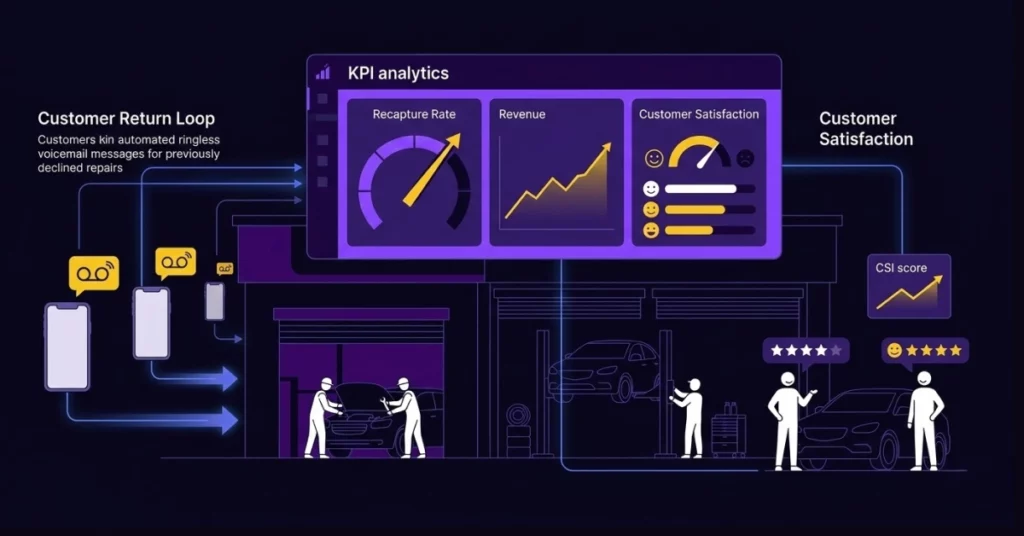
Finally, you cannot manage what you do not measure. When tracking this campaign, do not just count the number of calls sent; count the revenue generated.
The primary metric to watch is the “Recapture Rate,” which is the percentage of declined customers who return for service within 14 days.
Additionally, monitor your Customer Satisfaction Index (CSI). Surprisingly, customers often appreciate follow-up when framed as “care” rather than “cash.” High retention and satisfaction scores are the ultimate goal, as reflected in benchmarks such as the J.D. Power Service Index.
Conclusion
In the automotive service industry, a “No” today often just means “Not right now.” By failing to follow up, you are essentially handing thousands of dollars in uncaptured revenue to your competitors.
Stop letting revenue drive off your lot. Automate your safety follow-ups, protect your customers, and increase your hours per RO without adding to your Advisors’ workload. Ready to recapture lost labor? Book a Service Demo with VoiceDrop today.
FAQ’s
How soon should I send a voicemail about a declined service?
The “Goldilocks Zone” is typically 24 to 48 hours after the appointment. At this stage, the issue is still fresh in the customer’s mind, but the immediate stress or rush of the dealership visit has faded, making them more receptive to a solution.
Should I follow up on “Yellow” (Cautionary) items?
Yes, absolutely, but the script should be adjusted. Frame “Yellow” items as “planning for the future” rather than an “immediate safety risk.” This positions you as a partner in their vehicle’s long-term health.
Can this strategy replace my Service BDC?
No, it empowers them. Automation handles high-volume, low-contact work, allowing your human agents to focus on complex issues and inbound appointments generated by the voicemail campaign.