If you’ve been searching for a mass communication tool to amplify your outreach efforts, CallFire is likely on your radar.
Known for its robust “Voice Broadcast” and text messaging capabilities, it’s a popular choice for businesses, political campaigns, and non-profits that need to reach thousands of contacts instantly without the hassle of manual dialing.
But when it comes to CallFire pricing, is it the right investment for your operational needs?
With scalable features like IVR (Interactive Voice Response) and bulk SMS, understanding precisely what you get for your money and how the credit system works is crucial.
In this guide, we’ll break down CallFire’s pricing structure, what features are included in its tiers, and how it compares to other solutions on the market.
By the end, you’ll have a clear idea of whether CallFire fits your budget and campaign goals.
What is CallFire?
CallFire is a cloud-based Communications Platform designed to streamline mass outreach by automating voice and text messaging campaigns.
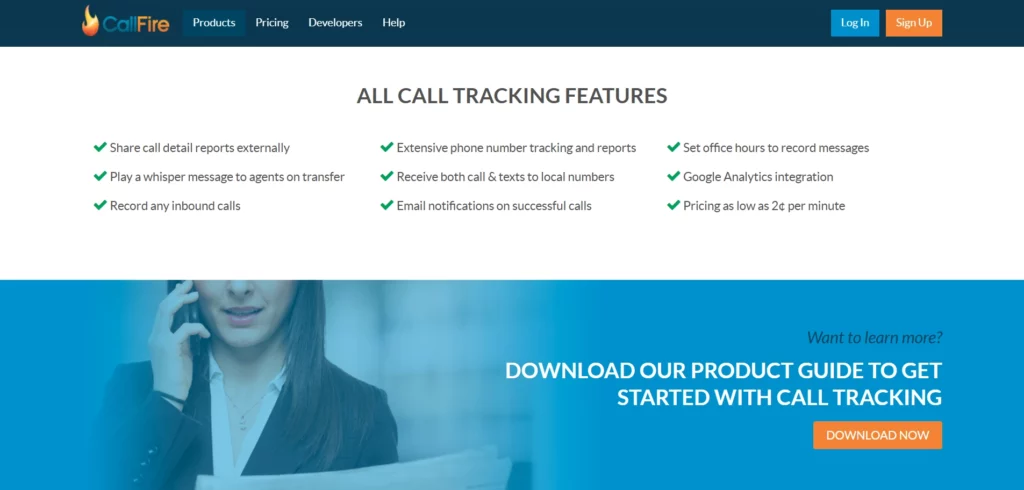
Unlike traditional business phone systems, CallFire specializes in broadcasting messages to large audiences simultaneously.
It uses cloud technology to manage mass texts, voice broadcasts, and call tracking, ensuring your message reaches the right people at the right time.
It is widely used by:
- Political Campaign Managers
- Small Business Owners
- Non-Profit Organizations
- Real Estate Agents
- Debt Collection Agencies
The platform integrates seamlessly with major CRM software and offers a developer API, aiming to bridge the gap between your contact lists and actionable engagement.
CallFire Pricing Plans Overview
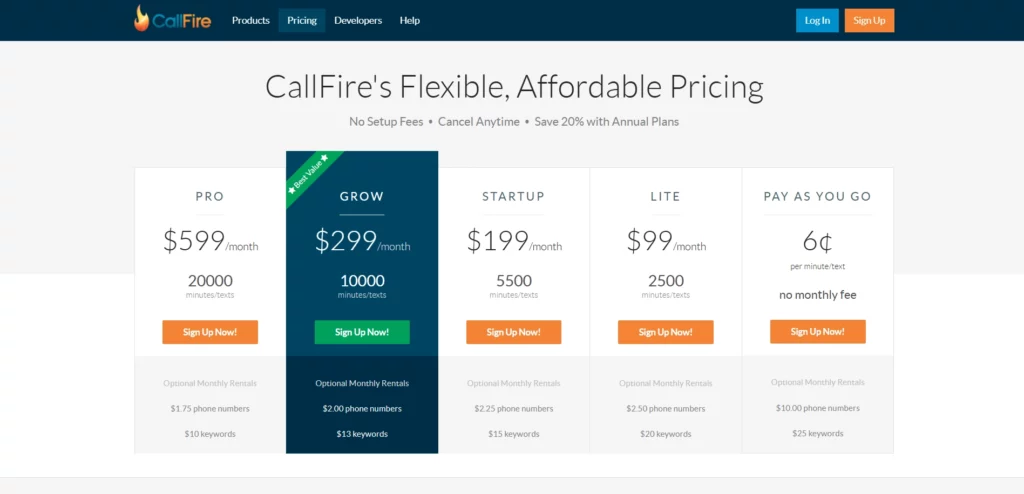
CallFire typically structures its offering into tiers based on the volume of “credits” (minutes or texts) you need: Lite, Startup, Grow, and Pro (Plan names and credit allotments generally reflect a tiered value system).
A few important notes before we dive into each plan:
- Plans are priced based on a monthly allowance of minutes/texts.
- Credits generally expire at the end of each billing cycle (use it or lose it).
- There is a flexible “Pay As You Go” option for sporadic users.
- No contract is required, allowing month-to-month flexibility.
While the price tiers seem straightforward, the real value of a tool depends on its performance and reliability. To see how these features hold up in real-world scenarios, read our full CallFire Review.
Let’s look at what the pricing tiers generally entail.
Lite Plan (Entry Level)
Price:
$99 per month
Free trial:
No (Pay As You Go option available for testing)
Features included in the plan:
- 2,500 Minutes/Texts per month
- Unlimited Contacts
- Call Recording (Inbound)
- System Broadcasts
- Reporting & Analytics
- Standard Support
- Local Phone Number capability (additional cost per number)
The Lite tier is a solid entry point for small businesses that want to professionalize their outreach but aren’t ready for massive volume.
It covers the essentials: sending out appointment reminders, alerts, or small-scale promotions without breaking the bank.
If your primary goal is to maintain consistent touchpoints with a modest database, this plan delivers the core CallFire experience at roughly 4 cents per unit.
However, for organizations planning heavy campaign blasts, the 2,500 credit limit may be restrictive.
Startup & Grow Plans (Scaling Operations)
Price:
$199 – $299 per month
Free trial:
No
Features included in the plan:
- Everything in Lite
- 5,500 to 10,000 Minutes/Texts per month
- Lower Cost Per Unit (approx 3 – 3.5 cents)
- Dedicated Keywords (for SMS marketing)
- Interactive Voice Response (IVR) setup
- API Access for integrations
- Discounted Phone Number Rentals
The Startup and Grow plans are the most popular choices for growing businesses. They unlock significant volume increases, which is CallFire’s primary value proposition.
According to recent marketing statistics, SMS open rates can reach 98%.
Tools like the Startup and Grow plans aim to leverage this by allowing you to broadcast thousands of messages simultaneously.
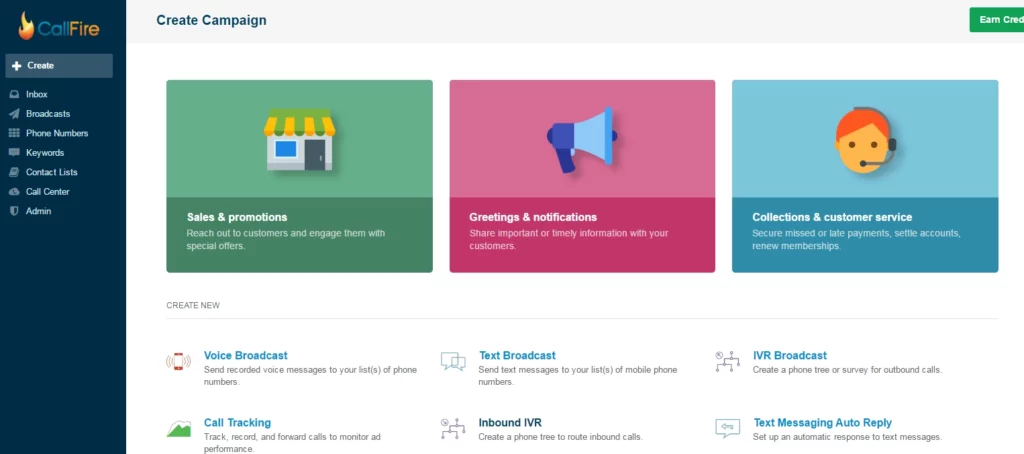
The system handles the heavy lifting of dialing or texting, allowing you to set up “Press 1” campaigns in which live agents intervene only when a customer shows interest.
A reduction in per-unit cost in these tiers makes it much easier for staffing agencies or political groups running monthly drives to achieve ROI.
With robust reporting, you can track which campaigns are performing and adjust your strategy in real time.
Pro Plan (High Volume)
Price:
$599 per month
Free trial:
No
Features included in the plan:
- Everything in Grow
- 20,000 Minutes/Texts per month
- Lowest Standard Rate (approx 3 cents per unit)
- Priority Support
- High-Volume API limits
- Advanced IVR Logic
- Maximum discounts on Keywords/Numbers
The Pro plan is designed for large organizations that require a heavy-hitting approach to mass communication. The principal value here isn’t just in volume, but in cost efficiency.
At this level, you are paying the lowest advertised rate per message, ensuring that large-scale blasts maximize the budget.
If your business handles complex surveys, massive political polling, or nationwide alerts, the Pro plan provides the necessary bandwidth and infrastructure.
The Overall Pros & Cons
CallFire is a heavyweight in the mass communication space, but it’s not without its drawbacks. Here is a summary of what users typically experience.
Pros
- Ease of Use: The interface is intuitive, allowing users to set up a Voice Broadcast or SMS campaign in minutes.
- Flexibility: The Pay-As-You-Go option lets seasonal users (such as political campaigns) use the tool without a monthly subscription.
- IVR Capabilities: Simple drag-and-drop tools make setting up phone trees (“Press 1 for Sales”) accessible to non-technical users.
- Scalability: You can scale from sending 100 messages to 100,000 messages instantly without changing hardware.
- Unlimited Contacts: Unlike some CRM tools, CallFire doesn’t charge you based on the size of your database, only on your usage.
Cons
- Expiring Credits: On monthly plans, unused credits typically do not roll over to the next month, leading to potential wasted budget.
- Strict Compliance: To avoid spam filters, the platform has strict review processes for campaigns, which can sometimes delay launch.
- Dated Interface: Some users feel the UI is functional but lacks the modern polish of newer SaaS competitors.
- Cost at Scale: While the Pro plan is efficient, ultra-high volume users might find enterprise-specific competitors with slightly lower per-unit rates.
- Support Response: Reviews vary regarding the speed of customer support during peak campaign times.
If you feel that the ‘use-it-or-lose-it’ credit model doesn’t align with your business growth, you might find a better fit elsewhere. We’ve compared the most cost-effective tools in our guide on the Top 5 CallFire Alternatives.
The best alternative for CallFire in terms of an AI voice agent and ringless voicemails
If your primary focus is maximizing reach through AI-powered voice and ringless voicemails rather than a traditional voice broadcast or SMS suite, CallFire might be more infrastructure (and noise) than you need.
That’s where VoiceDrop comes in.
VoiceDrop is explicitly built for sales teams, cold outreach specialists, lead-gen agencies, recruiters, and businesses that want to reach new prospects with scalable, automated voice campaigns and ringless voicemail drops.
Unlike standard voice broadcasting, which can ring the phone (and be intrusive), Ringless Voicemail drops messages directly into the inbox, respecting the prospect’s time while ensuring delivery.
Starting at $95 per month, VoiceDrop lets you send up to 1,000 ringless voicemails. The ENTERPRISE plan also guarantees the best pricing in the market.
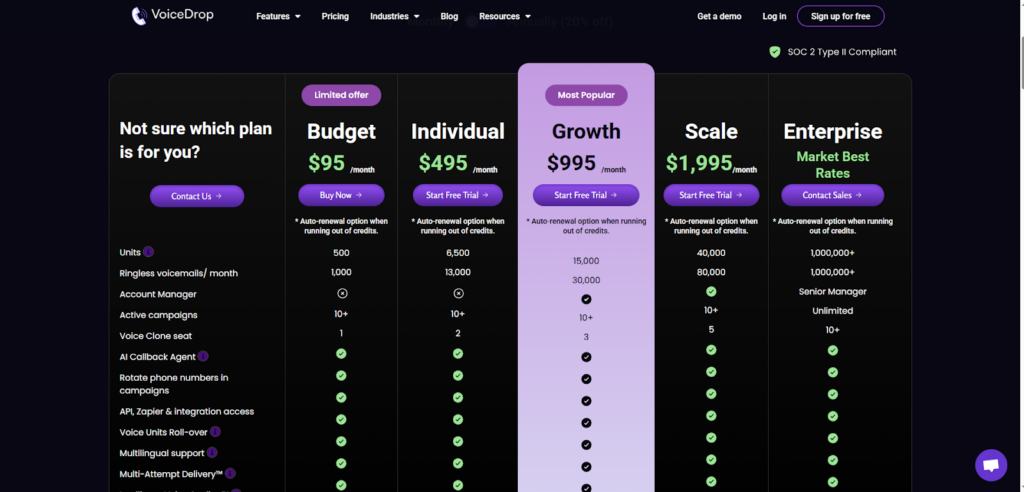
Features of VoiceDrop include:
- Use a phone number you already own
- 10+ active campaigns
- Voice Clone seat(s)
- Rotate phone numbers in your campaign
- Use any phone number you own to send out the RVM
- API, Zapier, Make & CRM integration access
- Voice Units Roll-over
- Multilingual support
- Multi-Attempt Delivery™
- Intelligent Voice Scaling™
You’ll get all features included in other plans, plus a 7-day free trial to see why VoiceDrop is considered the top choice for ringless voicemail software by industry experts, and how it stands out in real-world use cases compared to traditional broadcasters.
FAQ’s
Is CallFire free?
No, CallFire does not offer a free plan. However, they do offer a “Pay As You Go” model where you only purchase the credits you need without a monthly subscription fee.
Does CallFire charge extra for usage?
Yes and no. The monthly plans come with a set allowance of minutes/texts. If you exceed that allowance, you must purchase additional credits (usually at the overage rate of your specific plan, e.g., 6 cents on Pay As You Go).
What is CallFire used for?
CallFire is primarily used for mass notifications, marketing promotions, emergency alerts, and debt collection. It automates the simultaneous contact of thousands of people by phone or text.
Is there a setup fee or onboarding cost?
Generally, no. CallFire prides itself on being a self-service platform with no setup fees. You can create an account, buy credits, and start a campaign on the same day.