Understand how AI calling compares to ringless voicemail for customer outreach.
Are your outreach campaigns not getting the response you expected? Do you find it hard to choose between modern tools like AI calling services and ringless voicemail to connect with customers? Finding the most efficient, cost-effective, and non-intrusive method can be overwhelming.
Should you rely on AI calling services for real-time interaction, or opt for ringless voicemail that delivers personalized messages directly to voicemail without ringing a single phone? The answer depends on your goals, whether it’s scalability, personalization, or customer comfort.
In this complete comparison guide, explore how both technologies work, their pros and cons, and which one can help you achieve higher engagement, better ROI, and more meaningful customer connections.
What Is an AI Calling Service?
An AI calling service is an advanced communication tool powered by artificial intelligence that automates voice interactions with customers. Instead of relying on live agents, businesses use AI voice systems to make outbound calls, deliver personalized messages, answer basic questions, and even schedule follow-ups, all in real time. These services use natural language processing (NLP) to understand and respond to human speech, making conversations feel more natural and engaging.
However, while it offers convenience and scalability, some customers may still prefer human-like warmth and privacy, which is where ringless voicemail stands out.
What Is Ringless Voicemail?
Ringless voicemail is a marketing and communication technology that allows businesses to deliver voice messages directly to a recipient’s voicemail inbox, without the phone ever ringing. This means the message appears just like a missed call voicemail, but the recipient experiences zero interruption. It’s a subtle yet powerful way to reach prospects and customers without disrupting their day.
Ringless voicemail campaigns can be highly personalized, scalable, and cost-effective. It is ideal for promotions, appointment reminders, and customer follow-ups. Since messages are pre-recorded, businesses can maintain consistency in tone and delivery, while still adding a personal touch.
Key Differences Between the Two
While both AI calling services and ringless voicemail aim to improve customer outreach, they operate very differently in how they connect with audiences. The key distinctions lie in their delivery method, interruption level, personalization potential, and overall cost-efficiency.
Delivery Method (Call vs. Voicemail Drop)
An AI calling service works by placing live, automated calls to prospects. When the phone rings, the recipient must answer to engage with the AI in real time. This live interaction can be effective for urgent notifications or time-sensitive outreach. It also depends heavily on the recipient’s willingness to pick up, which is often low in today’s busy world.
In contrast, ringless voicemail takes a gentler, smarter approach. With solutions like VoiceDrop, your message goes directly into the recipient’s voicemail inbox without ringing. It feels natural, non-intrusive, and respectful of their time that builds trust and familiarity.
Cost & Scalability
AI calling campaigns can quickly become expensive and resource-intensive. Each call consumes time, data, and sometimes requires a human handoff when prospects want to speak with a real agent. This limits how many calls can be handled in a day and increases overall campaign costs.
On the other hand, ringless voicemail offers unmatched scalability and affordability. You can send thousands of personalized voicemail messages in just minutes, all without the need for live agents or time-consuming calls. This ensures that your message reaches a broader audience efficiently, making it an ideal choice for businesses seeking high ROI from their outreach.
Engagement & Response Behavior
AI calling forces prospects to make an immediate decision, answer, or decline. This often leads to low pick-up rates since many people ignore unknown numbers or automated calls. Even if the call connects, the interaction may feel rushed or impersonal, reducing overall engagement.
With ringless voicemail, recipients have control over when to listen, process, and respond to your message. This flexibility improves engagement and boosts callback rates since the listener feels no pressure. Studies have shown that people are more likely to respond when they can do so on their own terms.
Pros and Cons of Each
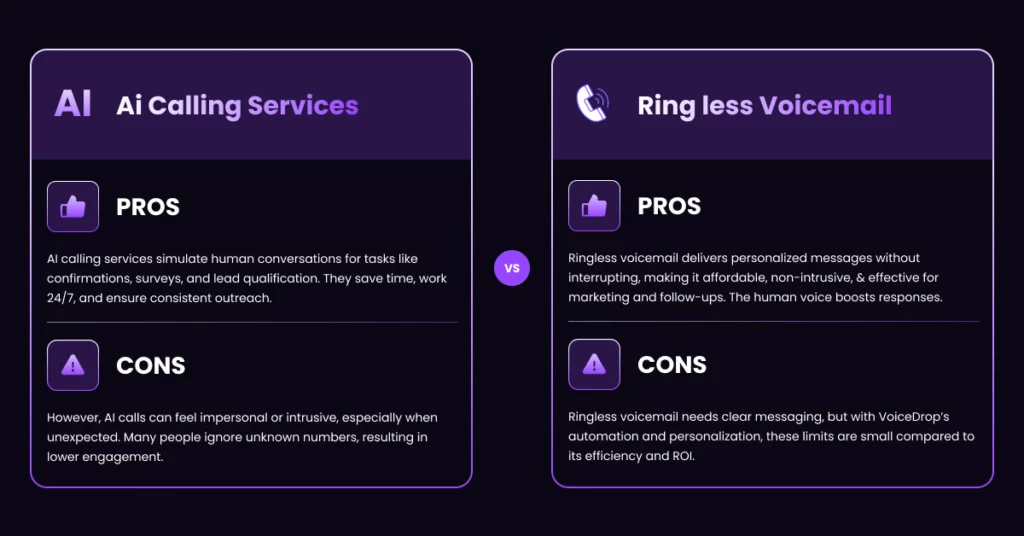
Both AI calling services and ringless voicemail offer distinct advantages depending on your business goals. Understanding their strengths and weaknesses helps determine which tool aligns best with your outreach strategy.
Pros & Cons of AI Calling Service
AI calling services provide real-time communication that can simulate human conversations, making them useful for appointment confirmations, surveys, or lead qualification. They save time for sales teams and can operate 24/7 without fatigue, ensuring consistent outreach.
However, AI calls can feel impersonal or intrusive, especially when recipients receive unexpected automated calls. Many people ignore calls from unknown numbers, leading to low engagement rates.
Pros & Cons of Ringless Voicemail
With ringless voicemail, businesses can send personalized, pre-recorded messages directly to voicemail inboxes. This approach is cost-effective, scalable, and respectful of the recipient’s time. It is perfect for marketing campaigns, reminders, or follow-ups. The human voice element also helps create genuine connections and higher response rates.
While ringless voicemail is powerful for engagement. It also requires crafting clear, concise voice messages to make the best impression. However, when used strategically with VoiceDrop’s automation and personalization tools, these limitations are easily outweighed by its outreach efficiency and ROI potential.
Which Is Right for Your Business?
Choosing between AI calling and ringless voicemail comes down to five simple criteria: budget, urgency, goal (conversation vs awareness), target audience size, and whether you prioritize personalization or speed.
If your budget is tight and you need to reach thousands of prospects with a consistent, human-sounding message, ringless voicemail (VoiceDrop) is the smarter choice.
If you need immediate, two-way conversations, for example, qualified sales calls or time-sensitive crisis outreach, AI calling is the tool that forces real-time interaction.
Integration & API Options
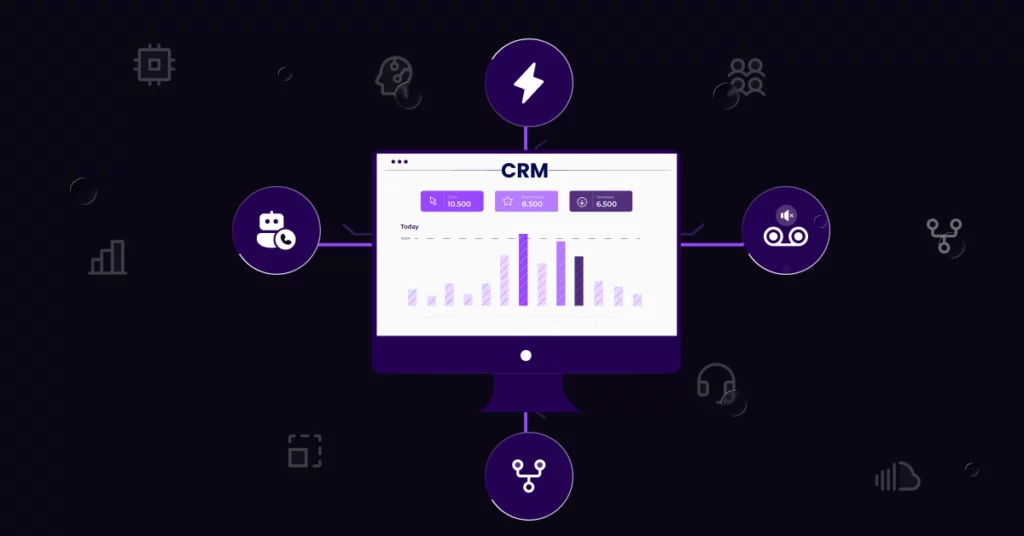
Both technologies are built to plug into these systems so that businesses don’t have to manage outreach manually. For example, a CRM integration lets you automatically send a voicemail or make a call whenever a lead’s status changes. Using automation tools such as Zapier or n8n, you can send a voicemail drop via VoiceDrop. With API connections, developers can build custom triggers between VoiceDrop and other apps in their marketing stack.
The advantage of ringless voicemail is its strong campaign messaging automation capability. You can set it up to send automatic voicemail drops based on real-time CRM updates or customer actions. This will save your team time and ensure consistent follow-up.
Privacy & Compliance
When it comes to automated outreach, privacy and compliance are non-negotiable. AI calling services involve placing live, automated calls to consumers, which means they fall under the same legal category as robocalls. Businesses must obtain prior express written consent before contacting individuals using automated systems. Violating TCPA regulations can result in hefty fines. Additionally, AI systems must provide an opt-out option (such as pressing a key to stop further calls) and honor “Do Not Call” lists to stay compliant.
Ringless voicemail operates differently because it delivers messages directly to voicemail servers without a phone to ring. While this method is generally considered less intrusive, businesses must still follow consent and opt-out rules to remain compliant. Ringless voicemail is typically viewed as a form of direct messaging rather than a live call, reducing the risk of consumer disruption.
Implementation Plan
Launching a ringless voicemail campaign is simple, fast, and incredibly effective when done strategically. Whether you’re reaching out to leads, reminding clients about appointments, or following up on missed calls, the process can be automated for consistency and scale. Here’s a straightforward step-by-step plan to help you implement it successfully using VoiceDrop:
Step 1: Define Your Campaign Goals
Start by identifying what you want to achieve. Are you driving callbacks, promoting a new offer, or re-engaging past leads? Clear goals help shape your message and determine the right audience segment for your campaign.
Step 2: Build and Segment Your Contact List
Import your contacts from your CRM or lead database. Then, segment your list based on criteria like purchase history, location, engagement level, or customer status. Targeted lists ensure that your voicemail feels personal and relevant, not generic.
Step 3: Write and Record Your Message
Craft a short, conversational script, ideally 20–40 seconds that sounds human and friendly. Focus on value, not a hard sell. End with a clear call-to-action (CTA), such as “Call us back at…” or “Visit our website to learn more.” VoiceDrop makes recording and uploading your message quick and easy.
Step 4: Schedule or Automate Delivery
With VoiceDrop, you can either schedule your voicemail drops for specific times or set up automation triggers through your CRM or tools like Zapier and n8n. For example, when a new lead is added or a follow-up reminder is due, a voicemail can automatically be sent, saving your team hours of manual work.
Step 5: Launch a Test Campaign
Before going full-scale, test your voicemail on a small batch of contacts. Check for audio clarity, timing, and delivery success rates. Review feedback and tweak your message if needed.
Step 6: Monitor, Measure, and Optimize
Once your campaign is live, track performance metrics such as delivery rate, callback rate, and conversion rate. Use VoiceDrop’s analytics dashboard to see what’s working best and make data-driven improvements to future campaigns.
Final Recommendation
For most businesses that need scalable, low-cost, and non-intrusive outreach, ringless voicemail with VoiceDrop is the smarter, budget-friendly solution. It delivers personalized voice messages at scale, respects your audience’s time, and drives higher callback rates with less spend. Use it to build awareness, increase appointment shows, and recover missed opportunities.Ready to see it in action? Start a campaign or try VoiceDrop for free to test voicemail drops on your audience and measure real results.