
Volume is the lifeblood of telemarketing. If your agents aren’t dialing, they aren’t selling.
However, for Call Center Managers and Business Owners, scaling that volume creates a dangerous financial paradox. You need high output to generate leads, but “High Volume” is exactly what triggers the hidden penalty clauses in your VoIP contract.
It is the industry’s dirty secret: The “Unlimited” plan you bought for $30/month was never designed for a power dialer. It was designed for a receptionist.
Most carriers bury “Fair Usage Policies” (FUP) deep in their terms of service. These policies often cap “unlimited” usage at 2,500 or 3,000 minutes. Once you cross that invisible line, you face throttling, blocked numbers, or sudden “overage” bills that wreck your margins.
In this guide, we will rank the top providers, expose the realities of VoIP termination they hide, and introduce the “Hybrid Stack” (VoiceDrop + VoIP), a strategy that allows you to scale outreach without hitting the “Fair Use” wall.
Decoding the “Fair Usage Policy” (The Fine Print)
Before you sign a 12-month contract, let’s do the math on what “Unlimited” actually means.
The “Day 18” Problem
Most “Unlimited” plans (such as RingCentral, Zoom, or Nextiva) impose a hard cap of 3,000 minutes per user/month.
- The Math: A typical full-time telemarketer works 22 days a month.
- The Reality: 3,000 minutes ÷ 22 days = 136 minutes (2.2 hours) of talk time per day.
Does your best closer talk for only 2 hours a day? Unlikely. Data shows that a typical telemarketer makes 52 calls per day. On a standard “Unlimited” plan, a productive agent will hit the 3,000-minute wall by Day 18 of the month.
For the remaining 10 days, you are either paying exorbitant overage fees or dealing with throttled speeds that kill call quality. This is not a bug; it is a feature of Fair Usage Policies.
For a deeper understanding of these regulations, you can review the FCC VoIP Consumer Guide to see how service types are defined.
Category 1: General Business VoIP (The “Fake” Unlimited)
These platforms are excellent for internal team meetings but hostile environments for cold calling.
RingCentral / Zoom Phone / 8×8
- The Trap: These providers prioritize “human” conversation patterns. Their algorithms aggressively monitor Concurrent Calls and call duration.
- The Consequence: Telemarketing is characterized by short calls (voicemails, gatekeepers). If a General VoIP provider sees 100 calls under 30 seconds, they will flag your traffic as “Robocalling.”
- Carrier Transparency: Because they resell bandwidth from major carriers, they are quick to burn your number to protect their own network reputation. You might wake up to find your main sales line marked “Spam Likely” across all major networks.
Grasshopper / OpenPhone
- The Positioning: Position these tools primarily as “Solopreneur” solutions.
- The Trade-off: While they are cheap, often costing between $20 and $30, they lack the essential dialer features needed for high-volume outreach.
- The Bottleneck: They do not offer power dialing, click-to-call efficiency, or CRM integrations, making them unsuitable for scaling teams.
Category 2: Dedicated Sales Dialers (True High Volume)
Unlike general VoIP, these tools are built specifically for sales teams. They are significantly more expensive, but they offer higher caps and specialized features.
Kixie (The Power User Choice)
Kixie is a favorite among power users because it offers a more robust “Unlimited” minutes plan. However, you must be prepared for the cost. It is significantly more expensive per seat than standard VoIP because Kixie bakes the heavy carrier costs directly into the license fee.
PhoneBurner (The Bundle)
PhoneBurner operates on a unique model where they handle the carrier side entirely. This ensures you don’t get blocked as easily. Yet, the cost-per-seat is high, often exceeding $100 per user. For a 10-person team, this cost becomes prohibitive compared to a modular stack approach.
You can compare user satisfaction ratings for these platforms by checking the G2 Auto Dialer Reviews.
The Hidden Downsides of Flat-Rate Calling
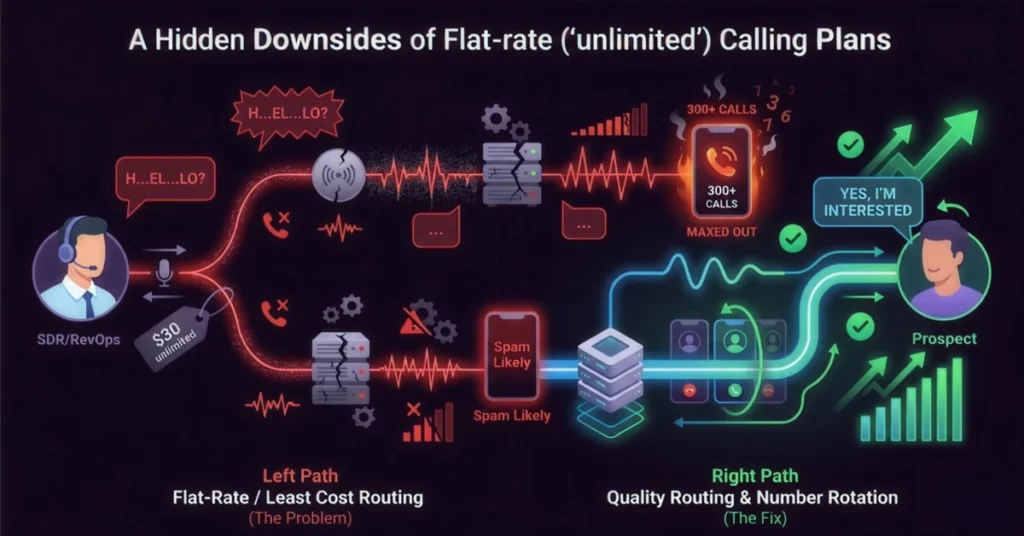
When evaluating dialing solutions, you must look beyond the sticker price. Cheap unlimited plans often come with quality issues that can ruin your campaign’s effectiveness.
Connection Quality
To offer an “Unlimited” plan for $30, providers often use “least cost routing” (LCR). This method routes your call through the cheapest possible path, which frequently results in poor audio quality, latency, and dropped calls. Consequently, your agents come across as unprofessional, and prospects hang up sooner.
“Spam Likely” Flagging
Additionally, if you hammer a single “unlimited” line with 300 calls a day, carriers will flag your number within 48 hours. Once your ID shows “Spam Likely,” your answer rate drops to near zero. While dedicated dialers help, basic unlimited plans rarely include the necessary number rotation strategies for free.
Carrier algorithms punish low connection rates. If you are dialing dead numbers or wrong contacts, your spam score increases instantly. Protect your caller’s reputation by scrubbing your list first. Verify your lead list with 1Lookup to ensure every dial connects to a real person, not a disconnected line. 1Lookup is built by the same team as VoiceDrop.
The “Hybrid Stack” Strategy: Efficiency Over Volume
Smart sales leaders are moving away from brute-force dialing. Instead of paying for unlimited minutes to listen to dial tones, they use VoiceDrop technology to filter leads first.
The Strategy: Use Ringless Voicemail Marketing to maximize efficiency. You can use VoiceDrop to send 1,000 messages instantly. Then you use your expensive “Live Lines” only to talk to the 50 people who actually call back.
This method drastically reduces your need for “Unlimited” outbound minutes by up to 80%, allowing you to switch to cheaper, higher-quality VoIP plans.
Implementing a Scalable Telemarketing Workflow
You can build a tech stack that scales to unlimited levels without incurring unlimited costs by following this simple workflow.
Step 1: List Scrubbing & Enrichment
First, never waste minutes on dead numbers. Always use a validation tool to ensure that every number you dial is active. This protects your sender reputation and saves time.
To run a successful Ringless Voicemail campaign, you need accurate mobile numbers, not landlines. Don’t waste budget on low-quality data. Get 98% accurate mobile data with 1Lookup’s Deep Skip Tracing to maximize your delivery rates before you launch.
Step 2: Automated First Touch (VoiceDrop)
Stop burning agent time on cold calls. Instead, you should deploy a targeted campaign using a Ringless Voicemail Drop.
Instead of a live cold call, the system sends a ringless drop directly to the prospect’s inbox. The message might say, “Hey, this is [Name], I have a quick question about [Topic]…” This effectively filters out the uninterested leads without burning a single minute of agent time.
Step 3: The “Inbound” Closing Call
As a result of the previous step, your agents now spend 100% of their time answering calls from interested prospects. This completely changes the math. You no longer need an expensive “Unlimited Outbound” plan; you simply need a stable inbound line to handle the qualified traffic.
For more on connecting these tools, explore our VoiceDrop Integrations.
ROI Calculator: Flat Rate vs. Pay-As-You-Go
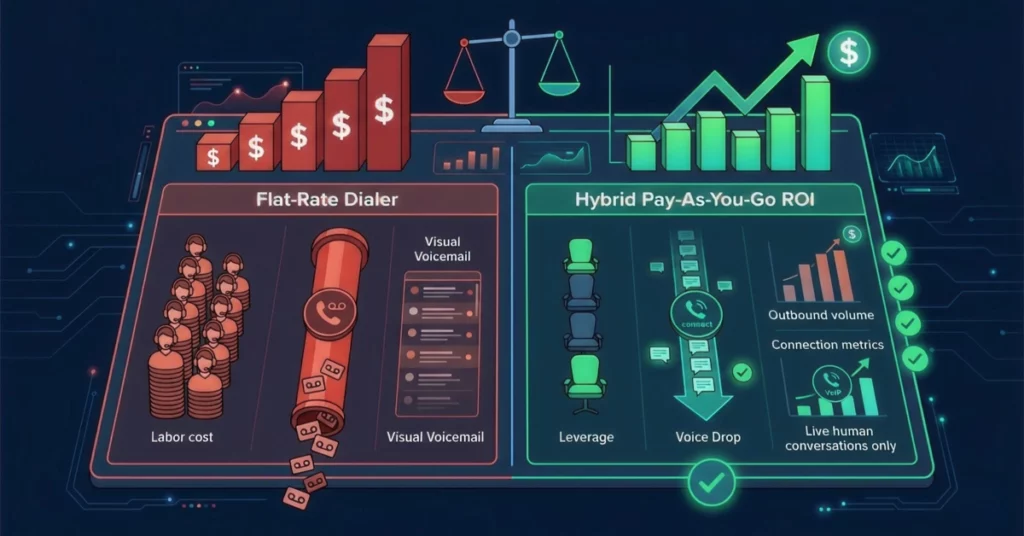
Let’s look at the financial impact of switching to a hybrid model for a team of 5 agents.
Scenario A (Unlimited Dialer) If you choose a premium dialer like PhoneBurner or Kixie, you might pay $150/seat.
- Calculation: $150 x 5 Agents = $750/month.
Scenario B (VoiceDrop Hybrid). Alternatively, you can stack technologies.
- $100 for VoiceDrop credits (covering thousands of drops).
- $30/seat for a basic, high-quality VoIP line for inbound calls ($150 total).
- Total: $250/month.
This approach highlights massive savings while maintaining the same or higher contact rate. For technical definitions on these cost structures, refer to the Gartner VoIP Definition.
Conclusion
The promise of “Unlimited Calling” is enticing, but for high-volume telemarketing, it is often a mirage. Between Fair Usage Policy caps, spam flagging, and expensive per-seat licensing, the “Flat Rate” model is broken for modern sales teams.
In 2026, the competitive advantage belongs to teams that prioritize efficiency, not just activity. By adopting a Hybrid Stack using VoiceDrop for the heavy lifting and a standard VoIP line for the closing, you regain control of your budget.
Don’t let a carrier’s fine print dictate your sales cap.
Ready to scale without the limits? Get Your Free Demo of VoiceDrop today and see how many hours of dialing you can save.
FAQ’s
Do unlimited calling plans really have a limit?
Yes. Most “Unlimited” plans have a Fair Usage Policy (FUP) cap of around 3,000 minutes per user/month. Exceeding this limit can result in immediate service suspension or costly overage fees.
What is the best auto dialer for small businesses?
For pure volume, tools like PhoneBurner are good but expensive. However, for cost-efficiency, stacking a CRM with VoiceDrop enables higher volume at significantly lower cost.
How can I avoid my calls being flagged as “Spam Likely”?
Do not use a single unlimited line for high-volume calling. Use number rotation strategies and warm up your numbers, or use Ringless Voicemail to bypass the carrier flags entirely.
Is VoIP cheaper than a traditional landline for call centers?
Yes, VoIP is generally 30-50% cheaper. However, for high-volume sales teams, usage-based VoIP (paying for what you use) is often cheaper than flat-rate “unlimited” plans because you avoid paying for idle time.