SaaS bloat has become the silent budget killer of 2026.
In previous years, “growth at all costs” was the mantra. Today, CFOs and RevOps leaders are scrutinizing every line item. The era of unquestioningly approving $150/seat tools for every Sales Development Representative (SDR), regardless of their actual output, is effectively over.
Research indicates that hidden costs in software implementation can amount to 3-6% of mid-sized distributors’ total revenue. This stems largely from inefficiency, redundancy, and the “sticker shock” that follows contract signing.
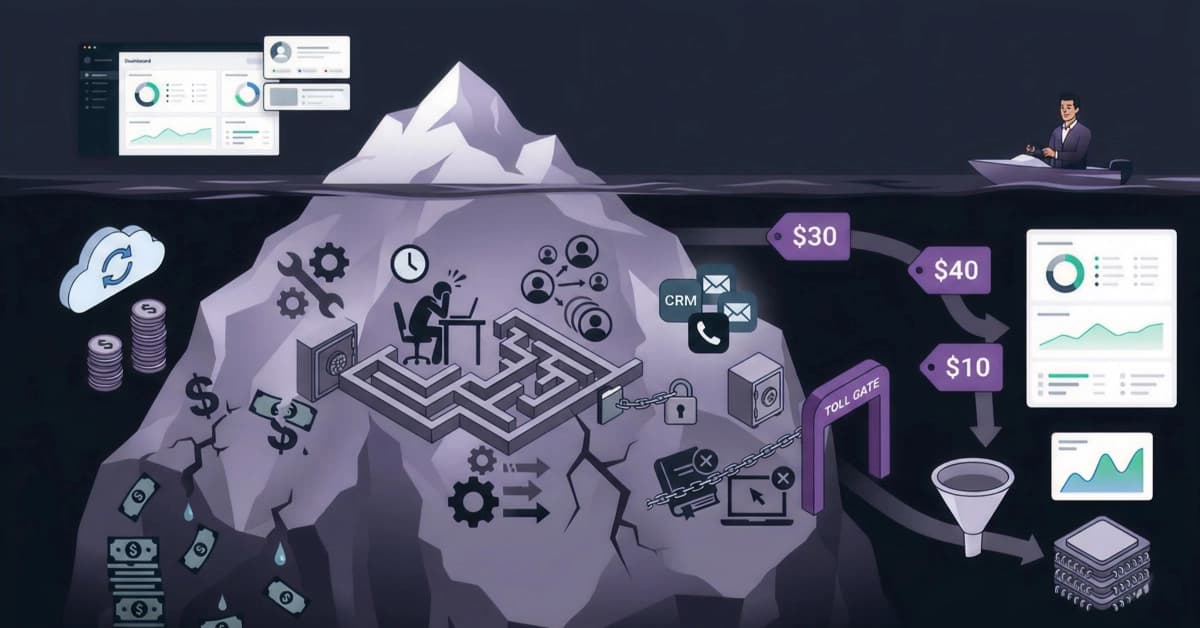
Most companies fixate on the advertised monthly price, completely ignoring the “iceberg costs” beneath the surface: mandatory implementation fees, data enrichment add-ons, and lengthy training requirements.
In this guide, we will break down the Total Cost of Ownership (TCO) of industry giants like Outreach and Salesloft versus the agile “Modular Stack” approach (CRM + VoiceDrop). Our goal? To help you identify which model actually drives revenue, and which is just expensive shelfware.
The Truth About Pricing Models: Per-Seat vs. Usage
Before dissecting specific tools, you must understand the financial mechanics of Sales Engagement Platforms (SEPs). The pricing model you choose dictates your scalability.
The “Per-Seat” Trap (Fixed Cost)
Traditional enterprise platforms rely on a per-seat pricing model. This is a “pay-to-play” structure where you are billed for every user login, regardless of their output.
- The Risk: If you hire 10 new reps, your overhead spikes immediately, often before those reps have generated a single dollar of pipeline.
- The Reality: You are paying for potential, not performance. If a rep is on leave, in training, or underperforming, that $150/month seat is a sunk cost.
The Usage-Based Advantage (Variable Cost)
In contrast, usage-based pricing (the model used by VoiceDrop) flips this dynamic. You pay for the activity (voicemails dropped, calls made), not the person sitting in the chair.
- The Benefit: This scales perfectly with demand. Your tech stack costs align directly with your outreach volume, ensuring you never pay for an empty seat.
The “Gatekeeping” Tactic
Furthermore, be wary of feature gating. Vendors often lock essential features, such as Local Dialing or specific integrations, behind expensive “Enterprise” tiers. Therefore, the advertised “Pro” price is rarely what you end up paying.
Category 1: The Enterprise Giants (The $150+ Club)
These “All-in-One” platforms dominate the market share. While they are powerful, they come with heavy price tags that can cripple a lean startup’s runway.
Outreach.io (The Enterprise Standard)
Outreach is powerful, but that power comes with a high entry barrier.
- License Cost: Can exceed $140/user/month once essential features (like local presence dialing) are added.
- Implementation Tax: You cannot simply “plug and play.” Enterprise implementations often cost between $1,000 and $8,000 just for setup and mandatory onboarding.
Salesloft (The Add-On Heavyweight)
Similarly, Salesloft competes at the top of the food chain. Their pricing structure initially seems affordable, but costs add up quickly with add-ons. Features like “Conversation Intelligence” or “Deals” are often separate SKUs that significantly increase the monthly per-seat cost.
Moreover, readers should be warned about overage charges. If your team exceeds its allotted dialer minutes, the penalties can be steep. For a broader view of how users feel about these pricing structures, check the G2 Sales Engagement Reviews.
Category 2: The Aggressive Challengers (Mid-Market)
To combat the giants’ high costs, several challengers have entered the market. Although these tools are cheaper, they come with hidden traps that buyers must navigate.
Some challengers have gained massive popularity by bundling a contact database with their engagement tools, which can be a great value. However, their “Unlimited” plans often include “Fair Use” caps. Heavy users may find themselves restricted on email credits or mobile number exports, forcing an upgrade to a custom enterprise plan.
HubSpot Sales Hub (The Scaling Trap)
HubSpot is famous for its “Start Free” philosophy. Indeed, the Sales Hub starts at a low price, often around $20/seat. Yet, the jump to the “Professional” or “Enterprise” tier is massive, often skyrocketing to $100-$150 per seat. Once you need advanced automation or sequences, the price advantage disappears entirely.
The “Hidden Costs” That Kill ROI
When calculating your budget, the subscription fee is just the tip of the iceberg. Here are the three “Silent Killers” of sales tech ROI:
1. The Implementation Drag
Time is money. Enterprise tools often require a 4- to 8-week ramp-up period. During this time, you are paying for the software and the implementation team, yet generating zero value.
- Stat Check: While businesses that use CRMs effectively see an average ROI of $8.71 for every dollar spent, complex implementations often erode this margin by delaying “Time-to-Value.”
2. The “Shelfware” Effect
Are you paying for features you don’t use? The average utilization rate of enterprise platforms is shockingly low.
- The Reality: 80% of features in massive all-in-one suites go untouched by the average SDR. If you are paying for “Revenue Intelligence” but your team only uses the dialer, you are overpaying by at least 50%.
3. Data Enrichment Dependencies
A platform is like a Ferrari; it looks great, but it won’t move without gas (data). Most SEPs do not include premium mobile data. You will likely need to stack a contract with ZoomInfo or Lusha on top, adding $ 10k to $20k to your annual opex.
Tip: Why burn budget on annual data contracts? Get verified mobile numbers with 1Lookup on a flexible basis to keep your “gas tank” full without the commitment.
The “Modular Stack” Strategy: How to Save 40%
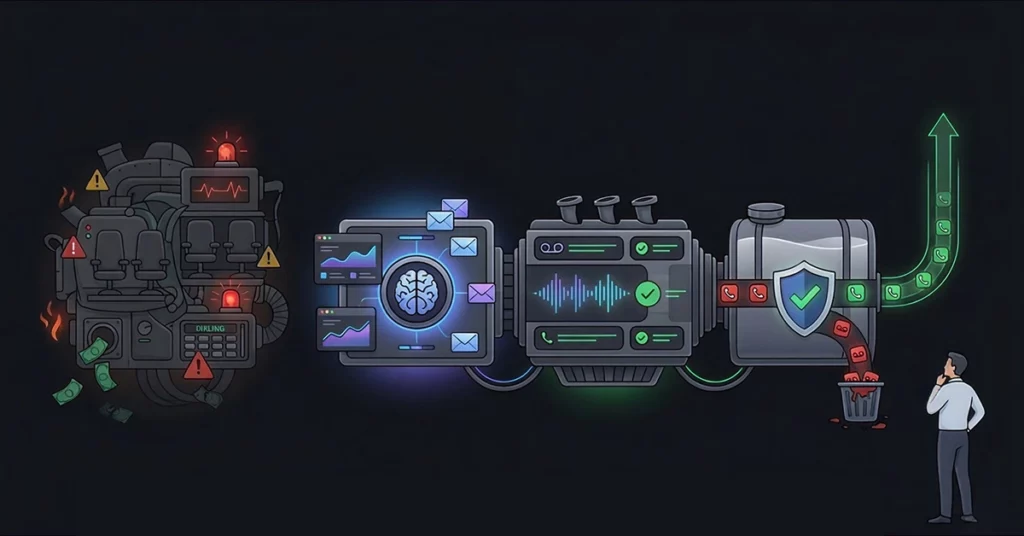
Smart RevOps leaders are moving away from “All-in-One” suites toward “Best-of-Breed” stacks. This allows you to build a custom workflow that fits your specific sales motion.
The Winning Formula
- The Brain: A reliable CRM (HubSpot Starter, Pipedrive).
- The Muscle: VoiceDrop for high-volume, ringless voicemail and automated outreach.
- The Fuel: A specialized data tool for verified mobile numbers.
Why This Beats the Enterprise Model: By decoupling the Outreach Engine from the CRM, you regain financial control.
Consider the ROI of different channels. While phone sequences are expensive to staff, email marketing remains a powerhouse with an ROI of $42 for every $1 spent.
By using VoiceDrop to automate the heavy lifting (voicemails and audio sequencing) and your CRM for email, you maximize ROI in high-ROI channels while slashing costs in expensive ones. You avoid the “Per-Minute” penalties of big dialers and only pay for the drops that successfully land.
Learn more about this mechanism in our guide to Ringless Voicemail Marketing.
The Automated Workflow: Integration & Automation
Building a modular stack might sound complex, but integration tools make it seamless. Here is how you can practically build this workflow.
Step 1: The Data Sync
First, use a tool to push enriched leads directly into your CRM. This ensures your sales team always has accurate contact information before they attempt outreach.
Pro Tip: Don’t let your dialer hit dead ends. Use 1Lookup’s Deep Skip Tracing to enrich your lists with accurate mobile numbers before you start your campaign. 1Lookup is built by the same team as VoiceDrop.
Step 2: The Trigger (Zapier/Webhooks)
Next, you need to understand that you don’t need a native dialer to automate calls. You can simply set a trigger using Zapier. For example, configure the system so that when Lead Status = “New,” it automatically triggers a VoiceDrop campaign. This automates the first touch without an agent ever having to lift a finger.
Step 3: The Follow-Up
Finally, manage the response. If the prospect calls back, the agent answers live. If not, the system automates a text or email follow-up. This workflow removes the need for expensive “Power Dialers” for early-stage leads, saving significant budget. You can explore the possibilities of these connections on our VoiceDrop Integrations page.
Measuring TCO (Total Cost of Ownership)

To make a data-backed decision, run this calculation for your team.
The True Cost Formula:
$$(\text{License Cost} \times \text{Seats}) + \frac{\text{Implementation Fee}}{12} + \text{Data Costs} + \text{Mandatory Training} = \text{True Monthly Cost}$$
When you apply this to an enterprise tool, a “$130/seat” license often balloons to $200+/month.
Compare this to the VoiceDrop model: No seat fees. No implementation fees. Just usage. This flexibility allows you to aggressively scale up during Q4 and scale down in slower months without being locked into a rigid contract.
For more on controlling wasted software spend, read Zylo’s guide to SaaS Spend Management.
Conclusion
Ultimately, agility is worth more than a long list of unused features. In the current economic climate, the ability to pivot quickly and control cash flow is paramount.
The Modular Stack allows you to scale costs up or down based on actual sales volume, rather than headcount. Therefore, you should avoid getting locked into a 12-month contract for shelfware that drains your budget.
Ready to see how much you can save? Get Your Free Demo today and start building a more efficient sales stack.
FAQ’s
What is the average cost of a sales engagement platform?
Enterprise tools average $120-$160 per user/month, plus substantial setup fees. However, modular stacks can achieve similar or better results for $50-$70 per user/month by removing unused features.
Are there free alternatives to Outreach?
Yes, but they are limited. Stacking a free CRM (like HubSpot Free) with a pay-as-you-go tool like VoiceDrop is the most effective “low cost” strategy for growing teams.
Does VoiceDrop replace the need for Salesloft?
For the outreach component, yes. VoiceDrop handles voicemails and mass communication more efficiently, while your CRM handles deal tracking and pipeline management.
Why are implementation fees so high?
Enterprise platforms are complex and rigid. They charge you for “Success Managers” to configure workflows and train your staff. Modular tools like VoiceDrop are “Plug and Play,” removing this cost entirely.