It is the dreaded scenario for every high-ticket merchant. You see a live notification for a $2,000 order, you watch the purchase intent peak, and then… silence. The customer leaves, and the cart becomes a ghost town.
For a dropshipper selling $20 phone cases, a lost cart is merely a nuisance. However, for a brand with a high Average Order Value (AOV) selling luxury furniture, e-bikes, or fine jewelry, it is a financial disaster. You aren’t just losing a sale; you are losing significant ad spend and a customer with high potential Customer Lifetime Value (CLV).
The solution isn’t to bombard them with generic discount codes that cheapen your brand. Instead, you need a personal touch that cuts through the noise. You need to leverage the power of the human voice.
The Silent Revenue Killer in High-Ticket E-commerce
When selling premium products, the buyer’s psychology changes. Unlike impulse buys, high-ticket items require a longer “consideration phase.”
Consequently, any perceived checkout friction can cause abandonment rates to skyrocket above the industry average.
Customers rarely abandon these carts solely because of the price tag. They leave because of doubt. They likely have a specific question about shipping, warranty, or build quality that a static webpage didn’t answer.
If your retargeting strategy fails to address this uncertainty immediately, the sale is lost to a competitor who offers more reassurance.
The Statistics of Abandonment: It’s Not Just You
If your abandonment rate feels high, the data suggests you are not alone. In fact, research indicates that nearly 70% of all online shopping carts are abandoned. For high-ticket merchants, this number can be even higher due to the anxiety surrounding large purchases.
Therefore, your recovery strategy must be more aggressive and tailored to your specific needs than that of a standard e-commerce store. For a deeper look at the industry averages, you can review the latest Cart Abandonment Statistics.
Why Traditional Recovery Methods Fail for High-Value Items
Most Shopify store owners rely on the standard “Email + SMS” playbook. While this works for low-cost items, it often falls flat for luxury goods. Here is why standard automation is failing your premium brand.
The Limits of Email Automation (Inbox Blindness)
Everyone’s inbox is flooded. A generic “You left something behind” email often looks like spam or gets buried in the “Promotions” tab.
Moreover, for a customer considering a $2,000 purchase, a templated HTML email feels impersonal. It suggests that you view them as just another number in your database, rather than a valued client.
The “Intrusion” Factor of SMS
On the other hand, SMS has high open rates, but it comes with a risk. A text message says, “Buy this now,” which can feel aggressive or annoying.
High-end customers value their privacy. Interrupting their dinner with a buzzing phone notification demanding a sale can actually damage your brand image rather than help it.
The “Blue Ocean” Strategy: Ringless Voicemail Drops
This is where VoiceDrop enters the picture as a “Blue Ocean” strategy, a new, uncontested market space. By using ringless voicemail, you can recover sales without being intrusive, offering true personalization at scale.
What is Ringless Voicemail?
Think of Ringless Voicemail as a digital courier. It allows you to insert a pre-recorded voice message directly into the customer’s voicemail inbox without their phone ever ringing. This technology respects the customer’s time.
They receive a notification and can listen to your message when they are ready, which aligns perfectly with the “white glove” service expectation of luxury buyers.
The Psychology of Voice: Building Trust
The human voice builds immediate rapport that text simply cannot match. When a customer hears a real person, perhaps the founder or a concierge, it triggers a psychological instinct for reciprocity.
It proves there is a human behind the website who cares about their experience, effectively removing checkout friction by offering a direct line of communication.
Implementing VoiceDrop in Your Shopify Flow
You might be thinking this sounds complicated, but the technical setup is surprisingly simple. You can integrate voice drops into your existing marketing automation flows in minutes.
Integration via Zapier and Klaviyo
The workflow operates automatically in the background. Typically, it looks like this:
- Shopify Checkout: The customer enters their phone number but abandons the cart.
- Trigger: An “Abandoned Cart” event is sent to your automation tool (like Klaviyo).
- Action: Zapier detects this event and triggers the VoiceDrop API to send the voicemail.
Once configured, this system runs 24/7, ensuring no lead is left behind. If you are ready to connect your store, check out the available VoiceDrop Integrations.
Segmentation: Targeting Carts Over $500
Crucially, you should not use this strategy for every single cart. It is most effective when reserved for your VIPs with high purchase intent.
Using Shopify’s filter options, set a rule to trigger the voice drop only when the Subtotal Price is greater than $500. This ensures your budget is strictly allocated to leads with the highest potential Return on Ad Spend (ROAS).
Pro Tip: Don’t waste your budget sending voice drops to landlines or invalid numbers. Before activating your flow, verify carrier details and line types for free using 1Lookup’s carrier lookup tool. 1Lookup is built by the same team as VoiceDrop. This ensures every cent is spent on a reachable mobile device, protecting your ROI.
Scripting Your Recovery: The “VIP Concierge” Approach
The script you use is the difference between a sale and a block. For high-ticket items, you must adopt a “Service” angle rather than a hard “Sales” angle.
The “Founder’s Reach Out” Script
“Hi, this is [Name], the founder of [Brand]. I noticed you were looking at the [Product] on our site and wanted to reach out personally. Since this is a significant investment, I wanted to see if you have any specific questions I can answer. Feel free to text or call me back at this number. Thanks!”
The “Support Concierge” Script
“Hi there, I noticed you didn’t complete your order for the [Item]. Since this is a high-value shipment, I wanted to ensure you didn’t have any issues with the shipping options or delivery dates. We want to make sure it arrives safely. Please let us know if we can help.”
Compliance and Best Practices (TCPA)
While ringless voicemail is a powerful tool, you must use it responsibly. Compliance is key to maintaining your brand’s reputation.
Obtaining Consent on Checkout
Always ensure your Shopify checkout settings are configured correctly. You must require a phone number and have the “Marketing Consent” checkbox enabled and visible.
Furthermore, ringless voicemail is generally compliant when sent to customers who have initiated a transaction (like starting a checkout).
However, you should always honor any “Do Not Call” requests immediately to stay on the right side of regulations.
Data Hygiene Check
Compliance starts with clean data. To ensure you are only engaging with valid, active subscribers (and avoiding potential spam traps), run a quick manual check on your high-risk numbers using the free phone validator at 1Lookup.
Measuring Success: ROI Calculation
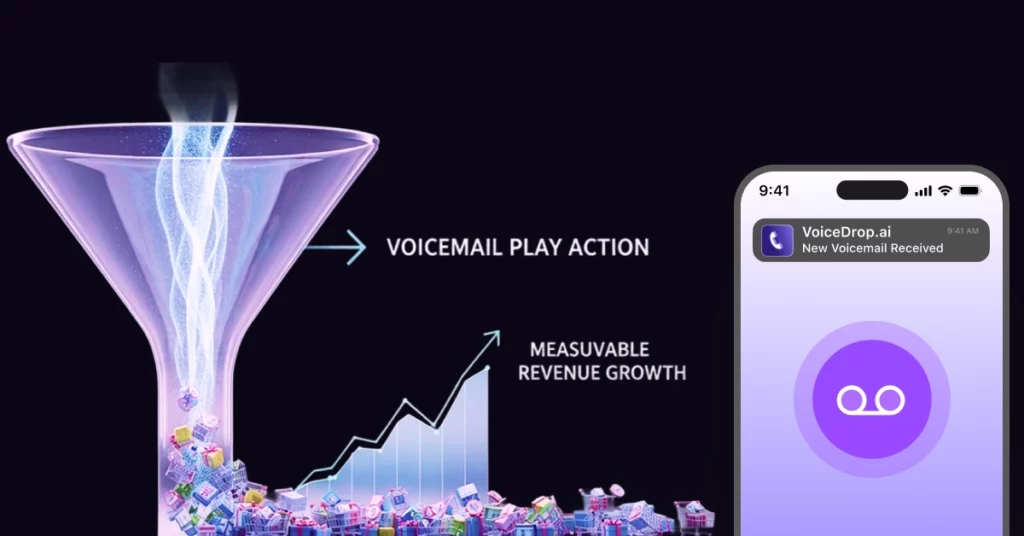
The beauty of this strategy is that it is easily measurable. You can track exactly how many abandoned carts were recovered after listening to a voicemail.
Comparing Conversion Rates (Voice vs. Email)
Let’s look at the math. If your standard marketing automation flow recovers 10% of carts, and adding a voice drop increases that to 20%, the revenue impact is massive.
For a store with ten abandoned $1,000 carts a week, that difference is an extra $1,000 in pure revenue every single week.
Furthermore, because you established a personal connection, the Customer Lifetime Value (CLV) of that recovered shopper is likely to be significantly higher than that of a cold lead.
We encourage you to A/B test your current flow against a VoiceDrop flow to see the data for yourself.
Conclusion
Automation shouldn’t mean robotic. The brands that dominate in 2026 will be the ones that use technology to feel more human, not less.
By using voice to reach out to your high-value customers, you differentiate your brand as a premium service provider. You stop being a faceless website and start being a partner in their purchase.
Start Recovering Revenue Today: Don’t let your next $1,000 sale walk away. Start Your Free Trial and set up your first recovery campaign in minutes.
FAQ’s
Will this annoy my customers?
Not if done correctly. Because the phone doesn’t ring, it isn’t an interruption. It appears as a notification, allowing them to listen at their leisure, which is far less intrusive than a cold call.
Does VoiceDrop work internationally?
Yes, VoiceDrop supports international delivery. This is vital for global dropshipping brands that have customers in the US, UK, Australia, and beyond.
Can I use my own voice?
Absolutely. In fact, we recommend it. Recording the message yourself adds an authenticity that AI voices sometimes lack, further cementing the trust between you and the buyer.