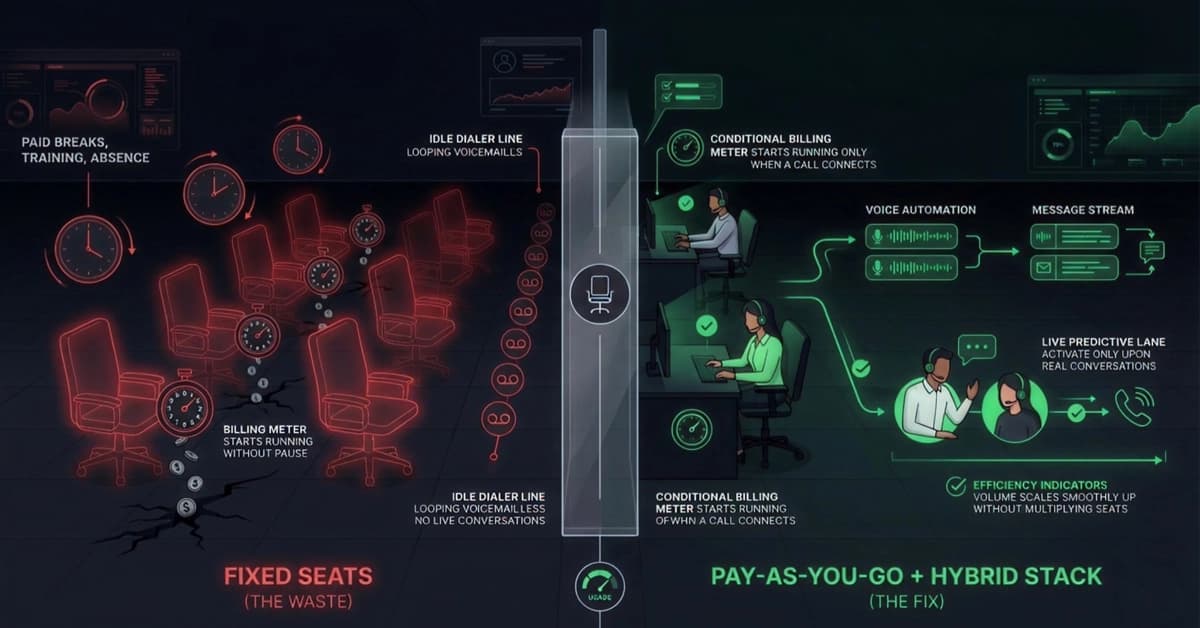
The traditional SaaS billing model often acts as a massive financial trap for modern telemarketing teams. Specifically, paying a flat $150 per agent seat wastes precious budget when agents are on break, in training, or simply absent.
Fortunately, a pay-as-you-go predictive dialer completely flips this outdated model on its head. With this usage-based approach, you only pay for the exact minutes your team spends actively connected to leads.
Therefore, we will explore the hidden drain of fixed-seat licenses, the mechanics of usage-based pricing, and how a “Hybrid Stack” (VoiceDrop + PAYG) maximizes your overall ROI.
What Exactly is a Pay-As-You-Go Predictive Dialer?
At its core, this software utilizes complex algorithms to pace outbound calls based on real-time agent availability. Consequently, it automatically dials multiple numbers simultaneously and routes only answered calls to live representatives.
Unlike standard subscriptions, the usage-based billing structure eliminates the expensive monthly per-user fee.
Instead, businesses pay strictly for carrier minutes used (e.g., $0.015 per minute) or per successful connection.
The Hidden Trap of Fixed “Per-Seat” SaaS Pricing

Call center managers constantly battle the financial drain of “Ghost Seats” on their operational budgets. In fact, outbound call centers typically experience a high turnover rate of 30% to 45%.
Furthermore, when an agent quits unexpectedly, you still pay for their dialer license until the end of the current billing cycle. Additionally, agent idle time significantly compounds this invisible financial waste.
On average, agents spend countless hours navigating CRMs, taking mandatory breaks, or completing post-call wrap-ups. Ultimately, fixed pricing forces you to pay expensive software fees for the time you don’t dial.
How Predictive Algorithms Maximize ROI on a Per-Minute Basis
Technology matters significantly more when you are actively paying per minute for carrier usage. Thus, the dialing system must remain highly efficient, so you never pay for dead air.
Advanced Answering Machine Detection (AMD)
Advanced AMD acts as a crucial first-line filter for your outbound campaigns. Since you are paying per minute, the dialer must accurately drop voicemails and connect only human voices. Otherwise, poor AMD means you end up paying premium rates just to listen to automated greetings.
Intelligent Call Routing & Pacing
Similarly, intelligent routing ensures optimal utilization of agents across the entire floor. The algorithm continuously adjusts the dialing pace to manage the strict abandon rate limit effectively.
As a result, this dynamic pacing keeps agents constantly talking without violating critical compliance regulations.
The “Hybrid Stack” Strategy: Filtering Leads Before You Pay to Dial
Savvy marketers are rapidly adopting the VoiceDrop methodology to slash their overhead costs. Instead of loading raw, unscrubbed lists into a predictive dialer and paying per minute for unanswered calls, you must filter them first.
Specifically, the strategy involves using VoiceDrop to ping the list before making any live dials. Next, you only push the engaged prospects or those who respond into the live predictive dialing queue.
Real-World Scenarios: When Does Usage-Based Pricing Make Sense?

Flat-rate pricing fails miserably in several common business situations, whereas pay-as-you-go thrives effortlessly.
Seasonal Call Centers
Scaling up for a busy season, such as Medicare open enrollment or holiday sales, is incredibly easy with flexible billing. Consequently, managers can add 50 temporary agents instantly without signing rigid annual software contracts.
High-Turnover Sales Teams
Usage-based pricing heavily protects profit margins for B2B or B2C teams that frequently onboard and offboard SDRs.
By only paying for active outbound usage, these volatile departments avoid wasting funds on empty desks.
Implementing a Scalable Telemarketing Workflow
Building a cost-effective tech stack requires a precise, step-by-step approach.
Step 1: Automated First Touch (VoiceDrop)
First, you must stop burning expensive dialer minutes on cold, unresponsive data. Instead, deploy a highly targeted Ringless Voicemail Drop campaign initially to gauge prospect interest without ever ringing their phone.
This ensures you only spend live dialer minutes on leads who have already heard your pitch and want to talk.
Step 2: Push Warm Leads to the Dialer (Integration)
Once a prospect shows clear interest from the voicemail, automation takes over the manual process. Then, you trigger a workflow in your CRM to push that contact directly into your PAYG predictive dialer campaign.
Step 3: Dialing with Compliance
Finally, telemarketing teams must navigate the complex legal side of predictive dialing carefully. Ensure your chosen software includes robust compliance safeguards for strict abandoned-call rules.
ROI Calculator: Fixed Seats vs. Pay-As-You-Go
Let us analyze a direct comparison scenario for a team of 10 agents with fluctuating hours. In Scenario A, dealing with a fixed license costs a minimum of $120 per seat. Therefore, 10 agents equal $1,200 per month, regardless of how much they actually dial.
Conversely, Scenario B utilizes the VoiceDrop and PAYG Dialer hybrid model. Here, you spend $200 on VoiceDrop credits and $400 in actual minutes, totaling only $600 per month. Ultimately, this highlights that you get significantly more actual conversations for exactly half the price.
Conclusion
Paying fixed monthly fees for telemarketing seats remains an outdated SaaS trap that drains budgets. Furthermore, the modern winning formula involves first filtering leads with VoiceDrop.
Subsequently, your team closes them using a highly efficient pay-as-you-go predictive dialer. Stop paying for idle agent time today.
Build a usage-based communication stack and watch your operational margins grow. Ready to scale without the limits? Get Your Free Demo of VoiceDrop today and see how many hours of dialing you can save.
FAQ’s
What is a pay-as-you-go predictive dialer?
It is an automated outbound calling system that uses algorithms to connect live calls to agents. Instead of charging a flat monthly fee per user, it charges strictly based on the carrier minutes consumed.
Is pay-per-minute cheaper than unlimited calling?
Often, yes. “Unlimited” plans usually have hidden fair-use caps and charge you for agent downtime, training, and turnover. Consequently, pay-per-minute ensures you pay only for the actual dialing activity.
How does Answering Machine Detection (AMD) save money on a PAYG plan?
Accurate AMD prevents agents from being connected to voicemails. Since you pay per minute, highly accurate AMD ensures you aren’t paying software and carrier fees just to listen to automated greetings.
Can I combine a predictive dialer with Ringless Voicemail?
Absolutely. Importantly, the most cost-effective strategy is to use VoiceDrop to automatically filter out uninterested leads, then load only engaged prospects into your predictive dialer to save on per-minute costs.