

Your sales team is currently drowning in silence. Instead of closing deals, they are likely wasting hours on manual dialing, data entry, and listening to endless ringtones. A Multi-Line Auto Dialer is not just a phone; specifically, it is a workflow accelerator.
By dialing multiple numbers simultaneously, it eliminates dead air and maximizes actual “talk time.” Consequently, productivity skyrockets as agents spend their day selling rather than waiting. In 2026, if you are dialing one number at a time, you are already losing revenue.
How Parallel Dialing Actually Works (The Mechanics)
This technology utilizes advanced algorithm-based routing rather than magic. Specifically, the software seizes 3 to 10 lines at once to force a connection.
Consider this a “Winner Takes All” scenario. The moment a human answers on Line 1, the system instantly drops the remaining lines or leaves a voicemail and connects the agent immediately.
Therefore, the agent moves seamlessly from one conversation to the next without a single second of delay.
Power Dialers vs. Predictive Dialers: The Critical Difference
Sales leaders often confuse these terms, yet the distinction is vital for strategy. “Power Dialers” typically dial one number at a time, albeit rapidly. In contrast, “Multi-Line” or “Predictive” dialers call many numbers simultaneously based on real-time agent availability.
Because of this parallel capability, multi-line dialing remains the superior choice for high-volume cold calling where pickup rates hover around 10-15%.
Answering Machine Detection (AMD)
AMD serves as the “secret sauce” of modern dialing technology. The software listens to the first two seconds of audio to analyze the connection. If it detects a long pause or a “Hello?”, it instantly connects the call. However, if it hears a digital tone or prerecorded speech, it filters the call out. This ensures that agents speak only to humans, saving countless hours of frustration.
The 3 Core Pillars of Dialer ROI

Sales managers need to know exactly what they get in return for the cost. Here is the breakdown of the return on investment.
Pillar 1: Eliminating “Idle Time”
The primary goal of any dialer is to reduce waste. Quantify the time currently lost in your team. For example, 45 seconds of ringing across 100 calls equals 75 minutes of lost time every single day.
Multi-line dialing compresses this wasted time to near zero. Consequently, agents can utilize that recovered time to engage more prospects.
Pillar 2: Momentum and Flow State
Sales operates heavily on psychology. Representatives perform significantly better when they establish a rhythm. Conversely, long pauses between calls cause “Call Reluctance.” Rapid-fire conversations, on the other hand, keep energy levels high. When an agent is in a “flow state,” their objection handling and closing ratios naturally improve.
Pillar 3: Data Hygiene & List Penetration
You cannot close leads that you do not touch. Multi-line dialers allow a small team to penetrate a list of 5,000 leads in a few days rather than weeks. According to recent sales productivity statistics, optimizing this workflow is essential for growth. However, aggressive dialing speed is useless if you are targeting dead numbers.
To avoid wasting your bandwidth on disconnected lines, you must verify your lead lists to ensure maximum connectivity before you even click “start.”
Advanced Features to Look for in 2026
Do not just buy a dialer; invest in a complete platform instead. Look for these specific capabilities.
Bi-Directional CRM Sync
Data integrity remains the key to efficiently scaling operations. A modern dialer must automatically log the call outcome, duration, and recording back into Salesforce, HubSpot, or GoHighLevel. Consequently, this eliminates manual data entry, freeing up your reps to focus on the next call.
Check out VoiceDrop Integrations to see how this seamless connection can clean up your current tech stack.
Local Presence & Dynamic Caller ID
Trust factors heavily influence pickup rates. People rarely answer calls from strange area codes. To combat this, the software automatically displays a local area code. If you are calling Texas, it shows a 512 number. As a result, pickup rates can increase by up to 40%.
In-Call Coaching (Whisper & Barge)
Managerial control improves team performance drastically. Features like “Whisper” allow managers to advise a rep during a live call without the prospect hearing. Furthermore, “Barge” features allow a manager to take over a call if the deal is at risk.
Automating the “No-Answer” Workflow
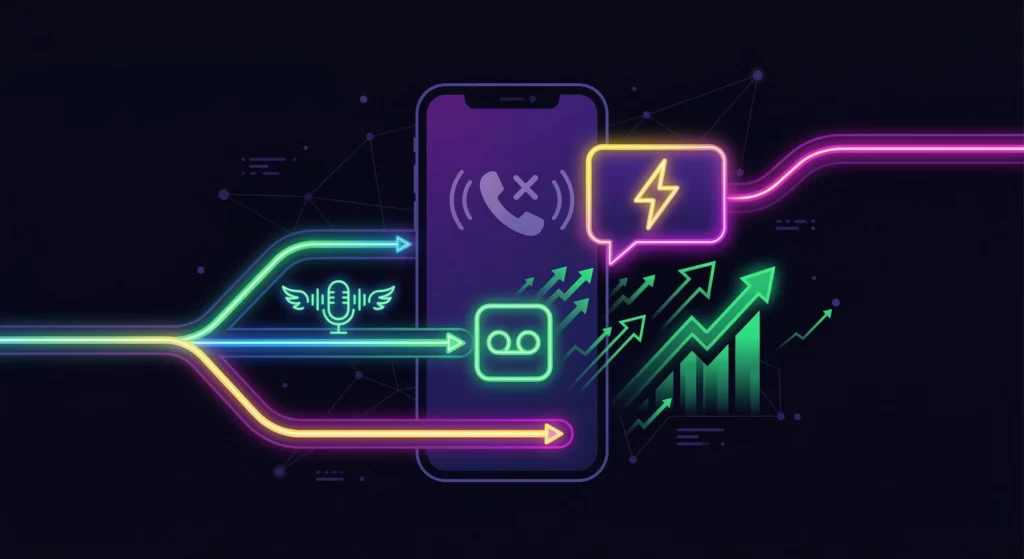
What happens when nobody picks up the phone? A robust system handles this automatically.
Ringless Voicemail Drops (RVM)
Efficiency continues even when nobody picks up. Instead of hanging up, the system drops a pre-recorded message into the prospect’s inbox. This turns a “dead call” into an inbound lead possibility. Ringless Voicemail Drops are essential for this strategy, ensuring your message is delivered without disturbing the prospect.
Automated Follow-Up SMS
An omnichannel approach wins more deals. If the call isn’t answered, the dialer should instantly trigger a text message. A simple message like “Hey, just tried to call you regarding…” can prompt a callback.
The Compliance Safety Net
This “Fear” section establishes trust by protecting the user from fines.
TCPA & The 3% Abandonment Rule
Compliance is non-negotiable in telemarketing. If two people answer at once, the system must drop one of the calls. Federal law limits this “Abandonment Rate” to 3%. Smart algorithms throttle dialing speed automatically to stay legal. Always review TCPA compliance rules to ensure your campaigns remain safe.
STIR/SHAKEN & Spam Labeling
Address the “Spam Likely” label on phones. Modern dialers register numbers to ensure they appear as “Verified Business” rather than spam. This registration is critical for maintaining high answer rates.
Strategic Use Cases by Industry
Different industries utilize this power in unique ways.
Real Estate Investors (Wholesalers)
This tool is perfect for “Circle Prospecting.” Investors can call 500 neighbors around a just-sold property to find the next seller. Consequently, they uncover off-market deals that others miss. However, to execute this strategy effectively, you first need accurate phone numbers for those properties.
Use reliable skip tracing to obtain accurate homeowner data before your dialing session, ensuring you reach the owners. 1Lookup is built by the same team as VoiceDrop.
Insurance Agents
For insurance, “Speed to Lead” is everything. Agents call web leads within 5 seconds of submission to beat competitors. Immediate contact drastically increases the likelihood of conversion.
Conclusion
The era of manual dialing is officially over. In a competitive landscape where speed-to-lead defines success, relying on single-line phones keeps you stagnant. A Multi-Line Auto Dialer does more than just call numbers; specifically, it fundamentally shifts your team’s focus from administrative busywork to high-value closing.
By eliminating idle time, ensuring compliance, and integrating seamlessly with your CRM, you are not just buying software; you are buying back your team’s day. Silence is expensive, but conversation is profitable. Do not let your best leads go cold while your reps listen to voicemail greetings. Start your dialing campaign today and turn your outreach into a competitive advantage.
FAQ’s
How many lines should I dial at once?
It depends on lead quality. For cold data, dial 3-4 lines. For warm leads, use single-line power dialing to avoid awkward pauses.
Does a multi-line dialer work with cell phones?
Yes, but you must comply with TCPA consent requirements. Always ensure your list is scrubbed against the DNC (Do Not Call) registry.
What is the difference between a parallel dialer and a predictive dialer?
They are often used interchangeably, but “Parallel” refers to dialing multiple lines. In contrast, “Predictive” refers to the algorithm that decides when to dial based on agent availability and average call duration.