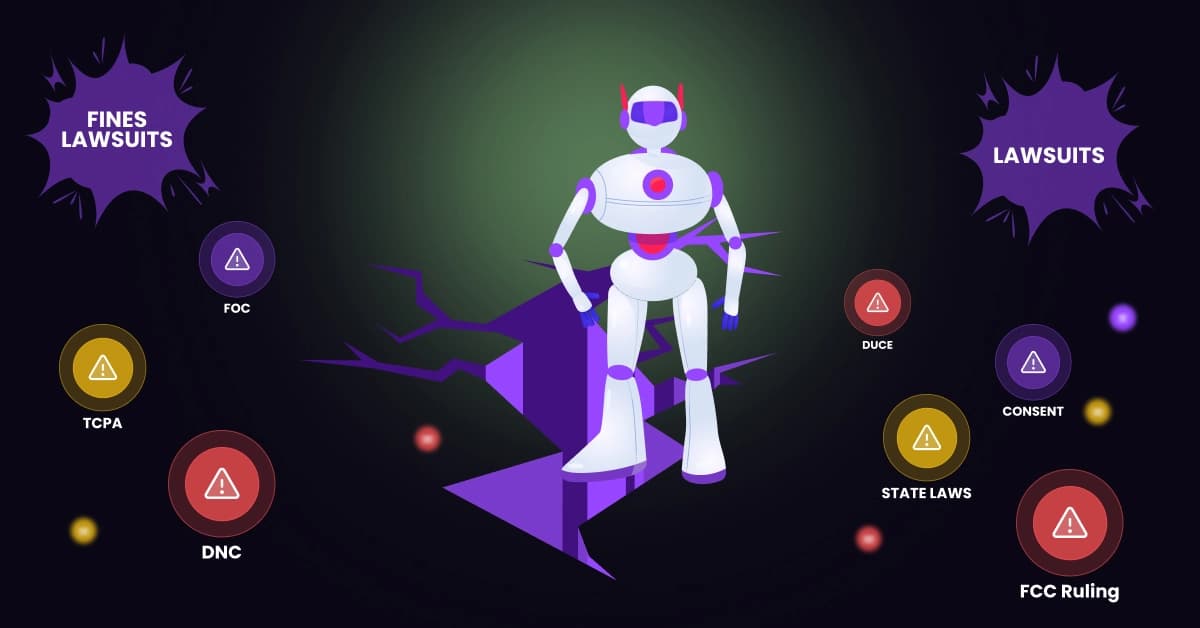
Is it illegal to have AI call people? Many businesses ask this question before using AI call agents for outbound sales. Using AI for automated calls can be risky if rules are not followed. Companies want to scale outreach without facing huge fines or lawsuits. The laws around AI calling for marketing are complex and constantly changing.
Our guide explains the answer clearly. It covers key federal, state, and international regulations for AI voice calls. You will learn about the FCC’s rules on AI-generated voices and state consent requirements.
We also highlight best practices for following TCPA guidelines. Plus, you’ll find strategies to reduce legal risks. Tools like VoiceDrop help businesses run compliant, modern ringless voicemail campaigns safely and effectively.
Understanding AI Calling
AI calling utilizes advanced AI technology and virtual voice assistants to automatically place, manage, and handle phone calls. Unlike traditional robocalls, these systems are much more sophisticated. They use Natural Language Processing (NLP) to understand human speech in real time. As a result, the AI agent can hold a natural, dynamic conversation with a customer.
So, is it illegal to have AI call people? Not necessarily. However, businesses must follow strict rules like obtaining consent and providing clear disclosures. Without compliance, AI calls can lead to legal and financial penalties.
Common use cases for AI agents are expanding rapidly across industries. These systems excel at repetitive, high-volume tasks. Examples include:
- Customer Service: Answering frequently asked questions and routing calls.
- Lead Generation: Making initial contact, qualifying leads based on responses, and setting appointments for human agents.
- Appointment Reminders: Confirming schedules and sending automated follow-up messages.
- Surveys: Conducting brief, automated polls and data collection campaigns.
- Automated sales cycles: Handling the early stages of the sales process to maximize Cost efficiency.
Legal Status of AI Calls
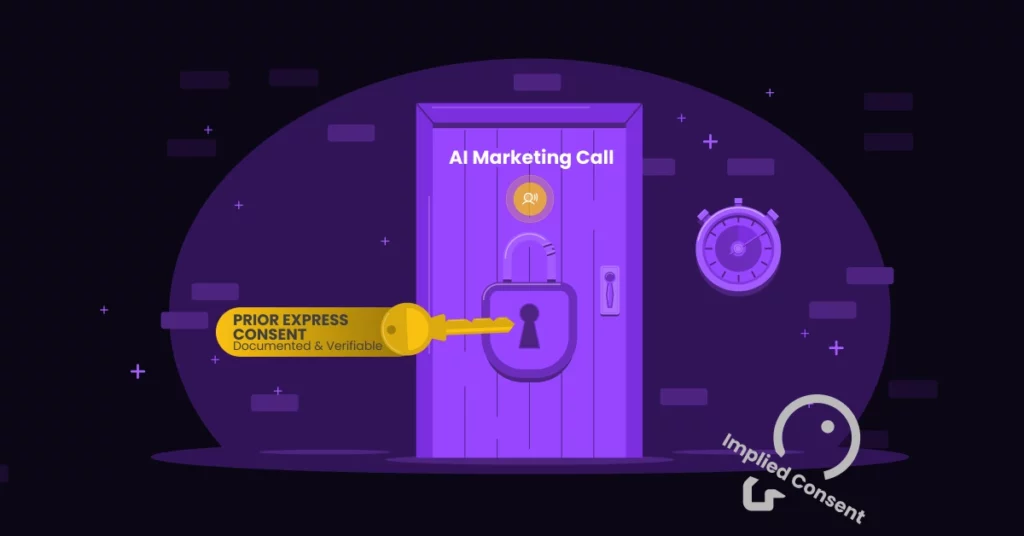
The legal status of AI calling depends on how the technology is classified. Under the Telephone Consumer Protection Act (TCPA), AI voices fall under “artificial or prerecorded voice.” This means AI calls are not automatically illegal. However, they must follow the same strict rules as robocalls, including obtaining prior consent.
In February 2024, the FCC issued a major Declaratory Ruling. The ruling confirmed that calls made with AI-generated voices are considered “artificial” under the TCPA. As a result, any outbound call using synthetic or AI-cloned voices must meet strict consent rules, especially for marketing.
This ruling increased the legal risks for unsolicited AI calls. The key to legality is not just the AI technology itself. Businesses must focus on compliance, consent, call purpose, and context. Therefore, obtaining proper consent should always be the top priority.
Transparency Requirements: Do You Have to Disclose AI?
Transparency is a key legal and ethical requirement for AI calling. Businesses must clearly tell recipients when they are speaking to an AI agent, especially for sales or promotional calls. Both the FTC’s Telemarketing Sales Rule (TSR) and state laws increasingly require this disclosure to prevent deception.
Best practice is to disclose at the very start of the call. The statement should be clear so that anyone understands they are talking to AI, not a human. Using a natural-sounding AI voice without disclosure can lead to serious penalties.
Transparency also builds consumer trust and helps meet TCPA rules. The disclosure should identify the business making the call and explain the purpose of the call. In short, honesty from the first second is essential for legal compliance and ethical AI calling.
Compliance With Do-Not-Call (DNC) Rules
The National Do Not Call (DNC) rules apply to AI calling just like any other telemarketing. Therefore, any AI-driven campaign must check its call lists against the DNC Registry before making calls. The FCC enforces these rules strictly.
To follow TCPA guidelines, businesses must subscribe to the federal DNC Registry and update their lists every 31 days. In addition, all AI agents must respect “stop calling” requests immediately. If a consumer opts out during a call, the AI must process the request and prevent further marketing calls.
Ignoring DNC rules is risky. Violations are common and can be very expensive. Therefore, following these rules is essential for legal and safe AI calling.
State and International Regulations
Is it illegal to have AI call people in different regulations? Regulations for AI calling (often termed “AI robocalling”) are primarily governed by existing telemarketing laws that have been expanded to classify synthetic voices as “artificial” entities requiring strict disclosure and consent.
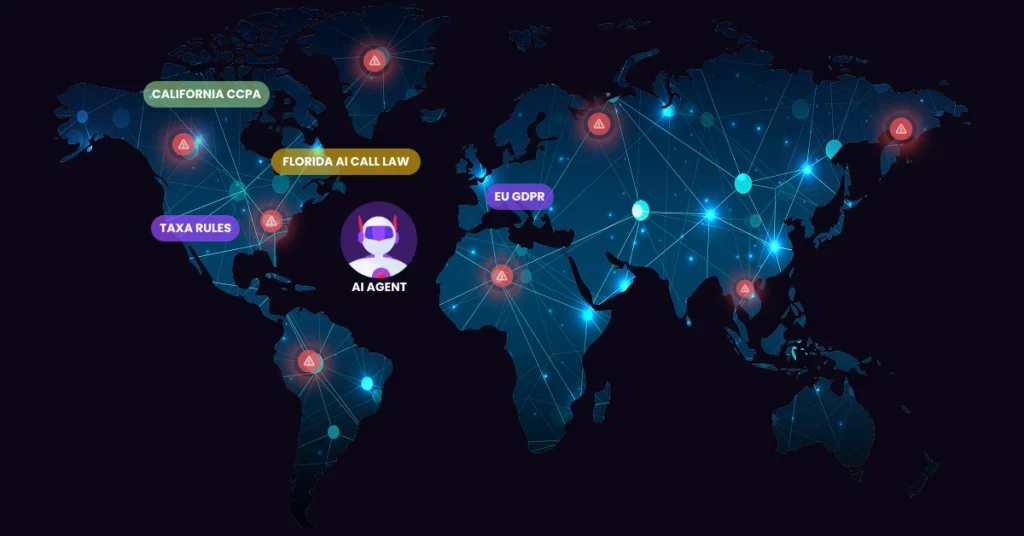
State-Specific AI Calling Laws
In 2025, state AI calling laws became more focused on transparency. Many key regulations took effect or reached important milestones this year, while some have enforcement dates in 2026.
- California (AB 2905): Effective January 1, 2025, businesses using AI virtual hosts must disclose AI involvement in every call. Failing to comply can result in $500 fines per violation under the California Invasion of Privacy Act.
- Tennessee (ELVIS Act): Effective July 1, 2024, this law saw major enforcement in 2025. It protects a person’s vocal likeness from unauthorized AI cloning. Individuals can sue if their voice is used without consent in calls or recordings.
- Florida: New rules in 2025 require clear AI disclosure for telemarketing calls. The law also bans AI-generated calls during quiet hours, before 8 AM and after 9 PM.
- Utah (Artificial Intelligence Policy Act): This law is already in effect. Regulated occupations, such as doctors and lawyers, must disclose AI use at the start of a call. Unregulated businesses only need to disclose if the consumer asks.
- New York (S.8420-A/A.8887-B): Enacted in December 2025, this law requires advertisements to identify AI-generated synthetic performers. This includes audio marketing and calls.
- Texas (HB 149): Enacted in June 2025, enforceable January 1, 2026. It limits AI use for behavioral manipulation and requires disclosure for government-related AI interactions.
International AI Calling Regulations
International AI calling regulations vary significantly by region, but most developed economies have converged on a “consent-first” model. As of 2026, many jurisdictions have implemented specific transparency requirements that mandate disclosing the use of AI at the start of a call.
- European Union (EU): Formally enforceable as of 2025, the Act classifies AI systems by risk. AI calling systems generally fall under “limited risk,” requiring transparency obligations where users must be informed they are interacting with AI. AI voice interactions are treated as personal data processing. Voice is considered personally identifiable information (PII). Fines can reach up to €35 million or 7% of global turnover for the most severe violations.
- United Kingdom (UK): Governed by the Information Commissioner’s Office (ICO) under GDPR and the Privacy and Electronic Communications Regulations (PECR). Prior consent is mandatory for any call without a human on the line. Callers must identify their company and the use of an automated assistant at the start of the call.
- Canada: The Canadian Radio-television and Telecommunications Commission requires prior express consent for any automated calls. The Canada Anti-Spam Legislation (CASL) imposes fines up to $10 million for businesses violating automated communication rules.
Cross-Border Compliance Best Practices
Companies making AI calls internationally need a strong compliance plan. First, keep detailed consent records for every recipient. Next, follow local Do Not Call (DNC) rules carefully.
Always apply the strictest law that applies to the person’s location. This helps avoid legal problems.
Using platforms with built-in compliance tools, such as for ringless voicemail, makes this easier. These tools help manage rules across borders and reduce the risk of fines or damage to your reputation.
Risks of Using AI Calls Illegally
Using AI calls without following the law carries financial, legal, and reputational risks. Ignoring TCPA rules and AI telemarketing laws can quickly cost a business millions.
Legal Penalties and Fines
The first risk is financial. TCPA penalties range from $500 to $1,500 per unsolicited AI call. For businesses making thousands of calls daily, fines can reach millions. AI calls using synthetic or cloned voices are held to the same strict standards.
Consumers or their lawyers can file class-action lawsuits. For example, some political groups faced multi-million-dollar fines for non-compliant robocalls.
Damage to Reputation
Illegally placing AI calls also hurts your brand. Consumers see unwanted automated calls as invasive or deceptive. This leads to negative reviews, social media backlash, and even carrier blacklisting. Poor experiences with automated sales calls create long-term damage that can be more costly than fines.
Enforcement and Audits
Regulators like the FCC and FTC actively monitor AI calling. Businesses may face unannounced audits, complaints, or full investigations. Enforcement usually follows high complaint volumes or illegal uses, such as scams or disinformation. Therefore, proactive compliance is the safest way to avoid penalties and protect your reputation.
Best Practices for Using AI Calls Legally
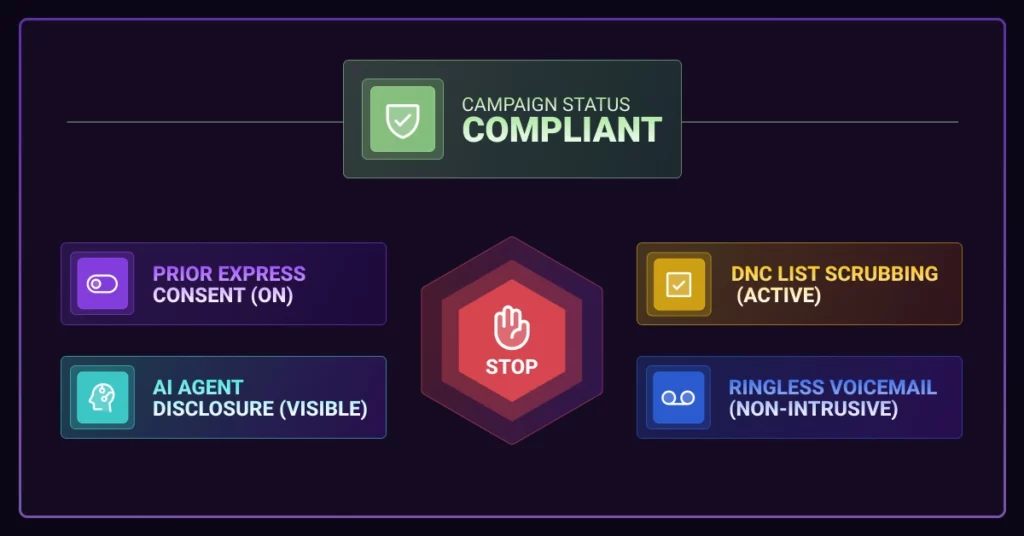
Businesses can leverage AI technology for automated sales legally and effectively by adopting strict compliance best practices. These steps minimize legal risk while maximizing the cost efficiency of the campaign.
- Obtain Explicit Consent: Always require and document prior express written consent for outbound marketing calls using an AI agent. Do not rely on implied consent.
- Scrub DNC Lists: Utilize a solution like the phone number validator to continuously scrub lists against federal and state DNC registries.
- Disclose AI Use: Clearly state at the start of the call that the recipient is speaking with an AI Call Agent. Transparency is non-negotiable.
- Respect Opt-Outs: Program the virtual assistant to immediately recognize and honor verbal opt-out requests.
- Use Compliant Alternatives: For initial cold outreach, consider using non-intrusive methods like ringless voicemail via VoiceDrop, which avoids the high-risk live connection, as a first step in your automated sales funnel.
- Integrate Compliance: Use solutions that offer CRM integration to log all consent, DNC status, and call records automatically.
Future of AI Calling and Regulations
The future of AI calling will bring more innovation and stricter rules. AI voices will become nearly identical to human voices. As a result, the FCC will focus more on clear disclosure and verified consent.
We can expect trends like hyper-personalized calls and advanced automation. At the same time, regulations will likely introduce digital watermarks to identify AI-generated voices. New rules on deepfakes and voice cloning are also expected.
Platforms like VoiceDrop are already preparing for these changes. They use compliant AI voice technology responsibly. Businesses must adapt early to meet ethical standards and stay within the law. Being proactive ensures safe, effective, and trustworthy AI communication.
Conclusion
Is it illegal to have AI call people? The clear answer is that it is legal, but only under conditions of strict TCPA guidelines, full transparency, and verifiable consent. Businesses must navigate a complex web of AI telemarketing laws, DNC rules, and state-specific AI calling laws.
The key takeaway is that risk mitigation must be your top priority. Do not use AI for unsolicited cold calls. Instead, employ compliant automated sales tools like ringless voicemail to warm up leads safely. VoiceDrop offers the features you need: DNC scrubbing, automation, and non-intrusive delivery, to leverage AI technology effectively and legally.
Ready to leverage the power of AI without risking costly legal penalties? Choose a solution built for TCPA guidelines and high engagement.
Click here to schedule a demo and see how VoiceDrop can provide compliant, scalable ringless voicemail and AI outreach solutions.
FAQ’s
Can AI call people without consent?
No. Is it illegal to have AI call people without consent? Yes, for marketing or sales purposes, it is. Businesses must get prior approval from recipients before making AI calls. This ensures compliance with federal and state telemarketing laws.
What laws regulate AI telemarketing calls?
AI calls are mainly governed by the TCPA (Telephone Consumer Protection Act) and the FTC’s Telemarketing Sales Rule. In addition, many states have their own rules. These laws treat AI-generated voices as “artificial” and require consent and clear disclosure.
Are AI calls treated differently if used for emergencies or informational purposes?
Yes. Calls for emergencies or purely informational purposes are often exempt from consent requirements. However, businesses must clearly identify the purpose of the call to avoid legal issues.
How can businesses ensure AI call compliance?
Businesses should always obtain consent, provide clear disclosure, and follow TCPA and state rules. Using compliant platforms like VoiceDrop helps automate these safeguards. Regularly updating call lists and tracking opt-outs also ensures ongoing compliance.
What penalties exist for illegal AI calls?
Violating AI calling rules can be costly. Fines under the TCPA range from $500 to $1,500 per call. In some cases, class-action lawsuits can reach millions. Therefore, is it illegal to have AI call people without following the rules? Absolutely, and the financial and reputational risks are high.