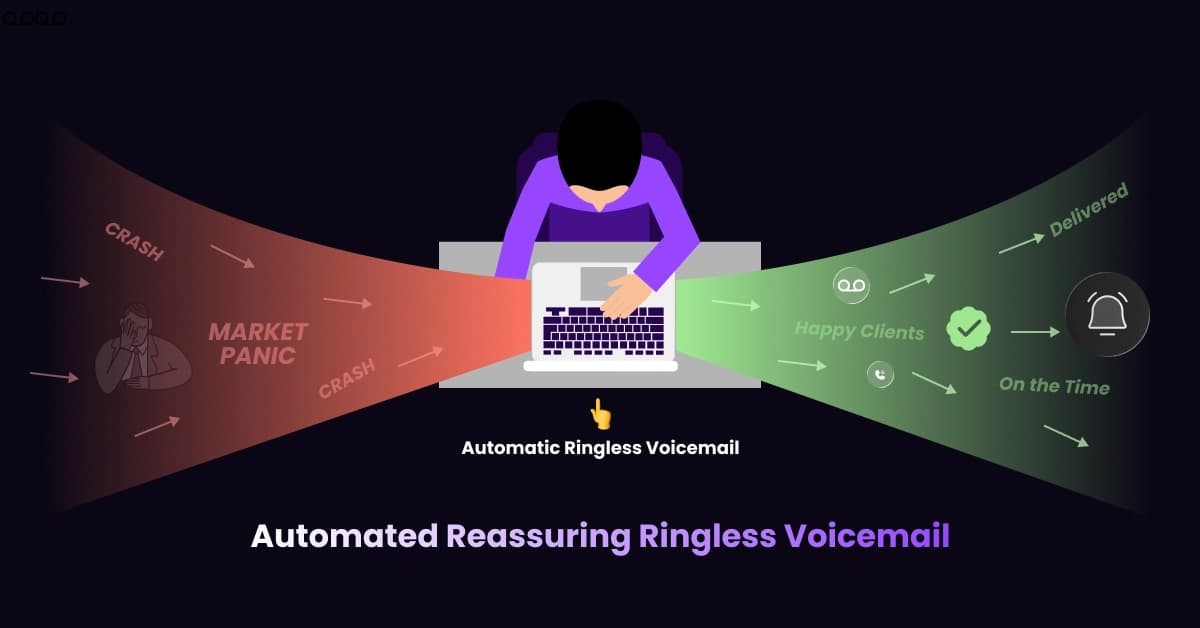
It is 9:00 AM on a Monday, and the Dow is down 600 points. The “Red Arrow” on your screen isn’t just a market indicator; it represents a looming flood of anxiety entering your inbox. At this moment, you have 500 prospects and clients who need immediate reassurance, yet you only have 8 hours in the day to reach them.
Attempting to call 500 clients individually is mathematically impossible. Yet, silence is expensive. When clients don’t hear from you during a crash, they don’t just panic; they start looking for a new advisor who is communicating.
You are trapped between a clock and a hard place. However, by automating your ‘Crisis Communication’ using Ringless Voicemail (RVM), you can virtually ‘touch’ every financial advisor prospect and client before your second cup of coffee, transforming a market dip into a massive retention win.
The “Silence” Trap: Why Standard Newsletters Fail in a Crash
When the market bleeds, your first instinct might be to send a mass email. Unfortunately, a generic HTML newsletter is often insufficient when a prospect is financially terrified.
The Tone Gap (Text vs. Voice)
There is a massive difference between reading a message and hearing it. The phrase ‘Stay the course’ reads as dismissive robot-speak in a generic email. It feels like a template, not advice.
In contrast, hearing your calm, steady voice say, ‘We have a plan for this,’ triggers a biological safety response. Voice humanizes the data. It proves you aren’t hiding behind a keyboard; you are standing in front of the problem.
Inbox Blindness & Speed
Furthermore, markets move significantly faster than Mailchimp. By the time your newsletter is designed, approved, and sent, the headlines have likely changed.
You need a communication channel that cuts through the noise immediately. A voicemail lands directly on their device, bypassing the clutter of a spam-filled inbox.
The “Hide and Seek” Perception
The biggest risk is perception. If prospects don’t hear from you during a dip, they assume you are hiding from the bad news.
On the other hand, proactive communication kills doubt. Initiating contact builds the “Advisor as Captain” persona, showing that you are present and manning the helm through the storm.
The Psychology of the “Voice of Reason”

Why does audio outperform text? Because market panic isn’t logical; it’s emotional. You are battling the ‘Fight or Flight’ response.
- Authority Transfer: A voicemail triggers the ‘Doctor is calling’ effect. It commands immediate attention and feels like a premium, 1-on-1 consultation, even if it’s a broadcast.
- Empathy at Scale: You cannot fake empathy in a PDF. A 30-second voice note validating their fear (‘I know the red arrows look scary today’) serves as an emotional circuit breaker, preventing rash decisions.
- Re-anchoring Expectations: Finally, you can use your voice to shift the narrative. The goal is to move their focus from “Daily volatility” to “Long-term goals” without the friction of scheduling a Zoom call. A quick message re-centers their perspective, preventing rash decisions before they happen.
Step 1: Segmentation – Triage Your Prospect List
You cannot treat every contact in your database the same way. Therefore, you must group your audience because the message for a retiree differs vastly from that of a young accumulator.
The “Fence Sitters” (Nervous Prospects)
These are leads close to signing who are now hesitating due to the news. Consequently, they need a “Risk Management” message to assure them that your strategy specifically accounts for these downsides.
The “Opportunity Hunters” (Cash on Sidelines)
Conversely, you may have aggressive investors or younger prospects in your pipeline. They need a “Buy the Dip” nudge to deploy cash while valuations are lower, viewing the volatility as a discount rather than a disaster.
Reactivating “Cold” Leads
Market volatility is the single best time to prospect. Why? Because your competitors are hiding under their desks. Investors are unhappy with their silent advisors and are seeking a second opinion.
Pro Tip: Don’t let a disconnected number cost you a new asset. Market volatility is the perfect time to win back old prospects, but only if you can reach them. Find Missing Prospect Numbers with 1Lookup to ensure your crisis message lands on a valid mobile device. 1Lookup is built by the same team as VoiceDrop.
Step 2: Designing the “Crisis Nudge” Scripts
Your tone must be “Calm, Prepared, and Proactive.” Here are the exact scripts you can record today.
The “Reassurance” Script (General Pipeline)
“Hey [Name], it’s [Your Name]. I know the headlines look ugly this morning. I’m reaching out just to remind you: We planned for this. Your portfolio was built specifically to handle this kind of market volatility. We’re holding steady. No action is needed right now, but I wanted you to hear it directly from me.”
The “Hesitant Prospect” Script (Nurture)
“Hi [Name], it’s [Your Name]. A lot of people freeze up when the market drops, but this is actually where the real planning happens. I have some ideas on how we can use this dip to your advantage. Let’s keep our meeting for Thursday.”
The “Calendar Fill” Script (Call to Action)
“Hi [Name], things are moving fast. I’ve cleared my afternoon to answer questions. Check the text I just sent for a link to my calendar if you want to chat.”
Step 3: Automating the Outreach with VoiceDrop
Now that you have your scripts, how do you execute this without spending all day on the phone? This is where technical leverage comes in.
Your crisis message is useless if it lands on a dead line. Verify your contact list instantly using 1Lookup to ensure 100% delivery rates before you hit broadcast.
The “Emergency Broadcast” Button
You can record one message and drop it to 500 phones instantly using Ringless voicemail marketing. This technology saves you 40+ hours of manual dialing, allowing you to focus on high-level strategy rather than repetitive tasks.
Ringless is Respectful
In a crisis, people are busy and stressed. A phone ringing off the hook can be annoying. A voicemail they can listen to quietly is a service, not an interruption. It respects their time while ensuring the message is delivered.
CRM Synchronization
For compliance and tracking, it is essential to keep records. You should discuss syncing with financial CRMs (such as Redtail or Wealthbox) via VoiceDrop Integrations to ensure that every voicemail drop is logged automatically as a “Client Touchpoint.”
Step 4: Omnichannel Reinforcement (Voice + SMS)
To maximize conversion and reassurance, you should pair the voicemail with a text message.
The “Double Tap” Method
The strategy involves sending a voicemail first to explain the emotion and context, followed immediately by an SMS to provide the call to action (link). The voice explains “Why,” and the text provides the “How.”
Delivering the Calendar Link
Do not make them search for your phone number. The SMS should contain a direct Calendly or scheduler link so they can book time immediately while their anxiety is high.
Filtering Inbound Traffic
You can also use SMS to filter the noise. For example: “Reply ‘CHAT’ if you need a review, or ignore if you’re comfortable.” This helps you prioritize who needs help most effectively.
Common Crisis Communication Mistakes to Avoid

While speed is important, accuracy and tone are paramount. Be wary of these pitfalls that can backfire.
Over-Promising a Recovery
Never tell a client, “The market will bounce back tomorrow.” You lose credibility instantly if it drops further. Instead, stick to process and strategy, not market predictions.
The “Radio Silence” Error
Waiting until the market recovers to call clients is a huge mistake. They need you most when the chart is red, not green. Your value is demonstrated in the trench, not at the victory parade.
Sounding Robotic
When recording your script, do not read it like a press release. Use a natural, conversational tone. Pause, breathe, and sound human, as if you are talking to an old friend.
Measuring Success: Tracking Your “Calm” Metrics
How do you know if the campaign worked? You need to look beyond vanity metrics.
Listen Rates vs. Open Rates
Compare the 96% listen rate of voicemail against the typical 20% open rate of your crisis email. This delta represents the number of clients who actually received your reassurance.
Inbound Call Reduction
A successful proactive nudge should significantly reduce the number of panicked inbound calls to your front desk. This outcome frees up your staff to handle complex issues rather than spend time on repetitive reassurance.
Retention Rate
Ultimately, the most important metric is retention. Track how many “at-risk” clients stayed with the firm after the volatility period ended compared to previous downturns.
Compliance and Archiving (The Boring Stuff)
Financial advisors are heavily regulated, so we must address FINRA and SEC concerns immediately.
The Archiving Rule
Ensure advisors know that digital voicemails must be archived just like emails. VoiceDrop allows you to download audio files to meet FINRA books-and-records rules.
Avoiding Promissory Language
Always remind yourself never to promise returns. Stick to facts: “We have a plan,” or “We are monitoring the situation.” This keeps you on the right side of compliance.
The Fiduciary Duty
Proactive communication is part of your fiduciary duty. Using automation ensures no client is left in the dark simply due to a lack of time.
Conclusion
In a bull market, anyone can be an advisor. However, in a bear market, communication earns your fee. The “Red Arrow” doesn’t have to mean a bad day; it can be the moment you solidify your client relationships for life.
Don’t let silence lose you a client. Set up your Crisis Comms workflow today.
Automate Your Advisor Workflow
FAQs
Will ringless voicemail violate compliance rules?
As long as the message is archived and contains no specific performance promises, it is generally treated like a standard voicemail or email. Always check with your compliance officer.
How often should I message prospects during a crash?
You should aim for once per “major event” (e.g., a 5% drop or a Fed rate hike). Don’t spam; provide value only when necessary.
Can I use this for insurance prospects as well?
Absolutely. Market volatility is a prime time to discuss annuities and fixed-income products as a safe harbor for their assets.