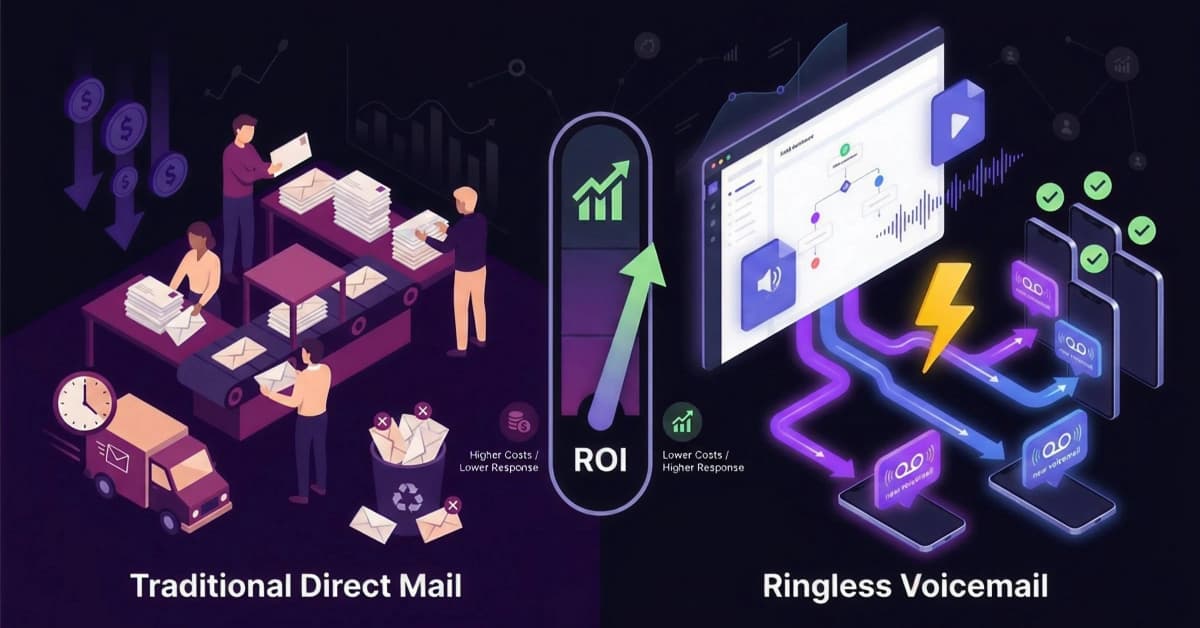
“Snail Mail” builds trust, but in 2026, that trust shouldn’t cost $1.00 per lead. The marketing landscape has shifted from “Physical” to “Digital Direct.”
Businesses bleed budget on postage for letters that end up in the recycling bin. Direct mail response rates are stagnating while costs rise. Stop paying for paper. Trade the cluttered physical mailbox for the attentive voicemail inbox.
This guide analyzes the ROI gap between traditional Direct Mail (High Cost, Slow Speed) and Ringless Voicemail (Low Cost, Instant Speed) to determine which channel actually drives prospect response.
The Hard Truth About Direct Mail Costs
Direct mail often feels like a safe bet, yet the financial reality is becoming harder to justify for scaling businesses.
The Rising Cost of Postage (CPM)
First, it is important to understand that direct mail costs are not static; they rise every year. You aren’t just paying for the lead; you are paying for paper, ink, design, and, most significantly, stamps. With consistent hikes in USPS business postage rates, the Cost Per Mille (CPM) continues to climb, eating into your profit margins before a single lead converts.
The “Lag Time” Problem
Direct mail lacks agility. A standard campaign takes 2-3 weeks from design to delivery. By the time your offer arrives, the lead is often cold or has found a solution elsewhere. In modern sales, speed determines the winner, and mail is inherently slow.
By the time your offer actually arrives in the prospect’s hands, the lead might already be cold or have found a solution elsewhere. In modern sales, speed is often the deciding factor, and mail is inherently slow.
The “Junk Mail” Fatigue
Finally, we must discuss the physical vSpam Folder.” Most mail is sorted directly over the trash can. Unless your envelope looks like a handwritten bill or a personal birthday card, it likely won’t get opened.
This “junk mail fatigue” means you are paying for distribution to people who will never see your message.
Ringless Voicemail: The “Digital Postcard”
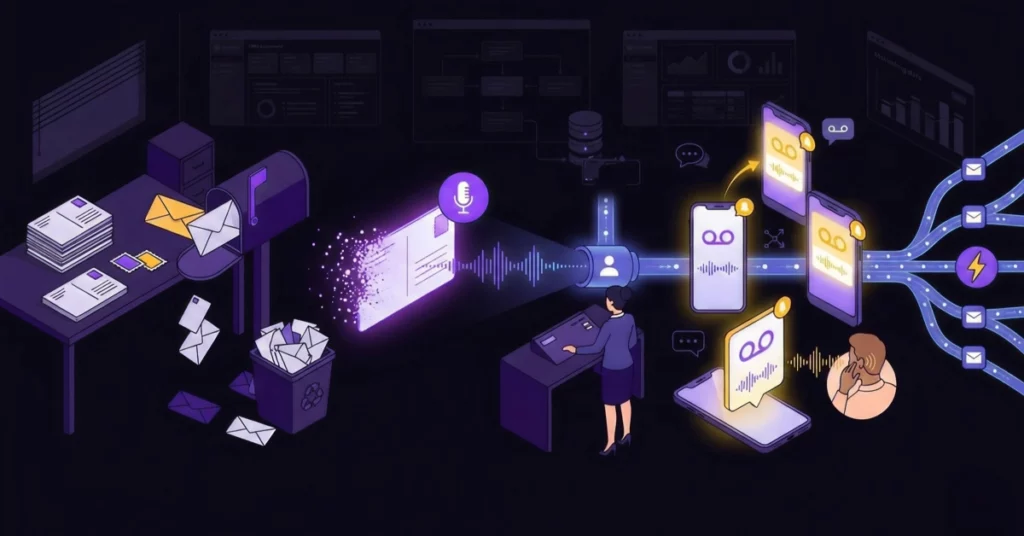
Ringless Voicemail (RVM) acts as a modern evolution of the postcard, delivering the same personal touch without the physical limitations.
Bypassing the Mailbox
RVM works by sliding a pre-recorded audio file directly into the mobile voicemail server. Unlike a physical mailbox, which is perhaps checked once a day, RVM sends a notification to the phone, a space people check upwards of 50 times a day. Therefore, visibility is almost guaranteed.
The Power of Human Voice
While direct mail relies on clever copy and glossy design to build trust, RVM relies on tone. A sincere, well-recorded voice message creates an immediate personal connection that a piece of paper simply cannot replicate. Hearing a human voice triggers a different psychological response than reading text, often leading to higher trust.
Speed of Execution
The most distinct advantage, however, is speed. You can record a message and drop it to 5,000 people in the time it takes to lick a single stamp. This allows for instant deployment of campaigns based on market triggers.
The ROI Calculator (Direct Mail vs. RVM)
Let’s look at the numbers. We will compare a hypothetical campaign to see the impact on your wallet.
Scenario: Targeting 5,000 Homeowners
Set the comparison stage: You need to reach 5,000 local leads to generate new business. Let’s look at the investment required for each channel.
- The Direct Mail Math. At a 1-2% response rate, a $3,750 spend yields a massive Cost Per Lead (CPL). You risk thousands upfront before generating a single call.
- The Ringless Voicemail Math RVM removes paper, ink, and postage costs. Even if the response rate matches direct mail, your ROI is 10x higher because the upfront risk is 90% lower.
- See exactly how much you save with our flexible pricing plans.
- Pro Tip: Don’t waste money sending drops to landlines. Verify your list for mobile-only numbers instantly with 1Lookup.
| Metric | Direct Mail (Physical) | Ringless Voicemail (Digital) |
| Unit Cost | ~$0.75 per piece | Fractions of a penny |
| Total Cost (5k Leads) | $3,750 | ~$150 – $300 |
| Time to Launch | 2-3 Weeks | < 1 Hour |
| Open Rate | Low (Junk Mail Risk) | High (Notification Driven) |
| ROI Verdict | Low | High |
Why RVM Wins on Agility & Analytics
Beyond cost, RVM offers data advantages that physical mail cannot compete with.
A/B Testing in Real-Time
With Direct Mail, testing two different headlines costs thousands of dollars and takes weeks to gather results. With RVM, however, you can split-test two different scripts in one morning. By the afternoon, you can analyze the callback rates and pivot your entire strategy to the winning message immediately.
Frictionless Response
Consider the user journey.
Reducing friction increases conversion. Compare the user journey:
- Direct Mail (High Friction): Read letter > Walk to computer > Type URL > Fill out form.
- RVM (Zero Friction): Listen to message > Tap “Call Back.”
RVM removes the barriers between the prospect and your sales team.
The Hybrid “Omnichannel” Strategy
You do not necessarily have to abandon direct mail entirely; instead, you can use technology to make it efficient.
Don’t Kill Mail, Boost It
If you must use direct mail (e.g., for legal notices or high-end real estate), use RVM to protect that investment. A multi-channel approach often yields the highest results.
The “Pre-Mail” Drop
A popular strategy is to send an RVM 24 hours before the mail arrives. A simple message like, “Hi, I sent you a package, look out for it,” primes the recipient. This ensures the expensive letter actually gets opened rather than tossed.
The Follow-Up Nudge
Additionally, if they haven’t responded to the mailer in 5 days, send an automated voice drop to remind them. This “nudge” maximizes the value of the postage you already paid for.
Compliance & Data Hygiene
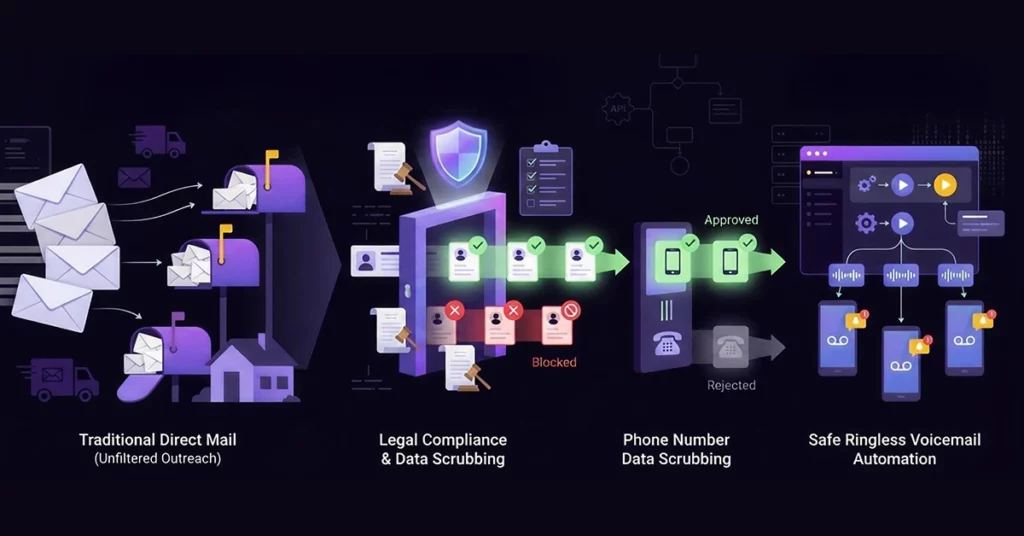
Digital outreach requires responsibility. Unlike physical mail, you cannot simply send messages to everyone.
TCPA vs. Postal Laws
Direct mail is largely unregulated; you can mail almost anyone. RVM, however, requires strict adherence to TCPA and DNC (Do Not Call) laws. You cannot “spray and pray.” For a detailed understanding of these regulations, refer to the official TCPA compliance guidelines.
Mobile vs. Landline Scrubbing
Direct mail lists often contain landline numbers. RVM technology cannot drop messages to landlines; these attempts will fail. You must scrub your data to isolate mobile numbers for high deliverability.
Recommendation: Before launching, ensure 100% deliverability by scrubbing your list with the Bulk Phone Validator from 1Lookup. 1Lookup is built by the same team as VoiceDrop.
Conclusion
To recap, Direct Mail offers tangibility but comes at a premium and at a slow speed. In contrast, RVM offers speed, volume, and voice trust at a significant discount.
Final Advice: Stop relying on the postal service to hit your sales quotas. Take control of your outreach with digital tools that provide better data and faster results.
Ready to save thousands on postage? Start your free trial with VoiceDrop and launch your first campaign in minutes.
FAQ’s
What is a good response rate for direct mail?
Typically, response rates hover around 2-4% for warm house lists. However, for cold prospecting lists, the rate is often under 1%, making it an expensive acquisition channel.
Is RVM cheaper than postcards?
Yes, RVM is usually 90-95% cheaper per “send” than a standard postcard campaign, primarily because there are no printing or postage costs.
Can I use my direct mail list for RVM?
You can, but only if you scrub the list first to identify mobile numbers and remove any contacts registered on the DNC list.