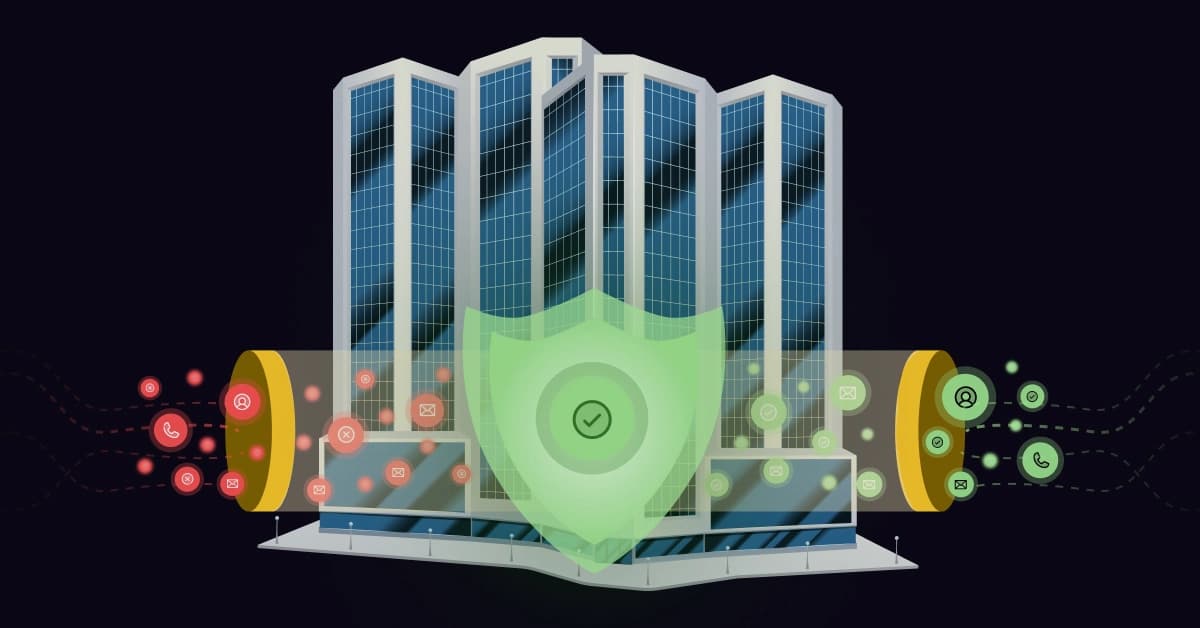
You can build the sleekest CRM or the fastest auto-dialer in the industry, but if your API returns disconnected numbers, your users will churn. In PropTech, Data is the Product.
For CTOs and Product Managers, the challenge isn’t just finding a skip tracing provider; it’s finding an API that balances millisecond latency with Tier-1 accuracy. If your application delivers “Ghost Leads” (wrong numbers), your users lose money, and you lose users.
This guide compares the top skip tracing APIs of 2026, dissecting them by Right Party Contact (RPC) rates, latency, and cost, to help you power the next generation of real estate tools.
Why Accurate Skip Tracing is the Backbone of PropTech
In the world of Real Estate SaaS, Data is the Product. Your users, whether they are wholesalers, agents, or high-volume investors, are not paying for a button that says “Call”; they are paying for the conversation that happens after the button is clicked.
The Problem of “Data Decay”
Consumer data is not static. People move, change careers, get divorced, and pass away. In 2026, a static database that isn’t updated in real-time is effectively useless.
- Carrier Changes: Approximately 10-15% of mobile users switch carriers annually.
- Migration: Post-pandemic migration patterns mean address history becomes obsolete faster than ever.
To survive, PropTech apps must rely on real-time API access that queries live networks rather than serving stale cache data.
The Cost of “Ghost Leads” for Investors
When your API returns bad data, it hits your user’s wallet directly. Consider an investor spending $5,000 a month on cold calling teams. If the skip tracing data provided by your app is 40% inaccurate, nearly half of that marketing budget is incinerated on dialing dead air or wrong numbers.
This financial bleeding creates a high churn rate for SaaS platforms. The cost of bad data goes beyond just wasted call minutes; it silently undermines the pricing power and growth potential of your entire platform.
Understanding Data Tiers: Where Does the API Pull From?
Not all APIs are created equal because not all data sources are equal. As a developer, you need to understand the “supply chain” of the data you are buying.
Tier 1 Data (Credit Header Data)
This is often referred to as the “Gold Standard” of skip tracing. Tier 1 data is sourced directly from credit bureaus (like TransUnion, Equifax, and Experian).
- Pros: Extremely high accuracy. Updates are frequent because they are tied to financial activity.
- Cons: Expensive. Access is heavily regulated, often requiring FCRA (Fair Credit Reporting Act) compliance and a strict vetting process for your business.
Tier 2 Data (Aggregated Web & Utility Data)
This data is scraped from online purchases, warranty registrations, utility bills, and public voting records.
- Pros: Significantly cheaper and easier to access via open APIs.
- Cons: Lower “Right Party Contact” (RPC) rate. This data can often be 30-60 days old.
The “Waterfall” Logic Approach
Smart developers don’t rely on a single source. They build (or buy) a Waterfall. This logic acts as a smart router for your data requests:
- The “Skim” (Tier 2): The API checks inexpensive public record caches first. If a match is found, it returns it instantly (Cost: ~$0.04).
- The “Deep Dive” (Tier 1): If Tier 2 yields no mobile number, the API automatically escalates the query to live credit header data (Cost: ~$0.12+).
Pro Tip: Look for an API that handles this logic internally. If you have to build your own waterfall by daisy-chaining different vendors, you increase latency and development overhead.
Key Technical Features to Evaluate in 2026
When reading API documentation, look beyond the marketing fluff. Here are the metrics that matter to your engineering team.
Latency and Response Time
If your app features a “Click to Reveal” button, user experience is paramount. You cannot have a user staring at a loading spinner for 10 seconds.
- Target: A synchronous API call should return data in under 1500ms.
- Requirement: Ensure the provider has scalable endpoints that don’t timeout during peak usage hours (e.g., 9:00 AM – 11:00 AM EST).
Match Rate vs. Accuracy Rate (RPC)
Beware of marketing metrics. A “Match Rate” simply means the API returned data; it does not mean the data is usable.
- Provider A: 98% Match Rate, but 40% are landlines or previous owners.
- Provider B: 75% Match Rate, but 90% are active mobile numbers of the current owner.
Because PropTech apps thrive on RPC (Right Party Contact), the latter option is vastly superior. Filling your users’ CRM with junk data just to show a “Match” leads to frustrated investors dialing dead air.
Ready to test real accuracy? Get 50 Free Credits on 1Lookup today and run a benchmark test against your current provider.
Litigator Scrubbing & DNC Compliance
In 2026, compliance is not optional. Your API should have built-in “Litigator Scrubbing.” This identifies serial plaintiffs, individuals who intentionally bait telemarketers to sue them for TCPA violations.
Protecting your users from lawsuits is a massive value-add. Adhering to a strict TCPA compliance guide is mandatory for any platform facilitating outreach.
Top Skip Tracing APIs for PropTech (Detailed Comparison)
1. BatchData API (Best for High-Volume Scaling)
BatchData aggregates multiple data vendors to maximize coverage for high-volume apps.
- Data Source: Hybrid (Tier 1 & 2 Waterfall)
- Best For: Apps processing 10k+ records/day.
- Dev Experience: Robust Sandbox & clearly defined rate limits.
2. TLOxp / TransUnion (Best for Institutional Grade)
The heavyweight champion of data, sourced directly from credit headers.
- Data Source: Tier 1 Exclusive (Credit Bureau).
- Best For: Banking-grade applications and enterprise platforms.
- Barrier to Entry: High. Requires strict FCRA vetting and physical site inspections. You cannot just “get an API key.”
3. 1Lookup (Best for RPC & Developer Ease)
A developer-first API focusing strictly on mobile number accuracy to prevent SMS delivery failures.
- Data Source: Real-Time Telco & Credit Header.
- Best For: PropTech apps that include built-in dialers or SMS tools.
- Key Feature: Built-in HLR lookups ensure numbers are active before you pay for them.
Integrating Data with Outreach Automation
Retrieving the phone number is only Step 1. Step 2 is making that data actionable. Modern PropTech apps are moving towards “One-Click Execution.”
Seamless Handoff to Ringless Voicemail
The ideal workflow for a user looks like this:
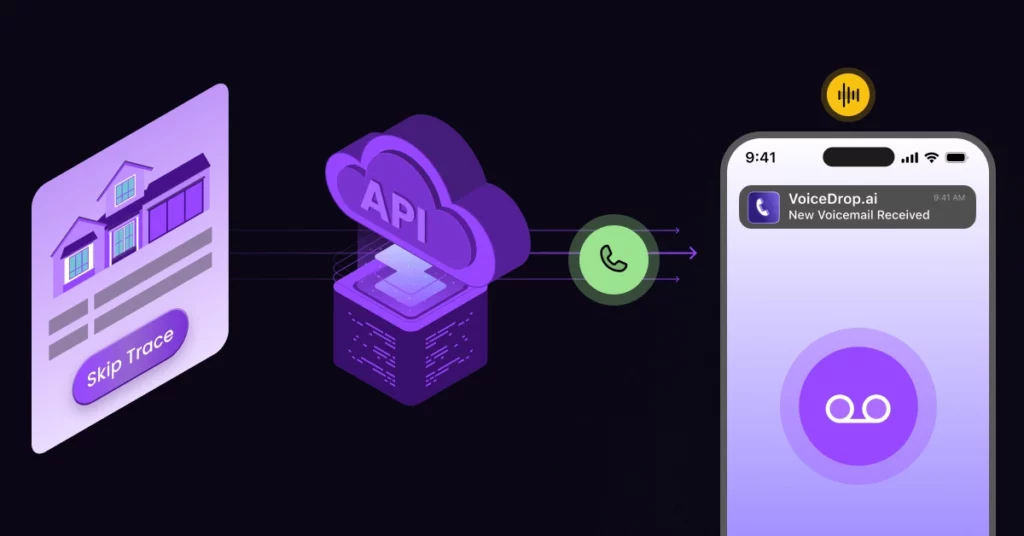
- User clicks “Skip Trace” on a property address.
- API returns a verified Mobile Number.
- The system automatically schedules a voicemail drop without the phone ever ringing.
This automation reduces manual friction. Once the mobile number is verified, the system can instantly trigger Ringless Voicemail Drops to initiate contact immediately.
Webhooks vs. Polling
Developer Note: Avoid polling the API endpoint to check for completed jobs, especially for bulk processing. Implement Webhooks. This allows the data provider to “push” the results to your server the moment they are ready, reducing server load and improving application speed.
Pricing Models: What Developers Need to Know
Your margins depend on how you buy data.
Per Match vs. Per Hit Pricing
- Under a Per Hit Pricing model, you pay $0.10 for a query even if the API returns “No Record Found.” If you run 10,000 records with a 50% hit rate, you effectively paid $0.20 per verified lead.
- Alternatively, Per Match Pricing charges $0.12 but only bills you when data is actually found.
The Verdict: Always negotiate per-match pricing for PropTech. It aligns the provider’s incentives with yours; they only get paid when they deliver value.
Volume Discounts and Enterprise Tiers
Prices in this industry are highly elastic. A standard rate might be $0.15 per match, but this can drop to $0.08 or lower once your API calls exceed 10,000 or 50,000 monthly requests. Negotiate volume tiers early.
Step-by-Step: Implementing a Skip Tracing Feature
If you are a Product Manager rolling this out, follow this checklist:
- Sandbox Testing: Run 100 known records (where you already know the phone number) through the API to benchmark accuracy.
- UI/UX Design: Differentiate the data visually. Use badges like “Verified Mobile” vs. “Landline” so users know which method of outreach to use (SMS vs. Call).
- Error Handling: Design graceful empty states. If the API returns a 404 or no match, offer the user a manual research option or a refund of their credit.
Measuring the ROI of Premium Data
Premium data costs more, but it yields higher returns. To justify the cost of a Tier 1 API to your stakeholders, use this formula:
- (Cost of API Execution) vs. (Revenue from 1 Closed Deal)
If a user spends $150 on skip tracing to find one deal that nets a $10,000 wholesale fee, the ROI is massive.
To accurately measure voice campaigns and their true ROI, you must track the conversion rate of the specific phone numbers provided by your API.
Future Trends in PropTech Data
The future of skip tracing is Predictive Analytics. We are moving away from simply asking “What is his number?” to asking “Is he likely to sell soon?”
APIs are beginning to integrate distress signals (pre-foreclosure filings, divorce records, tax liens) directly into the skip trace response. According to reports on predictive analytics in real estate, data-driven decision-making will separate the market leaders from the laggards in the coming decade.
Conclusion
The winner in the crowded PropTech space won’t be the app with the prettiest UI; it will be the app that provides the most actionable data.
Stop feeding your users ghost leads. Integrate a low-latency, Tier-1 API like 1Lookup’s skip tracing API to ensure every phone number in your system is reachable. 1Lookup is built by the same team as VoiceDrop.
What comes next? Once you have the data, you need to deliver the message. Seamlessly hand off those verified numbers to VoiceDrop to trigger automated Ringless Voicemail campaigns, closing the loop between finding the lead and converting it.
See the automation in action and build the ultimate real estate stack today.
FAQs
What is the average hit rate for a real estate skip tracing API?
For Tier 1 (Credit Bureau) data, you can expect hit rates of 90%+. For Tier 2 (Public Record) data, expect hit rates between 60-75%.
Can I skip trace LLCs using an API?
Yes, advanced APIs offer “Corporate Skip Tracing” functionality. This queries the Secretary of State records to identify the beneficial human owner behind the corporate entity.
Is skip tracing legal?
Yes, skip tracing is legal in the US as long as the data is used for legitimate business purposes (such as marketing, debt collection, or reprocessing) and the user complies with TCPA and DNC regulations.
How long does an API request take?
A synchronous (single) API call should take less than 1-2 seconds. Asynchronous (bulk file) processing can take anywhere from a few minutes to an hour, depending on the volume of records.