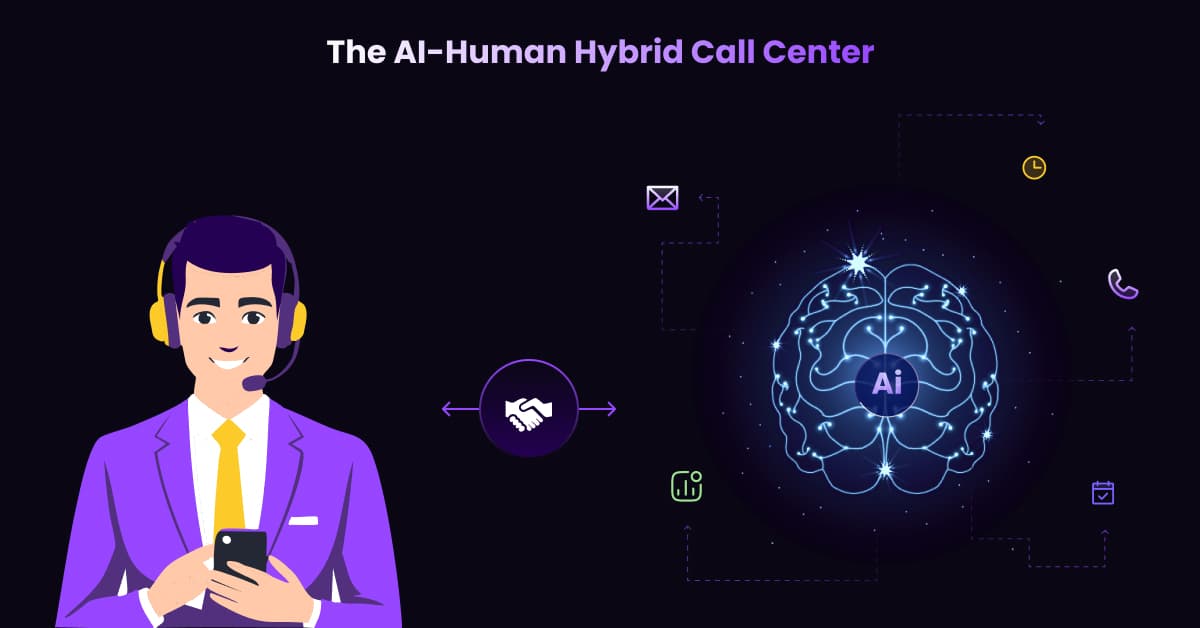
Are your sales and support teams struggling to keep up with the volume of customer interactions? Are you looking for ways to increase efficiency and scalability without losing the personal connection? The rise of the AI Call Center is fundamentally changing how businesses handle sales and Customer Outreach by integrating intelligent automation.
This expert guide will provide actionable insights into the shift. We will cover the benefits, limitations, the successful hybrid AI-human teams model, best practices, and the AI-driven tools like VoiceDrop.ai necessary for practical implementation. The goal is to show you how to leverage powerful AI technology to automate routine tasks, empower your human agents, and enhance customer experience without sacrificing the essential human touch.
What Is an AI Call Center?
An AI Call Center utilizes AI technology to automate a significant portion of customer interactions, handle sales and support tasks, and provide data-driven insights. It is a technological evolution of the traditional call center. Instead of relying solely on human agents, it integrates AI agents, often called virtual call assistants or conversational AI, into the workflow.
These AI agents can operate alongside human teams to streamline workflows and improve customer experience. They are designed to understand natural language, perform tasks like lead qualification, and manage simple inquiries autonomously. For example, VoiceDrop’s conversational AI Inbound Agent can handle callbacks 24/7, answering questions and qualifying leads automatically. This frees up human staff to focus on complex, high-value conversations.
How AI Call Centers Work
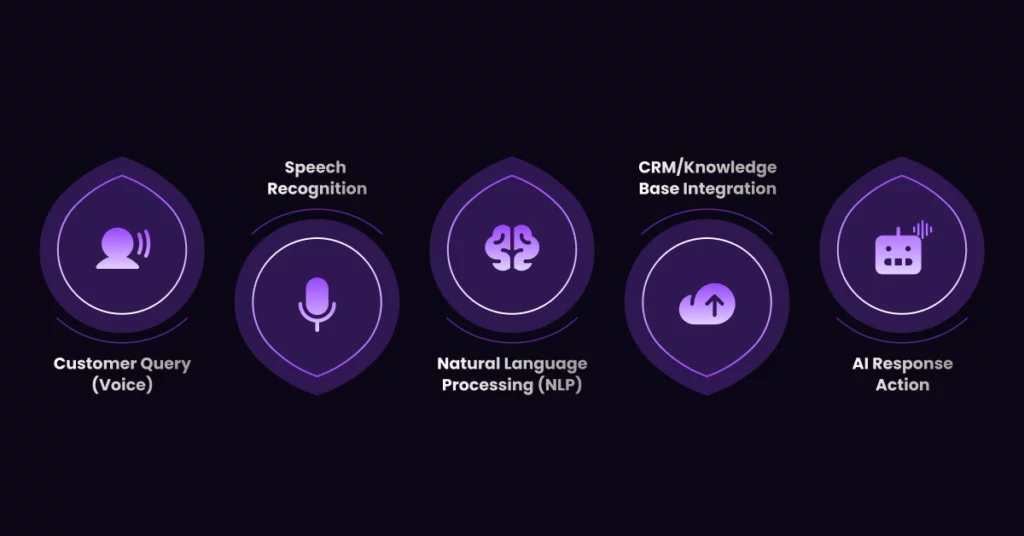
The operational mechanics of an AI Call Center rely on sophisticated AI technology, automation, and deep integration with business systems. This technology stack enables the center to process massive amounts of data and communicate dynamically with customers.
AI Technologies Behind Call Centers
The core technologies powering the AI Call Center include Natural Language Processing (NLP), speech recognition, and predictive analytics for sales. NLP enables the AI agents to understand the meaning, intent, and sentiment behind spoken or written customer queries, allowing them to respond naturally and relevantly. Speech recognition converts voice to text, which is then processed by the AI. This combination of AI technology and processing allows AI agents to understand customer queries, respond naturally, and even anticipate needs. For a deeper understanding of the core technology.
Automating Sales and Support Tasks
One of the biggest advantages of the AI Call Center is its ability to handle routine, repetitive tasks consistently. AI agents excel at automated lead qualification, answering frequently asked questions (FAQs), processing follow-ups, and managing simple appointment scheduling. This is the foundation of Automated sales. By handling these tasks, the AI frees up human agents to focus on complex problem-solving and consultative sales, boosting overall efficiency and ensuring customers receive consistent service.
Integration with CRM and Other Tools
The power of AI-driven tools multiplies when they integrate seamlessly with the existing Tech Stack. AI Call Centers must integrate with CRM tools (Customer Relationship Management) like HubSpot, marketing automation platforms, and analytics dashboards. This integration provides real-time data, enabling powerful AI-driven tools to feed insights directly into the sales pipeline. This streamlined workflow improves decision-making and ensures all customer data is synchronized. Explore how conversational AI agents enhance customer interactions through seamless integration: Conversational AI Agents Enhancing Interactions.
AI vs Human Agents
Comparing AI agents versus human sales and support agents shows clear strengths and weaknesses for each side. AI excels at efficiency, scale, and data consistency, while humans retain the advantage in emotional intelligence and complex scenarios.
For maximum effectiveness, organizations need hybrid AI-human teams that deploy AI for specific, routine tasks and rely on humans for high-stakes interactions. For example, VoiceDrop’s inbound AI agent can instantly qualify a warm lead, then immediately route that lead to a human agent for the relationship-building and closing phase. Learn more about how AI Call Center Agents Improve Customer Service.
Benefits and Limitations
Adopting an AI Call Center brings significant advantages, but businesses must be aware of the technology’s current limitations to implement it realistically.
Benefits of AI Call Centers
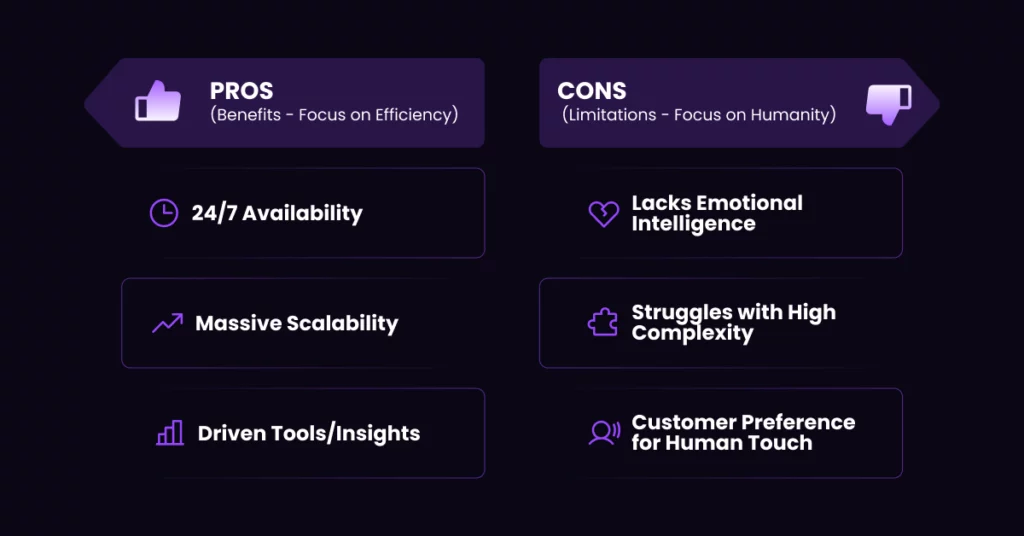
Key advantages include 24/7 availability and massive scalability without the operational cost of hiring and training human agents. AI agents guarantee consistent customer experiences across every call, reducing the risk of human error or emotional inconsistency. They also provide valuable data-driven tools, offering insights into customer behavior and conversation patterns that improve overall Quality Control. AI agents are vital for Automated sales, allowing businesses to handle a larger volume of leads efficiently.
Limitations of AI Call Centers
AI currently falls short in certain areas. It lacks true emotional intelligence and struggles to handle highly complex, unique, or sensitive customer situations that require abstract reasoning or deep empathy. Customers may also occasionally prefer human interaction for critical issues. These scenarios are where Human Roles remain essential to maintaining customer satisfaction, resolving novel problems, and closing high-value deals through personalized negotiation.
Balancing AI and Human Roles
The most successful model involves hybrid AI-human teams. Businesses must leverage AI agents for front-line tasks like screening and information delivery, while reserving human talent for relationship-building, complex problem resolution, and closing. This balanced approach ensures efficiency while retaining the essential human touch necessary for deep customer loyalty and maximizing revenue from complex sales.
The Future of Call Centers
The Future of call center operations is defined by advanced, collaborative AI technology. We expect to see increasingly sophisticated voicebots and deeper omnichannel integration. The roles of human agents will evolve, shifting from simple task execution to high-level strategy, training, and complex relationship management; truly becoming the most critical Human Roles.
Hybrid models will expand significantly, and businesses that adopt AI-driven tools will gain a distinct competitive advantage. The focus will be on maximizing human-AI collaboration to ensure the best possible customer engagement via voice. This evolution requires human teams to be adaptable, leveraging AI-driven tools for productivity. Find out what AI means for the call centers of the future.
Use Case: Hybrid Teams
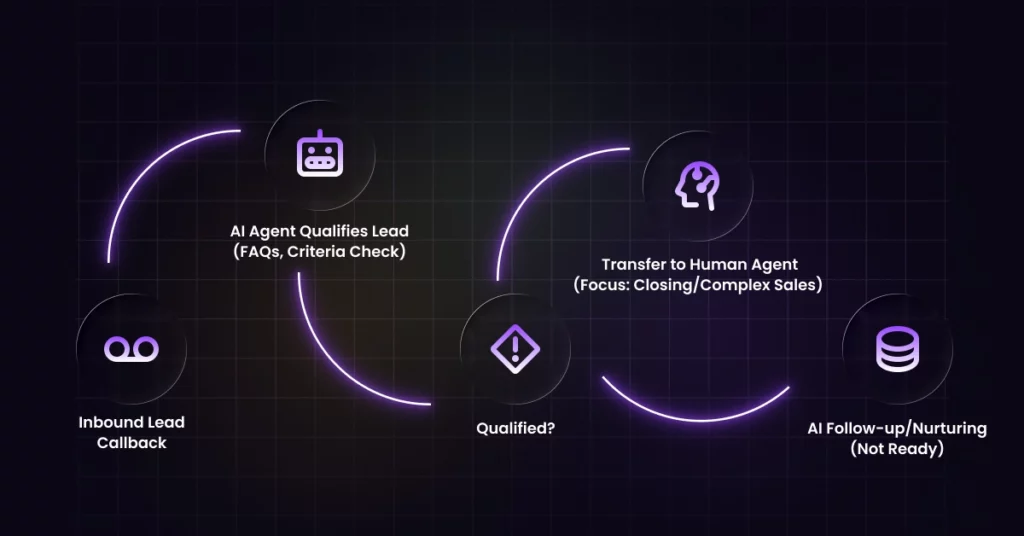
The hybrid AI-human teams concept is the practical implementation of the AI Call Center. In this model, the AI Call Center acts as the front-line qualifier and 24/7 support hub. For example, a ringless voicemail campaign generates callbacks (handled by VoiceDrop’s AI agent). The AI agent qualifies the lead based on pre-set criteria, answers immediate FAQs, and only transfers the call to a human sales agent when the lead is “hot.” This ensures human sales teams spend their valuable time only on qualified, ready-to-buy prospects, increasing their efficiency dramatically and maintaining personalization. This preserves the crucial Human Roles in high-stakes conversations.
Training & Quality Control
Effective training is crucial for both sides of the AI Call Center. AI agents must be trained using extensive data and NLP to understand language nuances, intent, and conversation context. This continuous training ensures accuracy and reduces errors.
For human agents, training must focus on soft skills, complex problem-solving, and how to effectively leverage the AI-driven tools (like knowing when and how to take over from an AI agent). Quality Control involves continuously monitoring and reviewing both human and AI interactions, optimizing AI scripts, and performing continuous Quality Control to ensure consistent customer satisfaction.
Tech Stack & Vendors
The Tech Stack of an AI Call Center is complex, requiring integration of multiple specialized components. Key technologies include the conversational AI engine itself (like the technology used to power VoiceDrop’s AI agent), integration middleware, data analytics tools, and core communication software.
Integration with the central CRM tools is non-negotiable. VoiceDrop.ai is a leading vendor providing specific, powerful AI-driven tools for ringless voicemail callbacks and lead qualification. When evaluating vendors, businesses must consider their existing Tech Stack, budget, and whether the solution provides the necessary Quality Control and compliance features.
Legal & Ethical Issues
Using an AI Call Center requires careful consideration of Legal Issues. Compliance with regulations like the TCPA (Telephone Consumer Protection Act) is paramount, especially regarding consent and automated dialing technologies. Businesses must ensure their AI agents are compliant with all federal and state regulations. For a complete guide, review TCPA compliance.
Ethical concerns center on transparency. Customers should know they are interacting with an AI agent. Additionally, businesses must maintain human oversight in critical interactions to prevent biased AI decisions and ensure ethical handling of customer data and privacy.
Action Plan for Adoption
Implementing an AI Call Center should be an empowering transition, not a disruptive overhaul. Start small by integrating specific AI-driven tools like VoiceDrop’s AI Inbound Agent for automated lead qualification. Train your existing team on the new Tech Stack, emphasizing that AI will automate the tedious tasks, freeing them for high-value Human Roles. Approach adoption with confidence and ease of transition.
VoiceDrop.ai is a trusted solution for seamless hybrid AI-human teams, scalable performance, and measurable results. It allows you to transform your sales floor, driving significant ROI and customer satisfaction.
Ready to transform your sales floor? Stop paying human agents to qualify cold leads. Let the AI Call Center handle the heavy lifting while your sales team focuses on closing. The future of the call center is here, and it’s a powerful partnership between human ingenuity and intelligent automation.
Click here to schedule a demo and see the AI-powered difference.
FAQ’s
1. What is an AI call center?
An AI Call Center uses AI technology to automate customer interactions, manage sales and support tasks, and provide data-driven insights, complementing human agents.
2. Can AI call centers replace human sales teams completely?
No. While AI can handle routine tasks and provide efficiency, Human Roles are still essential for complex negotiations, relationship-building, and personalized interactions.
3. What technologies power AI call centers?
AI Call Centers rely on Natural Language Processing (NLP), speech recognition, predictive analytics for sales, and machine learning to understand and respond to customer queries effectively.
4. What tasks are best handled by AI vs human agents?
AI excels at lead qualification, FAQs, appointment scheduling, and follow-ups, while humans handle complex sales, consultative conversations, and relationship management.
5. How do AI call centers integrate with other systems?
AI Call Centers can integrate with CRM tools, marketing automation, and analytics platforms, allowing seamless workflows and data-driven decision-making within the Tech Stack.