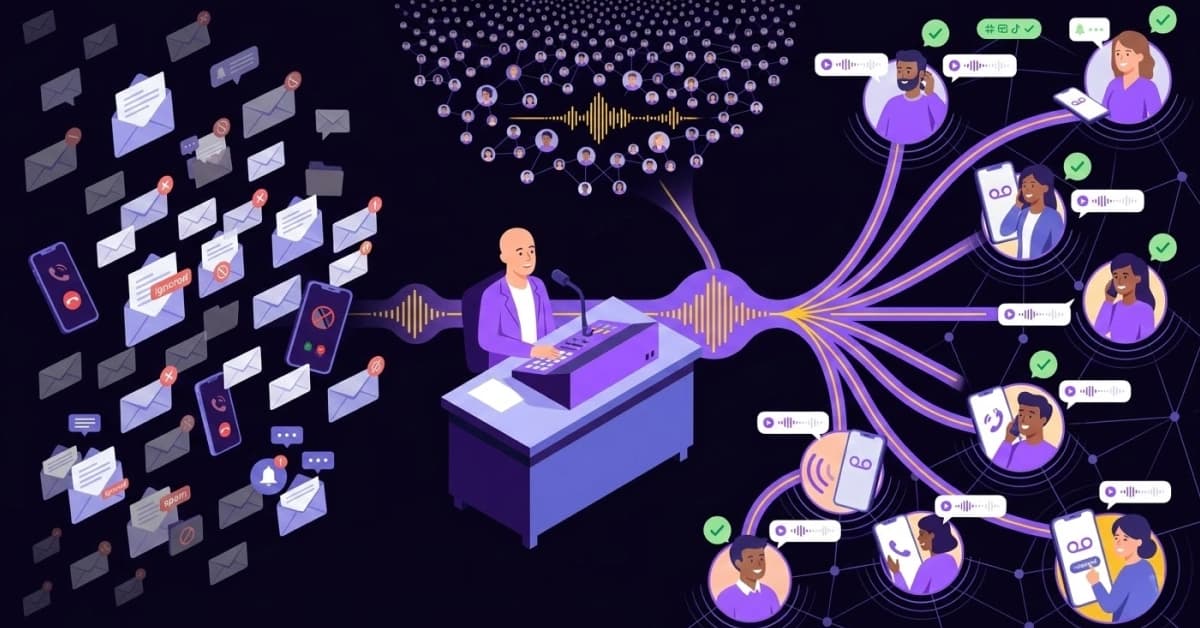
Imagine sending 50,000 emails and hearing… silence.
Universities are facing an engagement crisis. While alumni love their alma mater, they are exhausted by “digital noise.” Generic email blasts rot in spam folders, and calls from unknown numbers are blocked instantly.
For Development Directors, the old playbook is broken. The solution isn’t another app, it’s the human voice, scaled intelligently.
By pivoting from manual phone banks to Ringless Voicemail (VoiceDrop), you can personally engage thousands of alums instantly, driving participation rates that leave traditional methods in the dust.
The “Phoneathon” is Dead: Why Traditional Methods Fail
For decades, student call centers were the engine of the annual fund. Today, that engine has stalled. Here is why the old playbook is killing your ROI:
The “Unknown Number” Block
Modern behavior has shifted dramatically regarding phone usage. Most people simply do not answer calls from numbers that are not saved in their contacts. If an alum sees an unknown local area code, they assume it is spam. Consequently, the student caller wastes valuable time dialing numbers that will never be answered.
Email Open Rate Decline
Similarly, email is losing its effectiveness as a primary solicitation tool. Industry standards indicate that email open rates for universities often hover around 20%. This statistic means that 80% of your alumni never even see your carefully crafted “Giving Day” appeal. Therefore, relying solely on email guarantees you are missing the vast majority of your audience.
The Cost of Manual Labor
Finally, the economics of manual outreach no longer make sense. Paying students hourly to leave voicemails manually, one by one, is incredibly inefficient. Conversely, automation allows you to send 10,000 voicemails in just five minutes. Recent fundraising effectiveness data highlight this decline in alum participation rates over the last decade, underscoring the need for a shift in strategy.
The Psychology of Audio: Why Voice Drives Action
Text is transactional. Voice is relational.
- Emotional Resonance: A text asking for money feels cold. A voice message from a sophomore sharing their scholarship story feels real. It bridges the gap between the donor and the campus.
- Pattern Interrupt: Alumni scroll past emails on autopilot. They are not used to seeing a voicemail notification without a missed call. It sparks curiosity and forces a listen.
- The “VIP” Effect: When an alum hears the University President or Head Coach address them personally, they feel like an insider. This “VIP status” significantly boosts callback rates.
Step 1: Segmentation Strategies for Higher Yield
Stop blasting the entire database. Effective fundraising requires Behavioral Segmentation.
The LYBUNT & SYBUNT Lists
Target donors who gave “Last Year But Unfortunately Not This” (LYBUNT). A gentle voice reminder that their giving streak is about to end is a powerful psychological motivator.
Affinity-Based Groups
Relevance drives revenue. Don’t send a generic message. Send a voice note from the Band Director to former band members, or the Dean of Engineering to engineering grads.
Young Alumni (The Text Generation)
Recent graduates (from the last 5-10 years) rarely check email, but they live on their phones. Mobile-first communication is the only way to reach them effectively. Implementing robust donor retention strategies requires meeting these younger donors where they are: on their mobile devices.
Note: Since this demographic moves frequently for new jobs, their contact info decays the fastest. Ensure you aren’t sending messages to dead ends by refreshing your young alum list with 1Lookup’s contact enrichment. 1Lookup is built by the same team as VoiceDrop.
Step 2: Data Hygiene (The Foundation of Success)
You cannot successfully send mobile voicemails if your database is clogged with landlines. Data hygiene is the technical prerequisite for a successful campaign.
Identifying Mobile Numbers
Ringless Voicemail (RVM) technology specifically requires mobile numbers to function. Therefore, you must filter your database to separate landline numbers from cell phone numbers. Attempting to send RVMs to landlines will result in failed deliveries and wasted resources.
Reconnecting with “Lost” Alumni
Many alums move or change jobs shortly after graduation, leaving you with outdated contact info. You should discuss using data tools to identify new contact information for alumni who have moved since 2020.
Cleaning the Database
You can use the campaign results to improve your long-term data quality. Failed deliveries help you identify invalid numbers. Subsequently, you can update your CRM (Raiser’s Edge/Salesforce) and flag these records for research. Using tools to enrich alum data ensures you are always reaching out to valid, active phone numbers.
Step 3: Crafting the Perfect “Stewardship” Scripts
If you only call to ask for money, you will eventually burn out your donor base. Emphasize stewardship. Here are three distinct scripts to guide your strategy:
The “Thank You” (No Ask)
- “Hi [Name], this is [Student Name], a junior on the scholarship you helped fund. I just wanted to say thank you personally. Because of you, I’m able to focus on my studies this semester. We appreciate you!”
The “Giving Day” Urgency
- “Hi [Name], this is President [Name]. We are only 50 donors away from unlocking a $100,000 challenge grant. I need your help before midnight to secure these funds. Please check your email for the link.”
The “Event Invite” Hype
- “Hi [Name], Coach [Name] here. Homecoming is next week, and I noticed you haven’t registered yet. The team and I would love to see you there!
Step 4: Automating Outreach with VoiceDrop
Technical execution should not be a barrier. Modern tools make this process easy, even for non-technical Development Directors.
Scalability
Automation creates massive scale. You can upload a list of 5,000 Engineering Alumni and schedule the broadcast for 10:00 AM on a Tuesday. The system handles the heavy lifting while your team focuses on strategy.
The “Star Power” Advantage
With automation, you can record one high-quality message from a “Celebrity” Alum or a highly respected Professor. You then deliver this single recording to thousands of people simultaneously, creating a personal connection at scale that manual calling cannot match.
Omni-Channel Integration
To maximize impact, combine your channels. Send the voicemail and an email simultaneously. A message saying, “I just left you a voicemail, but wanted to send the link here…” dramatically increases click-through rates. Sophisticated ringless voicemail technology makes this seamless delivery possible without ever disturbing the donor with a ringing phone.
Step 5: Managing the “Warm Leads” (Inbound Process)
A successful campaign will generate callbacks. The fundraising team must be ready to handle this influx of engagement.
Routing the Callbacks
When alumni call back after listening to the voicemail, they shouldn’t hit a generic directory. You must route these calls to a Gift Officer or a dedicated stewardship line to ensure a human connection is made immediately.
Digital Giving Links
Make it easy for them to give. Ensure that the voicemail script directs them to a simple, mobile-friendly giving page. Phrases like “Link in bio” or “Check your text for the link” reduce friction in the donation process.
Syncing with CRM
Data continuity is vital. You need to log this interaction in your database so the donor isn’t solicited again too soon. Using fundraising CRM integrations allows you to automatically sync activity with platforms like Salesforce or Raiser’s Edge, keeping your records pristine.
Compliance and Best Practices in Higher Ed
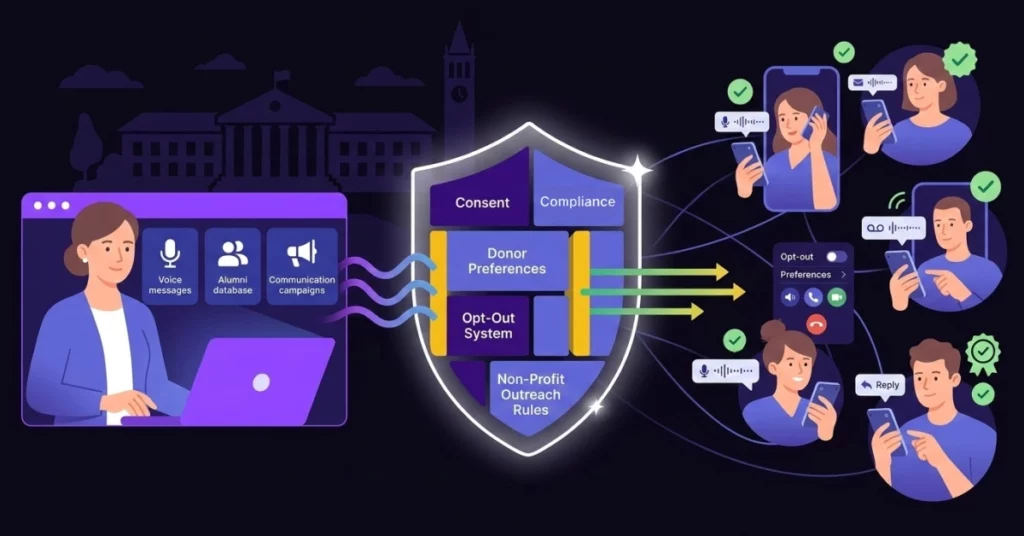
Universities are naturally risk-averse. However, these campaigns can be executed safely by adhering to regulations and best practices.
Non-Profit Exemptions
It is important to note that non-profit political and charitable organizations often have different TCPA allowances than commercial businesses. While this provides some flexibility, obtaining consent and respecting donor preferences is still key to maintaining trust.
Opt-Out Management
Respect is the foundation of fundraising. Always include a polite way for alumni to request “no more calls.” This respects their preferences and maintains a positive relationship for the future, rather than irritating them.
Conclusion
Fundraising is about relationships, not transactions. In a world of overflowing inboxes, the human voice cuts through the noise.
Don’t let your alums drift away. Modernize your Annual Fund today and engage your alumni on the device they use most.
Ready to see the difference? See VoiceDrop in Action and book a demo for your university.
FAQs
Best times to send fundraising messages?
Mid-week days, specifically Tuesday and Wednesday, between 10 AM and 2 PM, are ideal. This timing avoids the Monday morning rush and the weekend disconnect.
Can we use this for Pledge Reminders?
Yes. A friendly voice reminder about an outstanding pledge is significantly less aggressive than a formal collection letter and typically yields better results.
Is this appropriate for Major Donors?
For Major Donors, a personalized 1-to-1 call is best. Use VoiceDrop for the mid-level and annual-giving tier (the mass-audience tier), where personal calls are not scalable.